


Newly re-elected Brazilian President Luiz Inacio Lula da Silva offered warm words for Venezuela's Hugo Chavez on Monday, predicting the leftist leader would win elections next month on the strength of his measures to help the poor.
Silva, making his first foreign trip since winning a new four-year term last month, said it wouldn't be proper to endorse a candidate in Venezuela's Dec. 3 presidential vote, but added that Chavez's anti-poverty initiatives show his heart is in the right place.
"For many years here in Venezuela there wasn't a government that worried about the poor people as you have," Silva told Chavez in a speech. "It's the same people who elected me, who elected [Argentine President Nestor] Kirchner, who elected [Nicaraguan leader] Daniel Ortega, who elected [Bolivian President] Evo Morales. Surely, they will elect you president."
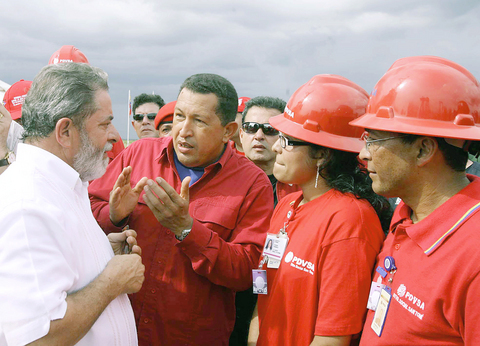
PHOTO: AFP
Silva and Chavez, both leading figures in the resurgent Latin American left, have built close ties despite differing approaches. While Chavez lashes out frequently at Washington, the more-subdued Silva maintains civil relations with the US government.
Nonetheless, the two have increasingly linked their countries through trade, infrastructure projects and deals to jointly explore for and refine oil.
On Monday, Silva and Chavez made an inaugural crossing of a new bridge near the city of Puerto Ordaz, calling it a key step toward South American integration.
The bridge -- the second to be built across the Orinoco River -- will cut the transport time for Brazilian exports entering Venezuela and reaching its Caribbean ports. It was built by Odebrecht, a Brazilian company, at a cost of US$1.2 billion.
Silva said he believes Chavez has shown "it's possible to grow economically while creating social justice."
Chavez said that he plans to reciprocate by visiting Brazil on Dec. 7, just days after he expects to be re-elected.
He said Silva's re-election was "vital for the future of all of us, for the unity of South America."
Chavez said both he and Silva have been wrongly "demonized" as leaders who oppose the private sector because their countries have been models of collaborative trade.
Trade between the two countries has also been swiftly growing -- it surpassed US$3.4 billion from January to last month, according to Brazilian statistics.
Last year, the two leaders laid the cornerstone for a US$2.5 billion refinery in the Brazilian state of Pernambuco that will process both Venezuelan and Brazilian oil.
Chavez and Lula attended a ceremony on Monday marking the start of drilling at an oil field in the Orinoco River basin.
Brazil's Petrobras is helping state-run Petroleos de Venezuela SA quantify Venezuela's massive heavy crude deposits. Petrobras also said negotiations were advancing with PDVSA to jointly develop five heavy oil fields and four offshore natural gas fields in Venezuela.
"It's a task that we have pending: a pipeline to bring gas to the people of the South," Chavez said.
The pipeline could cost about US$25 billion according to preliminary estimates by Petrobras.

Kouri Richins, a Utah mother who published a children’s book about grief after the death of her husband is to serve a life sentence for his murder without the possibility of parole, a judge ruled on Wednesday. Richins was convicted in March of aggravated murder for lacing a cocktail given to her husband, Eric Richins, with five times the lethal dose of fentanyl at their home near Park City in 2022. A jury also found her guilty of four other felonies, including insurance fraud, forgery and attempted murder for trying to poison her husband weeks earlier on Feb. 14, 2022, with a
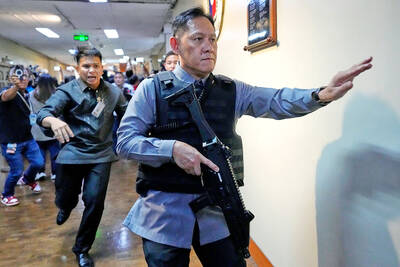
DELA ROSA CASE: The whereabouts of the senator, who is wanted by the ICC, was unclear, while President Marcos faces a political test over the senate situation Philippine authorities yesterday were seeking confirmation of reports that a top politician wanted by the International Criminal Court (ICC) had fled, a day after gunfire rang out at the Philippine Senate where he had taken refuge fearing his arrest. Senator Ronald “Bato” dela Rosa, the former national police chief and top enforcer of former Philippine president Rodrigo Duterte’s “war on drugs,” has been under Senate protection and is wanted for crimes against humanity, the same charges Duterte is accused of. “Several sources confirmed that the senator, Senator Bato, is no longer in the Senate premises, but we are still getting confirmation,” Presidential
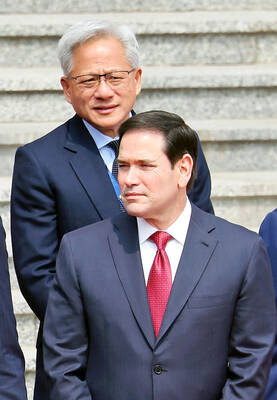
HELP DENIED? The US Department of State said that the Cuban leadership refuses to allow the US to provide aid to Cubans, ‘who are in desperate need of assistance’ US Secretary of State Marco Rubio on Wednesday said that Cuba’s leadership must change, as Washington renewed an offer of US$100 million in aid if the communist nation agrees to cooperate. Cuba has been suffering severe economic tumult led by an energy shortage that plunged 65 percent of the country into darkness on Tuesday. Cuba’s leaders have blamed US sanctions, but Rubio, a Cuban American and critic of the government established by Fidel Castro, said the system was to blame, including corruption by the military. “It’s a broken, nonfunctional economy, and it’s impossible to change it. I wish it were different,” he told

Myanmar yesterday published a parliamentary bill proposing the death sentence for those who detain or violently coerce people into working in online scam centers. Internet fraud factories have flourished in Myanmar, part of Southeast Asia’s scam economy, targeting Internet users worldwide with romance and cryptocurrency investment cons. The multibillion-dollar black market attracts many willing employees, but repatriated foreigners have also reported being trafficked to sites in Myanmar and tortured by scam center operators. The draft legislation would allow capital punishment for “violence, torture, unlawful arrest and detention, or cruel treatment against another person for the purpose of forcing them to commit online scams.” The


 RSS
RSS