

Mexican President Vicente Fox called on Wednesday for constitutional reforms that would allow Mexican leaders to travel abroad without congressional approval -- a day after lawmakers irked Fox by refusing to grant him permission to go to Australia and Vietnam.
Fox's spokesman Ruben Aguilar harshly criticized legislators for their action, saying that their arguments -- which included rumors that Fox was going to Australia just to visit his daughter -- were "childish" and "petty."
"This administration believes that this article of the Constitution has to be reformed because it causes unwarranted tension between the executive and legislative branches," Aguilar told reporters, saying that Mexico is one of the few countries where such rules exist.
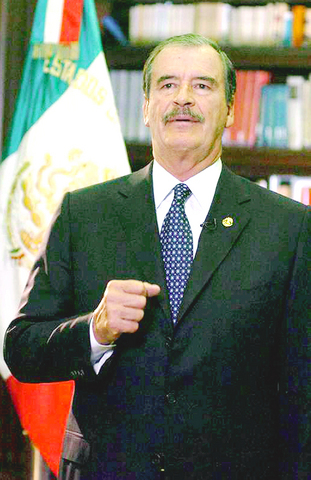
PHOTO: AFP
Later on Wednesday, Fox said the lawmakers' arguments were aimed at "generating an alarmist vision of our country."
Legislators said they were upset that Fox wanted to travel abroad while a political conflict in Oaxaca continued to smolder, and small bombs presumably planted by guerrilla groups had exploded on Monday in Mexico City.
Fox went on national TV on Tuesday night to express his disappointment, saying the decision "goes against Mexico's interests" and was "clearly partisan."
It was the second time in recent memory that Congress had exercised its power to block the president from traveling abroad -- usually a rubber-stamp vote.
The trip would have been Fox's last international trip. He leaves office on Dec. 1.
Congress voted 258-187, with six abstentions, to deny Fox permission for an official visit to Australia from Nov. 12 to Nov. 16.
From there he was to have traveled to Vietnam for the APEC summit in Hanoi on Nov. 18 and Nov, 19 .
The Senate approved the trip, but either house can block it.
Fox lashed out at Mexico's opposition political parties, especially the Institutional Revolutionary Party (PRI.
"I regret that lawmakers from the PRI refuse to listen to the voice of the people and aren't capable of acting responsibly to resolve local conflicts," he said.
That was an apparent reference to the refusal of the PRI governor of Oaxaca to heed calls to step down -- a stance that has fueled six months of protests, leaving nine dead and driving tourists away from one of Mexico's top tourist destinations.
On Wednesday the PRI leadership in a statement called Fox's accusations "offensive and baseless."
Also on Wednesday, a group of lawyers filed a lawsuit against Fox, saying he had not paid them US$3 million for defending him in a case over irregularities involving his 2000 campaign finances.
Monterrey-based lawyer Arturo Quintero said that he and two other lawyers filed the lawsuit in Mexico City after waiting more than a year to be paid.
The suit also names businessman Lino Korrodi, who was Fox's financial manager during his 2000 presidential campaign.
Election officials fined Fox's National Action Party after they found the party had received money from outside Mexico and exceeded campaign spending limits, among other violations.
The presidency declined to comment on the lawsuit.
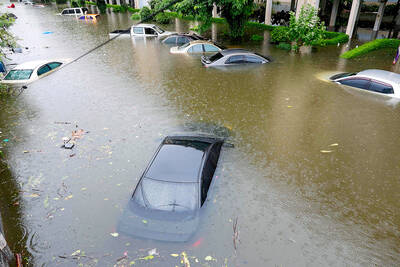
Several areas of Thailand’s capital city Bangkok were inundated by continuous rain from Thursday afternoon to yesterday morning that has disrupted traffic and forced some residents to evacuate. Major canals in Bangkok filled with accumulated rainfall exceeding 20cm, officials said yesterday. Floodwaters spread across the city, particularly in the central and eastern parts, blocking roads and stopping traffic. The Thai Meteorological Department warned that the heavy rain would continue in most parts of the country through today, citing a strong low-pressure system over the central region and strengthening southwest monsoon conditions. More than 84,000 people in 21 provinces nationwide were
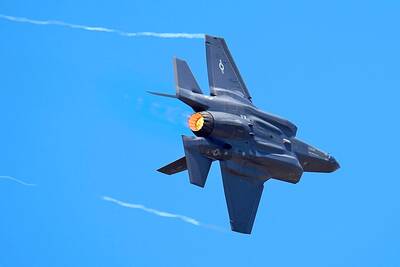
BAD TIMING: The disclosure of the incident, which is under investigation by at least two congressional committees, comes as Xi was to meet with Trump The Pentagon is investigating how parts of the US’ most advanced fighter jet ended up in Hong Kong, with a news outlet on Wednesday reporting that China has obtained the F-35 equipment. The F-35 Joint Program Office said in a statement that it and the US Department of Defense are aware of “a shipment issue” with F-35 components. “We are actively working with US authorities and industry partners to retrieve these components, investigate the incident and place safeguards to avoid a future occurrence,” the office said. UPS was shipping a cockpit canopy and weapons-bay door from an Australian military F-35 that was being

Yemen’s Saudi-led coalition early yesterday said it had intercepted two ballistic missiles and two drones launched by the Iran-backed Houthis toward the kingdom. The coalition said in posts on social media that the missiles were headed towards Khamis Mushait and the drones toward the capital, Riyadh, adding that it was monitoring the missile threat and drones launched at the kingdom, without providing further details. The Saudi Civil Defense had sent alerts overnight for Khamis Mushait and Abha, but not for Riyadh. The Houthis, who control the most populous parts of Yemen and much of the north, have been launching attacks
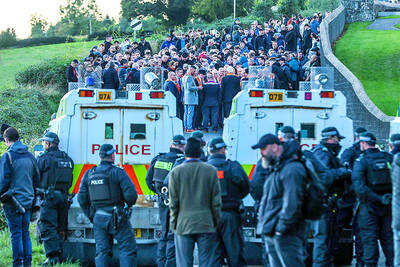
OLD WOUNDS: Protestant marchers seized on an overturned injunction to stage a march, which drew thousands of counterprotesters to block the road in Portadown UK leaders called for calm as a tense standoff with residents seeking to halt a pro-British Protestant march through a primarily Catholic area stretched into the night on Sunday, in one of the worst crises for Northern Ireland in the past few years. The tensions were triggered after a Belfast appeal court overturned a High Court injunction in the early hours of Sunday to clear the march by the Orange Order to go ahead for the first time since 1997. The Parades Commission, Northern Ireland’s independent body regulating contentious processions, had authorized 35 Orangemen to march silently along Garvaghy Road in Portadown,


 RSS
RSS