


The Taliban are planning a major winter offensive combining their diverse factions in a push on the Afghan capital, Kabul, intelligence analysts and sources among the militia have revealed.
The thrust will involve a concerted attempt to take control of surrounding provinces, a bid to cut the key commercial highway linking the capital with the eastern city of Jalalabad, and operations designed to tie down British and other NATO troops in the south.
Last week NATO, with a force of 40,000 in the country, said it had killed 48 more Taliban in areas thought to have been "cleared."
"They have major attacks planned all the way through to the spring and are quite happy for their enemy to know it," a source close to the militia said. "There will be no winter pause."
The Taliban's fugitive leader, Mullah Omar, on Saturday rejected overtures for peace talks from Afghan President Hamid Karzai and said it intended to try him in an Islamic court for the "massacre" of Afghan civilians.
Since their resurgence earlier this year the Taliban have made steady progress towards Kabul from their heartland in the south-east around Kandahar, establishing a presence in Ghazni Province an hour's drive from the suburbs.
They do not expect to capture the capital but aim to continue destabilizing the increasingly fragile Karzai government and influence Western public opinion to force a withdrawal of troops.
"The aim is clear," the source. said, "Force the international representatives of the crusader Zionist alliance out, and finish with their puppet government."
A winter offensive breaks with tradition.
"Usually all Afghans do in the winter is try and stay warm," said a Western military intelligence specialist in Kabul. "The coming months are likely to see intense fighting, suicide bombings and unmanned roadside bombs. That is a measure of how much the Taliban have changed."
The new Taliban, a rough alliance of Islamist zealots, teenagers seeking adventure, disgruntled villagers led by tribal elders alienated from the government, drug dealers and smugglers -- is no longer the parochial, traditional militia that seized Kabul almost exactly 10 years ago and was ousted by the US-led coalition in 2001.
Tactics, ideology, equipment and organization have all moved on. The use of suicide bombings, roadside bombs and targeted assassinations of those cooperating with Western forces are methods copied from Iraqi insurgents.
"They can't engage in big groups so ... they've moved on to these targeted assassinations," said Naimatullah Khan, deputy chief of the local council in southern Kandahar Province, who has seen several colleagues killed.
More than 70 suicide bombings, four times as many as last year, have together killed scores of civilians.
In 2001 the tactic was almost unknown among Afghans. French intelligence sources say militants are heading to Afghanistan rather than Iraq.
The Taliban are now exploiting modern militant propaganda such as recruitment videos and mass-produced DVDs and CDs.
This has been copied from international terrorist operators such as Osama bin Laden, thought to be hiding either in the eastern zones along the Afghan border with Pakistan or in the heavily wooded northern province of Kunar where there is continued skirmishing between US troops and militants.
In the south, the Taliban's strategy has been influenced by the doctrine of Pakistani spymasters who ran the insurgent war against the Russians in the 1980s.
"The idea then was to keep Afghanistan just below boiling point," said one Pakistan-based veteran of the jihad against Moscow's troops.
"The Taliban don't want an apocalyptic explosion of violence. They want a steady draining of the West's resources, will and patience," he said.
The Pakistani influence on the Taliban strategy does not surprise many observers. Senior NATO officials speak privately about `major Taliban infrastructure' in the neighboring country but Western military intelligence analysis has consistently underestimated the group's depth and breadth -- it can almost be considered the army of an unofficial state lying across the Afghan-Pakistani frontier that has no formal borders but is bound together by ethnic, linguistic, ideological and political ties.
Centered on areas dominated by Pashtun tribes, "Talibanistan" stretches from the Indus river to the mountainous core of Afghanistan and comprises tens of millions of people who, as well as language and traditions, increasingly share an ultra-conservative form of Islam.

‘IN A DIFFERENT PLACE’: The envoy first visited Shanghai, where he attended a Chinese basketball playoff match, and is to meet top officials in Beijing tomorrow US Secretary of State Antony Blinken yesterday arrived in China on his second visit in a year as the US ramps up pressure on its rival over its support for Russia while also seeking to manage tensions with Beijing. The US diplomat tomorrow is to meet China’s top brass in Beijing, where he is also expected to plead for restraint as Taiwan inaugurates president-elect William Lai (賴清德), and to raise US concerns on Chinese trade practices. However, Blinken is also seeking to stabilize ties, with tensions between the world’s two largest economies easing since his previous visit in June last year. At the
Nearly half of China’s major cities are suffering “moderate to severe” levels of subsidence, putting millions of people at risk of flooding, especially as sea levels rise, according to a study of nationwide satellite data released yesterday. The authors of the paper, published by the journal Science, found that 45 percent of China’s urban land was sinking faster than 3mm per year, with 16 percent at more than 10mm per year, driven not only by declining water tables, but also the sheer weight of the built environment. With China’s urban population already in excess of 900 million people, “even a small portion

UNSETTLING IMAGES: The scene took place in front of TV crews covering the Trump trial, with a CNN anchor calling it an ‘emotional and unbelievably disturbing moment’ A man who doused himself in an accelerant and set himself on fire outside the courthouse where former US president Donald Trump is on trial has died, police said yesterday. The New York City Police Department (NYPD) said the man was declared dead by staff at an area hospital. The man was in Collect Pond Park at about 1:30pm on Friday when he took out pamphlets espousing conspiracy theories, tossed them around, then doused himself in an accelerant and set himself on fire, officials and witnesses said. A large number of police officers were nearby when it happened. Some officers and bystanders rushed
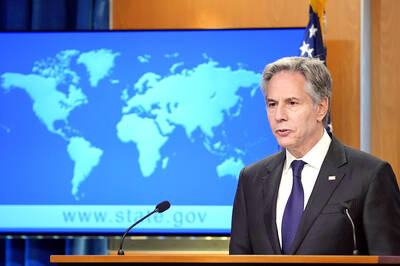
Beijing is continuing to commit genocide and crimes against humanity against Uyghurs and other Muslim minorities in its western Xinjiang province, U.S. Secretary of State Antony Blinken said in a report published on Monday, ahead of his planned visit to China this week. The State Department’s annual human rights report, which documents abuses recorded all over the world during the previous calendar year, repeated language from previous years on the treatment of Muslims in Xinjiang, but the publication raises the issue ahead of delicate talks, including on the war in Ukraine and global trade, between the top U.S. diplomat and Chinese


 RSS
RSS