


It has been described as the highest junkyard in the world. Covered in discarded mountaineering detritus and suffering under thousands of tourists' boots every year, environmental groups are to launch a push for a radical solution -- the temporary closure of the world's highest mountain.
Warnings that an ecological disaster is imminent in the area around the mountain have largely been ignored amid years of turmoil in Nepal. But conservationists think that growing political stability in the Himalayan kingdom means that the time has come.
Maoist rebels declared a ceasefire with Nepal's government in April after a decade-long insurgency. The Kathmandu Environmental Education Project (KEEP) said that the relative calm has removed an obstacle in its efforts to persuade the authorities that a temporary closure of the mountain is the only solution to help it repair itself.
"The Maoist insurgency presented conservation organizations in Nepal with serious challenges -- constraining programs, damaging infrastructure and threatening the security of staff. Now we are hoping for more open dialogue on conservation with the government, and resting Mount Everest for a number of years is at the top of our list," PT Sherpa, a spokesman for KEEP, said.
Campaigners warn that the price of tourism is discarded rubbish and medical waste and the colonization of the area by restaurants and Internet cafes.
"Providing enough electricity and water for the small communities surrounding Everest and the other Himalayan mountains becomes very challenging when there are tens of thousands of additional tourists and climbers in the region competing for these same resources," he said.
"Nepal is ravaged by water and air pollution caused by industrialization and increased tourism. Water supplies for local villages -- delivered through irrigation systems in the mountains -- are being critically depleted and urgent action needs to be taken," he added.
This year, a geological team sponsored by the UN Environment Program found signs that the landscape of Mount Everest has changed significantly since Sir Edmund Hillary and Tenzing Norgay first conquered the peak in 1953. A primary cause is the warming global climate, but the research party concluded that the growing effect of tourism was also critically taxing the region.
According to the survey, the glacier that once came close to Hillary and Norgay's first base camp has retreated 4.8km in the past two decades.
Hillary himself has become outspoken on a situation he believes is turning into an ecological scandal.
"I have suggested to the Nepal[ese] government that they should stop giving permission and give the mountain a rest for a few years," he said.
Elizabeth Hawley, a Kathmandu-based patron of The Himalaya Trust, an environmental charity founded and still run by Hillary, said that the pioneer remained utterly "appalled" at the levels and standards of tourism around Everest and the Khumba Valley.
"When Sir Edmund has said he wanted the mountain closed or visits limited, the last thing he wants is for the sherpas to lose their livelihoods, but we in the trust strongly believe that not just Everest but the whole of the Khumba Valley needs a sustained rest. These villages have become enormously wealthy by local standards, but along the trail towards Everest there are now restaurants and cyber cafes and bars, and this just doesn't seem right," she said.
Others have proposed limiting the number of professional expeditions and banning all commercial trips to base camp.
There are also fears that even "eco-tourism" is doing more harm than good.
Prakash Sharma, director of Friends of the Earth Nepal, believes that while many of the Western charity groups who trek to the foot of the mountain may be doing so for honourable causes, they are not considering the environmental consequences.
"The Khumbu region and the city of Kathmandu can comfortably hold about 40,000 people. In the coming months, during peak tourist season in the lower valley, there will be as many as 700,000," he said, adding that 20,000 to 40,000 of these people will attempt to ascend the Himalayas, including thousands who will at least trek to the foot of Everest.
"There is no infrastructure in this region to cope with the pollution this many people generate, and as a result the Nepali Himalayas have become the highest junkyard in the world," he said.
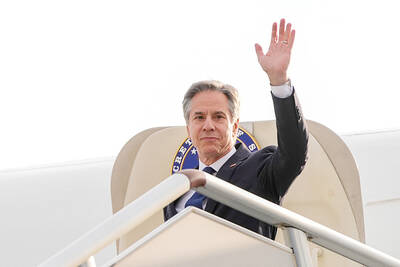
‘IN A DIFFERENT PLACE’: The envoy first visited Shanghai, where he attended a Chinese basketball playoff match, and is to meet top officials in Beijing tomorrow US Secretary of State Antony Blinken yesterday arrived in China on his second visit in a year as the US ramps up pressure on its rival over its support for Russia while also seeking to manage tensions with Beijing. The US diplomat tomorrow is to meet China’s top brass in Beijing, where he is also expected to plead for restraint as Taiwan inaugurates president-elect William Lai (賴清德), and to raise US concerns on Chinese trade practices. However, Blinken is also seeking to stabilize ties, with tensions between the world’s two largest economies easing since his previous visit in June last year. At the
Nearly half of China’s major cities are suffering “moderate to severe” levels of subsidence, putting millions of people at risk of flooding, especially as sea levels rise, according to a study of nationwide satellite data released yesterday. The authors of the paper, published by the journal Science, found that 45 percent of China’s urban land was sinking faster than 3mm per year, with 16 percent at more than 10mm per year, driven not only by declining water tables, but also the sheer weight of the built environment. With China’s urban population already in excess of 900 million people, “even a small portion

UNSETTLING IMAGES: The scene took place in front of TV crews covering the Trump trial, with a CNN anchor calling it an ‘emotional and unbelievably disturbing moment’ A man who doused himself in an accelerant and set himself on fire outside the courthouse where former US president Donald Trump is on trial has died, police said yesterday. The New York City Police Department (NYPD) said the man was declared dead by staff at an area hospital. The man was in Collect Pond Park at about 1:30pm on Friday when he took out pamphlets espousing conspiracy theories, tossed them around, then doused himself in an accelerant and set himself on fire, officials and witnesses said. A large number of police officers were nearby when it happened. Some officers and bystanders rushed
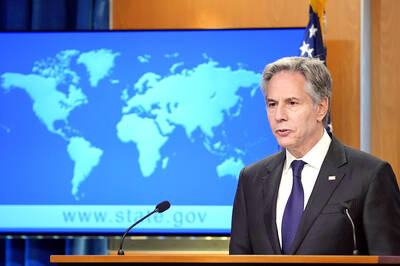
Beijing is continuing to commit genocide and crimes against humanity against Uyghurs and other Muslim minorities in its western Xinjiang province, U.S. Secretary of State Antony Blinken said in a report published on Monday, ahead of his planned visit to China this week. The State Department’s annual human rights report, which documents abuses recorded all over the world during the previous calendar year, repeated language from previous years on the treatment of Muslims in Xinjiang, but the publication raises the issue ahead of delicate talks, including on the war in Ukraine and global trade, between the top U.S. diplomat and Chinese


 RSS
RSS