


World powers scheduled to meet in London yesterday were likely to agree on the principle of imposing sanctions on Iran over its nuclear program but not to approve specific language, a US official said.
"What we would expect to come from this meeting is the political decision to move to the next step of diplomacy, which is a sanctions resolution," the official with the administration of US President George W. Bush said.
The official, who spoke on condition of anonymity, said the foreign ministers would likely ask their political directors to spend the next several days hammering out specific language on sanctions.
"I expect activities to intensify in New York and in other capitals," he said.
Divided
World powers are divided over how best to resolve the Iran deadlock. Russia and China have up until now been wary of rushing into sanctions and some European countries say diplomacy must be given more time.
Washington has been aggressively lobbying for sanctions at the UN Security Council after long-running talks with Iran to stop enrichment failed to produce results.
Ministers from Russia, France, Britain, the US and China -- the permanent members of the Security Council -- and Germany were due to meet in London at 5pm.
Iran again urged the West on Thursday to solve the dispute through talks but repeated it would not stop uranium enrichment. Tehran says the program is only for power generation but the West suspects it wants to make a nuclear bomb.
Iranian President Mahmoud Ahmadinejad said on Thursday that his country would not be intimidated by threats.
"Those who threaten Iran by sanctions and embargoes should know that this nation lived under the hardest situation in the past 27 years and achieved nuclear technology. This nation will not be frightened by the threats," state-run television quoted Ahmadinejad as saying.
Iran insists that its enrichment of uranium is purely for peaceful purposes to be used for nuclear energy. But the US and many European nations believe Iran wants to enrich uranium to produce nuclear weapons.
Failed talks
Talks between European and Iranian negotiators have failed to convince Tehran to suspend its enrichment program.
US Secretary of State Condoleezza Rice, British Foreign Secretary Beckett and French Foreign Minister Philippe Douste-Blazy will attend the meeting at Lancaster House, Beckett's official residence, their offices said.
Germany, Russia and China will also send high-level officials to the talks, an official said, but he did not know whether they would be foreign ministers.
The representatives are likely to confirm that the European-Iranian negotiations are at a standstill and issue a statement referring the Iran file back to the Security Council and stating the principles they agree on, a senior council diplomat said, speaking on condition of anonymity because talks are still taking place.
Lower-level officials from the six nations will meet in London before the ministers arrive, the Foreign Office said.
Britain announced the planned talks after hours of conflicting reports about whether the ministers planned to meet, suggesting jostling among diplomats behind the scenes.
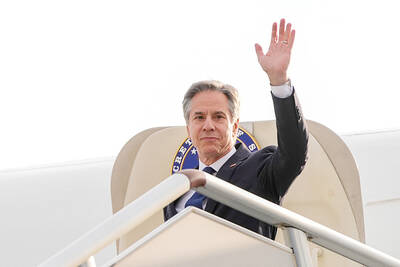
‘IN A DIFFERENT PLACE’: The envoy first visited Shanghai, where he attended a Chinese basketball playoff match, and is to meet top officials in Beijing tomorrow US Secretary of State Antony Blinken yesterday arrived in China on his second visit in a year as the US ramps up pressure on its rival over its support for Russia while also seeking to manage tensions with Beijing. The US diplomat tomorrow is to meet China’s top brass in Beijing, where he is also expected to plead for restraint as Taiwan inaugurates president-elect William Lai (賴清德), and to raise US concerns on Chinese trade practices. However, Blinken is also seeking to stabilize ties, with tensions between the world’s two largest economies easing since his previous visit in June last year. At the

UNSETTLING IMAGES: The scene took place in front of TV crews covering the Trump trial, with a CNN anchor calling it an ‘emotional and unbelievably disturbing moment’ A man who doused himself in an accelerant and set himself on fire outside the courthouse where former US president Donald Trump is on trial has died, police said yesterday. The New York City Police Department (NYPD) said the man was declared dead by staff at an area hospital. The man was in Collect Pond Park at about 1:30pm on Friday when he took out pamphlets espousing conspiracy theories, tossed them around, then doused himself in an accelerant and set himself on fire, officials and witnesses said. A large number of police officers were nearby when it happened. Some officers and bystanders rushed
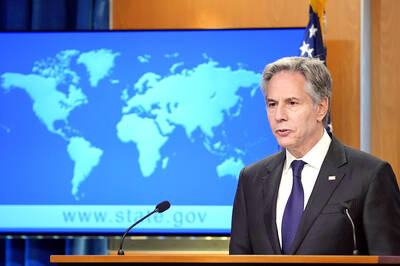
Beijing is continuing to commit genocide and crimes against humanity against Uyghurs and other Muslim minorities in its western Xinjiang province, U.S. Secretary of State Antony Blinken said in a report published on Monday, ahead of his planned visit to China this week. The State Department’s annual human rights report, which documents abuses recorded all over the world during the previous calendar year, repeated language from previous years on the treatment of Muslims in Xinjiang, but the publication raises the issue ahead of delicate talks, including on the war in Ukraine and global trade, between the top U.S. diplomat and Chinese
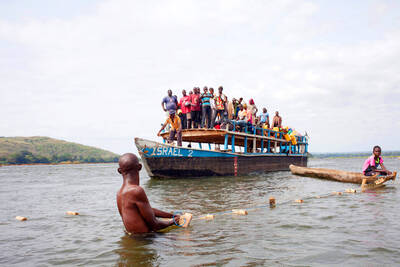
RIVER TRAGEDY: Local fishers and residents helped rescue people after the vessel capsized, while motorbike taxis evacuated some of the injured At least 58 people going to a funeral died after their overloaded river boat capsized in the Central African Republic’s (CAR) capital, Bangui, the head of civil protection said on Saturday. “We were able to extract 58 lifeless bodies,” Thomas Djimasse told Radio Guira. “We don’t know the total number of people who are underwater. According to witnesses and videos on social media, the wooden boat was carrying more than 300 people — some standing and others perched on wooden structures — when it sank on the Mpoko River on Friday. The vessel was heading to the funeral of a village chief in


 RSS
RSS