


White House loyalists are fighting to save President George W. Bush's anti-terror plans from collapsing under Republican squabbles in Congress. In cliffhanger votes, a House of Representatives committee rejected, and then endorsed, Bush's proposal to continue tough interrogations.
The tug-of-war on the House Judiciary Committee was evidence of the difficulty Bush is having in lining up support for his proposals just weeks before November's elections.
Democrats sat on the sidelines "watching the cat fights" among Republicans on the surveillance and detainee legislation, Senate Minority Leader Harry Reid said.
Reid noted that Senate Majority Leader Bill Frist was forced to postpone consideration of those bills this week, and senators are debating border security "because they have nothing else to do."
To win a largely symbolic endorsement of the White House's detainee proposal, Republicans on the House Judiciary Committee performed a series of procedural gymnastics.
After an initial vote resulted in rejection, Republican aides brought in two absent members -- Representative Henry Hyde of Illinois and Elton Gallegly of California -- and called four additional votes before finally gaining a 20-19 endorsement. It still must be voted on by the full 435-member House.
Things became muddled as Republican Representative James Sensenbrenner asked members to repeat their votes.
"I voted no, yes," Representative Louie Gohmert, also a Republican, said at one point.
The "favorable rating," while not required to send the bill to a full House vote, was worth the fight for White House loyalists struggling to keep the bill alive in the waning days of the congressional session.
Prospects were not much clearer in the Senate, where the White House and a group of dissenting Republicans were in negotiations over the detainee bill.
One top Republican predicted the House would accept any deal worked out between the White House and the opposition senators.
"If the Senate and the White House have reached an agreement, that is probably what would end up becoming law and making its way to the president's desk," said House Intelligence Committee Chairman Pete Hoekstra.
Intricate negotiations on both interrogation techniques for detainees and legalizing the president's warrantless wiretapping program left the prospects for passage uncertain, even after a meeting on Wednesday between Bush and Republican congressional leaders.
For the White House, there was some good news.
The House Intelligence Committee approved by voice vote a bill that would put into law the administration's warrantless wiretapping program. The sponsor, Representative Heather Wilson, had rewritten the measure to make it more to Bush's liking. The Judiciary Committee later endorsed a similar version, 20-16.
Wilson's revision, likely to draw Bush's support, is the bill that probably will make it to the full House.
Under Wilson's revised bill, the president may conduct the secret surveillance only under specific conditions. For example, the president must notify Congress within five days of authorizing surveillance, name the entity that poses the threat and state the reason for believing the attack is imminent.
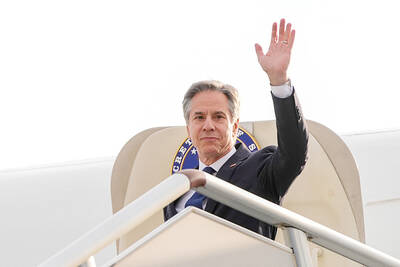
‘IN A DIFFERENT PLACE’: The envoy first visited Shanghai, where he attended a Chinese basketball playoff match, and is to meet top officials in Beijing tomorrow US Secretary of State Antony Blinken yesterday arrived in China on his second visit in a year as the US ramps up pressure on its rival over its support for Russia while also seeking to manage tensions with Beijing. The US diplomat tomorrow is to meet China’s top brass in Beijing, where he is also expected to plead for restraint as Taiwan inaugurates president-elect William Lai (賴清德), and to raise US concerns on Chinese trade practices. However, Blinken is also seeking to stabilize ties, with tensions between the world’s two largest economies easing since his previous visit in June last year. At the

UNSETTLING IMAGES: The scene took place in front of TV crews covering the Trump trial, with a CNN anchor calling it an ‘emotional and unbelievably disturbing moment’ A man who doused himself in an accelerant and set himself on fire outside the courthouse where former US president Donald Trump is on trial has died, police said yesterday. The New York City Police Department (NYPD) said the man was declared dead by staff at an area hospital. The man was in Collect Pond Park at about 1:30pm on Friday when he took out pamphlets espousing conspiracy theories, tossed them around, then doused himself in an accelerant and set himself on fire, officials and witnesses said. A large number of police officers were nearby when it happened. Some officers and bystanders rushed
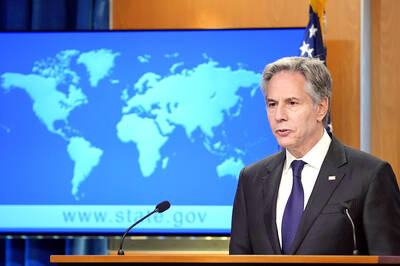
Beijing is continuing to commit genocide and crimes against humanity against Uyghurs and other Muslim minorities in its western Xinjiang province, U.S. Secretary of State Antony Blinken said in a report published on Monday, ahead of his planned visit to China this week. The State Department’s annual human rights report, which documents abuses recorded all over the world during the previous calendar year, repeated language from previous years on the treatment of Muslims in Xinjiang, but the publication raises the issue ahead of delicate talks, including on the war in Ukraine and global trade, between the top U.S. diplomat and Chinese

RIVER TRAGEDY: Local fishers and residents helped rescue people after the vessel capsized, while motorbike taxis evacuated some of the injured At least 58 people going to a funeral died after their overloaded river boat capsized in the Central African Republic’s (CAR) capital, Bangui, the head of civil protection said on Saturday. “We were able to extract 58 lifeless bodies,” Thomas Djimasse told Radio Guira. “We don’t know the total number of people who are underwater. According to witnesses and videos on social media, the wooden boat was carrying more than 300 people — some standing and others perched on wooden structures — when it sank on the Mpoko River on Friday. The vessel was heading to the funeral of a village chief in


 RSS
RSS