


It was supposed to be like other elections in the Arab world: The president paints himself as a changed man, the respected opposition candidate is discredited and the opposition ends with an embarrassing loss.
Yemen's landmark presidential election, however, is proving to be anything but ordinary.
Voters went to the polls here yesterday to choose a president and local council representatives in a surprisingly heated contest pitting voters' desire for change against their fear of instability. It may prove to be one of the most open electoral battles in the region, analysts and election monitors say, as President Ali Abdullah Saleh fends off the biggest electoral challenge of his 28-year rule.
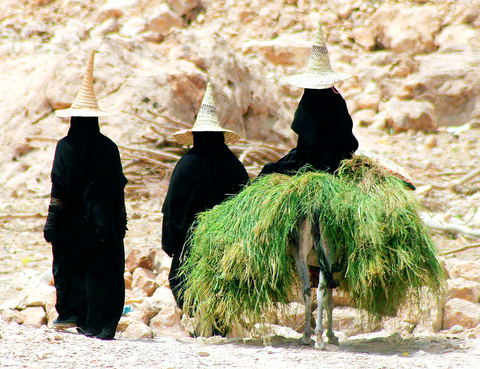
PHOTO: EPA
His most serious challenger is Faisal bin Shamlan, 72, a former minister and member of parliament who has a reputation of integrity. Shamlan, backed by a coalition of the four largest opposition parties, including its Islamists, has promised to fight government corruption and to distribute authority among Yemen's regions. Government corruption, he insists, has led to growing militancy, Yemen's scourge.
Virtually no one expects Shamlan to win, but most analysts expect his challenge to embolden the opposition in future elections, if not to prompt real political change.
Yemenis are increasingly angered by corruption and a lack of opportunity. But they also see a government with dwindling power in the face of growing Islamist influence, analysts say. Saleh had pledged that he would not run again, but he reversed himself in June after rallies that he said expressed the people's will.
Yemeni officials have gone out of their way to show democracy at work. In a first, all candidates have been given free time on Yemeni television and government financing. They have been given free rein to canvass and campaign everywhere Saleh has, and an independent elections commission has been set up to ensure neutrality. Independent monitors have been encouraged to observe and the news media have been welcomed to report freely.
Each side has attacked the other in speeches, anthems and party newspapers. But Saleh has hit more aggressively in recent days.
The election comes against the backdrop of Yemen's fight against Islamic militancy as part of the Bush administration's war on terrorism. Last week, Yemeni security men thwarted two suicide bombing attacks against oil installations. On Saturday, the government said it had arrested four suspected members of al-Qaeda who were plotting attacks on Sana, the capital.
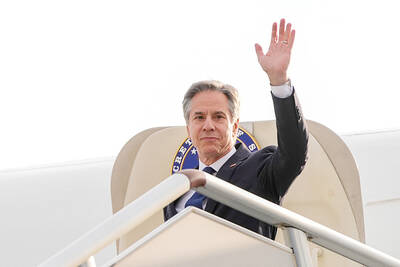
‘IN A DIFFERENT PLACE’: The envoy first visited Shanghai, where he attended a Chinese basketball playoff match, and is to meet top officials in Beijing tomorrow US Secretary of State Antony Blinken yesterday arrived in China on his second visit in a year as the US ramps up pressure on its rival over its support for Russia while also seeking to manage tensions with Beijing. The US diplomat tomorrow is to meet China’s top brass in Beijing, where he is also expected to plead for restraint as Taiwan inaugurates president-elect William Lai (賴清德), and to raise US concerns on Chinese trade practices. However, Blinken is also seeking to stabilize ties, with tensions between the world’s two largest economies easing since his previous visit in June last year. At the
Nearly half of China’s major cities are suffering “moderate to severe” levels of subsidence, putting millions of people at risk of flooding, especially as sea levels rise, according to a study of nationwide satellite data released yesterday. The authors of the paper, published by the journal Science, found that 45 percent of China’s urban land was sinking faster than 3mm per year, with 16 percent at more than 10mm per year, driven not only by declining water tables, but also the sheer weight of the built environment. With China’s urban population already in excess of 900 million people, “even a small portion

UNSETTLING IMAGES: The scene took place in front of TV crews covering the Trump trial, with a CNN anchor calling it an ‘emotional and unbelievably disturbing moment’ A man who doused himself in an accelerant and set himself on fire outside the courthouse where former US president Donald Trump is on trial has died, police said yesterday. The New York City Police Department (NYPD) said the man was declared dead by staff at an area hospital. The man was in Collect Pond Park at about 1:30pm on Friday when he took out pamphlets espousing conspiracy theories, tossed them around, then doused himself in an accelerant and set himself on fire, officials and witnesses said. A large number of police officers were nearby when it happened. Some officers and bystanders rushed

Beijing is continuing to commit genocide and crimes against humanity against Uyghurs and other Muslim minorities in its western Xinjiang province, U.S. Secretary of State Antony Blinken said in a report published on Monday, ahead of his planned visit to China this week. The State Department’s annual human rights report, which documents abuses recorded all over the world during the previous calendar year, repeated language from previous years on the treatment of Muslims in Xinjiang, but the publication raises the issue ahead of delicate talks, including on the war in Ukraine and global trade, between the top U.S. diplomat and Chinese


 RSS
RSS