


Somalia's weak government sought help on Tuesday in probing the country's first-ever suicide bombing, an unsuccessful attempt to assassinate the interim president that officials pin on al-Qaeda.
Authorities boosted security around the government seat of Baidoa where wreckage from two car bombs, at least one of which was driven by a suicide attacker, still littered the street outside parliament.
In the aftermath of Monday's blasts and an ensuing gunbattle that killed 11 people and wounded 18 but left President Abdullahi Yusuf Ahmed unscathed, officials said they were convinced al-Qaeda was behind the attack.

PHOTO: AP
And with such accusations flying, tensions soared between the administration in Baidoa and Somalia's powerful hardline Islamist movement that controls much of the south of the country, including the capital Mogadishu.
Meanwhile, neighboring Ethi-opia, a strong ally of Yusuf's government that fears the rise of so-called "jihadists" in Somalia, condemned the attack and vowed "to do whatever is necessary" to protect the administration.
The UN refugee agency said it was concerned that the assassination bid would prompt a new surge in already rising numbers of Somalis crossing the border into Kenya.
Security forces interrogated two presumed attackers captured after Monday's assault, but government spokesman Abdirahman Mohamed Nur Dinari said foreign expertise was needed to investigate the suspected al-Qaeda link.
"Our local investigators are already probing the attack, but we really need international help and expertise in the whole exercise," he said in Baidoa, about 250km northwest of Mogadishu.
If al-Qaeda was involved, "we really do not have the expertise to uncover the [details of the] attack that was well-organized by the same groups that are carrying out attacks in Iraq and Afghanistan," Dinari said.
He said a massive security presence had been deployed in and around Baidoa to search for an unknown number of attackers believed to have escaped in the chaos after the blasts.
Officials stopped short of publicly blaming the Islamists for the incident that killed five members of Yusuf's entourage, including his younger brother, and six attackers, but said privately they appeared to be involved.
"I am sure the Islamic courts are behind it," one senior government source said on condition of anonymity, adding there had been intelligence information from Mogadishu four days earlier about two explosive-laden cars being driven to Baidoa.
"We secured government buildings, but unfortunately we didn't believe that they would hit parliament and target the president," the official said.
Somali Prime Minister Ali Mohamed Gedi blamed the attack on "terrorists" organized within the country that has been wracked by anarchy and without a functioning central administration for the past 16 years.
Other officials say the attack was carried out by the same group responsible for the weekend murder of an elderly Italian nun in Mogadishu, an ambush amid fury over Pope Benedict XVI's comments about Islam.
But in the capital, the Supreme Islamic Council of Somalia (SICS) denied any responsibility for Monday's attack or the nun's slaying, and said they were the work of the "enemies of Somalia."
Some senior members of the Islamist movement, notably its supreme leader Sheikh Hassan Dahir Aweys who is designated a "terrorist" by the US, have been accused of al-Qaeda ties and harboring extremists.
They deny the charges but US officials maintain that at least three men who participated in the 1998 al-Qaeda bombings of the US embassies in Kenya and Tanzania are living in Somalia under the protection of the Islamists.
Fears of a Taliban-style takeover of Somalia have been rising since the Islamists seized Mogadishu in June after months of fierce battles with a US-backed alliance of warlords and have since rapidly expanded their territory.
Osama bin Laden himself has hailed the activities of Somali Islamists, praising them for driving out US and UN peacekeepers sent to the lawless Horn of Africa nation in the mid-1990s.
In July, an audiotape attributed to bin Laden warned the world against sending troops to shore up the government's limited authority, something the administration has repeatedly called for over the objections of the Islamists.
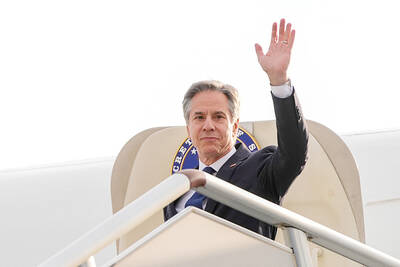
‘IN A DIFFERENT PLACE’: The envoy first visited Shanghai, where he attended a Chinese basketball playoff match, and is to meet top officials in Beijing tomorrow US Secretary of State Antony Blinken yesterday arrived in China on his second visit in a year as the US ramps up pressure on its rival over its support for Russia while also seeking to manage tensions with Beijing. The US diplomat tomorrow is to meet China’s top brass in Beijing, where he is also expected to plead for restraint as Taiwan inaugurates president-elect William Lai (賴清德), and to raise US concerns on Chinese trade practices. However, Blinken is also seeking to stabilize ties, with tensions between the world’s two largest economies easing since his previous visit in June last year. At the
Nearly half of China’s major cities are suffering “moderate to severe” levels of subsidence, putting millions of people at risk of flooding, especially as sea levels rise, according to a study of nationwide satellite data released yesterday. The authors of the paper, published by the journal Science, found that 45 percent of China’s urban land was sinking faster than 3mm per year, with 16 percent at more than 10mm per year, driven not only by declining water tables, but also the sheer weight of the built environment. With China’s urban population already in excess of 900 million people, “even a small portion

UNSETTLING IMAGES: The scene took place in front of TV crews covering the Trump trial, with a CNN anchor calling it an ‘emotional and unbelievably disturbing moment’ A man who doused himself in an accelerant and set himself on fire outside the courthouse where former US president Donald Trump is on trial has died, police said yesterday. The New York City Police Department (NYPD) said the man was declared dead by staff at an area hospital. The man was in Collect Pond Park at about 1:30pm on Friday when he took out pamphlets espousing conspiracy theories, tossed them around, then doused himself in an accelerant and set himself on fire, officials and witnesses said. A large number of police officers were nearby when it happened. Some officers and bystanders rushed

Beijing is continuing to commit genocide and crimes against humanity against Uyghurs and other Muslim minorities in its western Xinjiang province, U.S. Secretary of State Antony Blinken said in a report published on Monday, ahead of his planned visit to China this week. The State Department’s annual human rights report, which documents abuses recorded all over the world during the previous calendar year, repeated language from previous years on the treatment of Muslims in Xinjiang, but the publication raises the issue ahead of delicate talks, including on the war in Ukraine and global trade, between the top U.S. diplomat and Chinese


 RSS
RSS