


In this sandy wasteland of palm trees and wrecked seaside villas, there are warlords and then there are moneylords.
Yusuf Muhammad is a moneylord, a shipping magnate who threw his weight -- and men and money -- behind the Islamic militias and helped bring them to power in June.
"The cost of doing business had simply become unacceptable," Muhammad said of the days of anarchy before the Islamists took control. "So we made a move."
The move was initially celebrated by Mogadishu's people who, for the first time in 15 years of unrelenting clan warfare, enjoyed a modicum of peace. But three months into the new Islamic fiefdom, things are changing. While the millionaires of Mogadishu (and at 14,000 Somali shillings to the US dollar, there are quite a few) continue to bankroll the Islamists, poorer people here are increasingly ambivalent. They describe a harsh and brazen regime, whose troops bullwhip women for not wearing veils and summarily execute political enemies.
The much appreciated stability may be cracking. On Sunday, an elderly Italian nun was gunned down in front of a Mogadishu hospital where she had served for years. Hospital staff identified her as Leonella Rose Scorbatti and said she might have been shot by Islamic gunmen in revenge for Pope Benedict XVI's recent remarks on Islam.
Mogadishu is still an edgy place, where machine guns and bazookas are sold openly in the market and the signs of war are everywhere.
Razor-straight avenues mapped out by the Italians decades ago are corridors of ruin, with crumbling, bombed-out houses lining the streets and giant cactus plants exploding from the ground floor windows. White plaster storefronts are freckled by bullet holes. Junked pickup trucks lie half-buried in sand.
It is as if every single inch of this city of 2 million people, the country's capital when there was a functioning government, was at some point violently contested.
"That," said a truck driver, pointing to a pile of scorched white blocks sitting on top of a hill, "is the old parliament."
The new parliament, as it were, is the Shura Council, 91 sheiks from the major clans who have sworn their allegiance to the Council of Islamic Somali Courts, the new name of the Islamic government. They meet in a red-brick building.
In a way, this is a watershed for Somali politics. Somalia is a thoroughly clannish society, split by rivalries that go back to the days when the clans roamed the deserts and fought over pasture land. The Hawiye clan, Mogadishu's most powerful, dominates the Shura Council, but the Islamists seem to have done a better job than any previous government of uniting the major clans and subclans. Almost all Somalis are Sunni Muslims, and several business leaders said religion may prove to be the Somalis' elusive connective tissue.
But it is not all smooth sailing. One complication is the transitional federal government, based in the inland town of Baidoa and internationally recognized. Despite two rounds of peace talks, the two sides have yet to figure out a way to share power.
Inside Somalia and out, the Islamic Courts have been likened to the Taliban, who rose to power in Afghanistan by bringing order, then turned to repression and terrorism.
It is a comparison the Islamic leaders do not necessarily mind.
"The Taliban are our brethren," Modei said.
The business leaders, though, have a different view.
"People here are free, freer than they have been for years," said Muhammad, the shipping magnate.
He said he had faith the Islamists would continue to deliver peace -- and prosperity.

‘IN A DIFFERENT PLACE’: The envoy first visited Shanghai, where he attended a Chinese basketball playoff match, and is to meet top officials in Beijing tomorrow US Secretary of State Antony Blinken yesterday arrived in China on his second visit in a year as the US ramps up pressure on its rival over its support for Russia while also seeking to manage tensions with Beijing. The US diplomat tomorrow is to meet China’s top brass in Beijing, where he is also expected to plead for restraint as Taiwan inaugurates president-elect William Lai (賴清德), and to raise US concerns on Chinese trade practices. However, Blinken is also seeking to stabilize ties, with tensions between the world’s two largest economies easing since his previous visit in June last year. At the

UNSETTLING IMAGES: The scene took place in front of TV crews covering the Trump trial, with a CNN anchor calling it an ‘emotional and unbelievably disturbing moment’ A man who doused himself in an accelerant and set himself on fire outside the courthouse where former US president Donald Trump is on trial has died, police said yesterday. The New York City Police Department (NYPD) said the man was declared dead by staff at an area hospital. The man was in Collect Pond Park at about 1:30pm on Friday when he took out pamphlets espousing conspiracy theories, tossed them around, then doused himself in an accelerant and set himself on fire, officials and witnesses said. A large number of police officers were nearby when it happened. Some officers and bystanders rushed

Beijing is continuing to commit genocide and crimes against humanity against Uyghurs and other Muslim minorities in its western Xinjiang province, U.S. Secretary of State Antony Blinken said in a report published on Monday, ahead of his planned visit to China this week. The State Department’s annual human rights report, which documents abuses recorded all over the world during the previous calendar year, repeated language from previous years on the treatment of Muslims in Xinjiang, but the publication raises the issue ahead of delicate talks, including on the war in Ukraine and global trade, between the top U.S. diplomat and Chinese
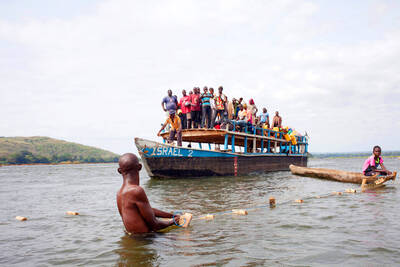
RIVER TRAGEDY: Local fishers and residents helped rescue people after the vessel capsized, while motorbike taxis evacuated some of the injured At least 58 people going to a funeral died after their overloaded river boat capsized in the Central African Republic’s (CAR) capital, Bangui, the head of civil protection said on Saturday. “We were able to extract 58 lifeless bodies,” Thomas Djimasse told Radio Guira. “We don’t know the total number of people who are underwater. According to witnesses and videos on social media, the wooden boat was carrying more than 300 people — some standing and others perched on wooden structures — when it sank on the Mpoko River on Friday. The vessel was heading to the funeral of a village chief in


 RSS
RSS