


This police beat has no precinct boundaries. It encompasses the vibrant gay club scene in the US capital, the sidewalks where transgender prostitutes ply their trade, even the Internet -- where criminals prey on men using gay dating sites.
It's the beat of a cutting-edge and award-winning police squad -- Washington's Gay and Lesbian Liaison Unit -- led by a burly, openly gay sergeant who gave up a career as a pro hockey referee to pursue law enforcement.
The unit investigates anti-gay hate crimes with zeal, but the bulk of its varied caseload arises from within the gay community -- notably drug abuse and gay-on-gay violence. Crimes get reported and solved, said Sergeant Brett Parson, because of his unit's efforts to win trust and obtain tips from a group that long viewed the police as hostile.
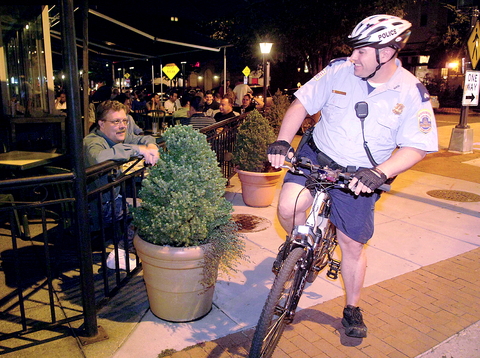
PHOTO: AP
"The biggest challenge, from Day One, has been to walk that very fine line between being advocates and enforcers," said Parson. "You want to build a strong relationship without losing respect because you're a pushover."
Historically, many gays across the US considered police departments a threat for raiding gay gathering places and employing unfairly selective arrest policies. The gay-rights movement is widely depicted as starting with riots over a 1969 police raid on the Stonewall Inn, a New York City gay bar.
widespread abuse
Amnesty International, in a report last year, contended that abuse by urban police officers is widespread, but acknowledged that many departments are striving to improve relations with the local gay and lesbian communities.
Cities as far-flung from Washington as Fargo, North Dakota, and Missoula, Montana, now have gay liaison officers, but Parson says none matches his department's commitment, establishing a unit with a mission to investigate gay-related crimes and to do community outreach. Parson also teaches fellow officers in the rest of department about gay-lesbian issues, a course he calls Gay 101.
Created in 2000 in a city with one of the nation's highest concentrations of gays, the unit now has six full-time officers, plus a cadre of part-time officers and volunteers from the community. It moved two years ago into a spacious storefront office near trendy Dupont Circle; posters condemning hate crimes decorate its walls.
The unit was formed after Police Chief Charles Ramsey concluded that the low number of anti-gay hate crimes reported in Washington was not cause for celebration but rather a troubling sign that the city's gays deeply mistrusted the police. In one notorious case, a police lieutenant admitted in 1997 that he had run an extortion racket targeting patrons of gay night clubs.
Ironically, Parson is pleased that the number of reported hate crimes has risen from two in 1998 to several dozen a year.
"That doesn't mean we're more homophobic -- it means you have a community that finally feels comfortable turning to the police," he said.
The unit gets involved in 10 to 15 murder cases a year, sometimes playing a key role in solving them.
In a recent sting operation, using an undercover officer, Parson's unit helped arrest a suspect who was arranging sexual trysts on a gay Internet dating site, then committing robbery on the assumption the other man wouldn't dare report the crime.
Most of the unit's tips and crime reports come from white gay men. Parson, who is white, has been working to develop better contacts with black gays -- Washington is 60 percent black -- and with the transgender community.
"Our job is to go even when we're not comfortable," he said.
The unit has assisted in the department's campaign to move transgender prostitutes away from one of their favored "strolls" near the Washington Convention Center.
"We go to the girls and say, `OK, it's time to move along,'" Parson said. "We want to be sure they're treated with respect."

SPEAKING OUT: After Siranudh Scott’s allegations surfaced, celebrities and public figures took to social media to share their own experiences of sexual misconduct and abuse A high-profile alleged sexual abuse case within a wealthy Thai beer brewing family has prompted a wave of painful accounts from survivors of unconnected abuse in the conservative nation. Siranudh Scott, a member of the billionaire Thai family that founded the ubiquitous Singha beer brand, posted an emotional video this month accusing his elder brother Sunit of repeatedly abusing him when he was a teenager. Sunit, who is in his 30s, later denied the allegations in a video posted online, but Singha parent Boonrawd dismissed him from his executive role with the company on Tuesday last week. “I felt I needed to speak

SEEKING ORDER: Rodrigo Paz said that ‘anyone who wants to destroy the nation will have to deal with this president and the full force of the constitution’ Bolivian President Rodrigo Paz on Wednesday said that the nation was at a “breaking point” after nearly a month of protests that have caused shortages of food, fuel and medicine. Paz, who took office six months ago amid the worst economic crisis there in four decades, is battling a groundswell of fury over his policies. The political capital, La Paz, has been besieged by low-income workers and members of the indigenous majority calling for his resignation. “The country needs order and is reaching breaking point,” the 58-year-old said at a public event in La Paz, renewing his appeal for dialogue. On Tuesday, the Bolivian
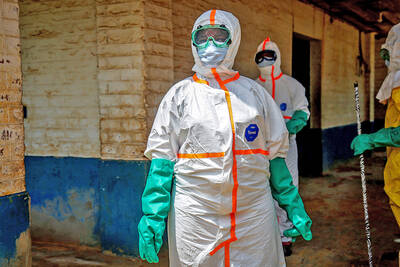
COMMUNITY CONFLICT: Concerns about disease spread from corpses has run up against friends and families’ desire to bury their dead as infection spreads in the area Angry residents of a town at the epicenter of the Ebola outbreak in the Democratic Republic of the Congo (DR Congo) attacked and burned a tent that was part of a health center where people are being treated for the virus, the staff there said Saturday. It was the second such attack in the region in a week. No one was hurt in the attack, according to reports but as patients ran out to escape the fire, 18 people with suspected Ebola infections fled the facility and are unaccounted for, a hospital director said. Angry residents arrived at the clinic in the

Forecasters in Europe yesterday warned of exceptional heat as record temperatures driven by a “heat dome” push temperatures well above seasonal norms across the continent. The surge follows a record-breaking Monday, with France logging its hottest day in the month of May on record, its weather agency said, and the UK also posting unprecedented highs. A so-called “heat dome” of warm air from northern Africa trapped under a high-pressure system over western Europe is behind the high temperatures not usually seen until high summer. Restrictions on outdoor work were imposed in parts of Italy, beaches in southwest France filled earlier than usual and


 RSS
RSS