


Some 250 children sickened by emissions from a lead smelter in western China remain in hospital weeks after the mass poisoning case was uncovered and at least four are likely to suffer permanent brain damage, state media said yesterday.
A top Chinese environmental official said the factory was emitting 800 times the acceptable levels and blamed local authorities for failing to do anything.
Four of the children from Hui county in Gansu Province are reported to have more than 450mg of lead per liter of blood -- a level which constitutes severe poisoning and that usually results in brain damage, the official Xinhua News Agency said.
At least 877 people from Hui county's villages of Xinsi and Moba, including 334 children under age 14, have tested positive for excessive amounts of lead in their blood since last year. Xinhua said the 250 hospitalized children, all of whom are under 14 years of age, are being treated with vitamin supplements and most are in stable condition.
The pollution has been traced to the Hui County Non-Ferrous Metal Smelting Plant, a ten-year-old factory that was allegedly warned several times by environmental officials to stop discharging pollutants but continued to do so. The plant has since been demolished.
In 2003, the plant released 182 tonnes of lead into the atmosphere, 800 times acceptable levels, Pan Yue (
He said the case and another in Hunan Province where two factories were found to have been dumping arsenide and other pollutants into a river for at least a year were "typical examples of pollution problems caused by a dereliction of duty" by local officials.
"The plants appeared to cause the pollution, but in fact the root of the problem lies in the local governments and local protectionism," Pan was quoted as saying.
There have been no reported arrests or punishments meted out to the Hui county plant or to county officials. The smelter has allegedly agreed to compensate affected villagers but details of the compensation have not been released.
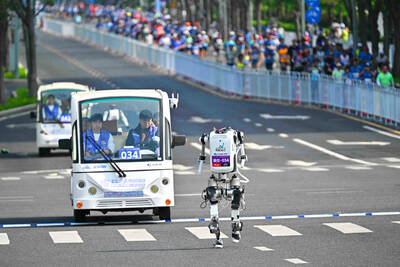
A humanoid robot that won a half-marathon race for robots in Beijing on Sunday ran faster than the human world record in a show of China’s technological leaps. The winner from Honor, a Chinese smartphone maker, completed the 21km race in 50 minutes and 26 seconds, said a WeChat post by the Beijing Economic-Technological Development Area, also known as Beijing E-Town, where the race began. That was faster than the human world record holder, Ugandan Jacob Kiplimo, who finished the same distance in about 57 minutes in March at the Lisbon road race. The performance by the robot marked a significant step forward

Four contenders are squaring up to succeed Antonio Guterres as secretary-general of the UN, which faces unprecedented global instability, wars and its own crushing budget crisis. Chile’s Michelle Bachelet, Argentina’s Rafael Grossi, Costa Rica’s Rebeca Grynspan and Senegal’s Macky Sall are each to face grillings by 193 member states and non-governmental organizations for three hours today and tomorrow. It is only the second time the UN has held a public question-and-answer, a format created in 2016 to boost transparency. Ultimately the five permanent members of the UN’s top body, the Security Council, hold the power, wielding vetoes over who leads the

South Korea’s air force yesterday apologized for a 2021 midair collision involving two fighter jets, a day after auditors said the pilots were taking selfies and filming during the flight and held them responsible for the accident. “We sincerely apologize to the public for the concern caused by the accident that occurred in 2021,” an air force spokesman told a news conference, adding that one of the pilots involved had been suspended from flying duties, received severe disciplinary action and has since left the military. The apology followed a report released on Wednesday by the South Korean Board of Audit and Inspection,
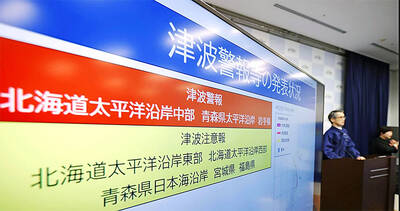
An earthquake registering a preliminary magnitude of 7.7 off northern Japan on Monday prompted a short-lived tsunami alert and the advisory of a higher risk of a possible mega-quake for coastal areas there. The Cabinet Office and the Japan Meteorological Agency said there was a 1% chance for a mega-quake, compared to a 0.1% chance during normal times, in the next week or so following the powerful quake near the Chishima and Japan trenches. Officials said the advisory was not a quake prediction but urged residents in 182 towns along the northeastern coasts to raise their preparedness while continuing their daily lives. Prime


 RSS
RSS