


Paul Salopek, an American journalist held on spying charges after he crossed into Sudan from Chad without a visa last month, was set free on Saturday, along with his Chadian driver and an interpreter.
New Mexico Governor Bill Richardson secured Salopek's release on Friday on what he called "humanitarian grounds" after flying to Khartoum to meet with Sudanese President Omar al-Bashir.
Salopek, a foreign correspondent on leave from the Chicago Tribune and on assignment for National Geographic, was detained with the two Chadians by a rebel group aligned with the Sudanese government.
They were seized Aug. 6 as they moved along the western border with Chad, in Darfur, the focus of a long, deadly conflict between non-Arab rebels and the Arab-dominated government. The three were held for more than a month. Salopek, who has won two Pulitzer prizes, was charged with espionage and writing "false news" about Sudan.
The charges were dropped, and after a brief court appearance in El Fasher, the capital of North Darfur, he was turned over to Richardson and flown to Khartoum. Salopek was to return with Richardson to New Mexico, where he and his wife, Linda Lynch, have a home.
The driver, Idriss Abdulraham Anu, and the interpreter, Suleiman Abakar Moussa, were to fly back to Chad.
The arrest of Salopek is one in a series of recent actions against journalists here in Sudan.
Newspapers have been censored and confiscated, and reporters beaten and harassed while trying to cover unrest over increases in the price of gasoline and other essential items.
On Saturday, Sudanese officials confiscated the entire press run of al Sudani, an independent newspaper, saying articles in it would compromise the investigation into the beheading of a prominent newspaper editor, Mohammed Taha, last week.
Journalists in Sudan said the confiscation of the newspapers, together with the killing of Taha, are among the results of a government crackdown. Censors have been assigned to newsrooms, excising articles and sometimes whole pages of newspapers.
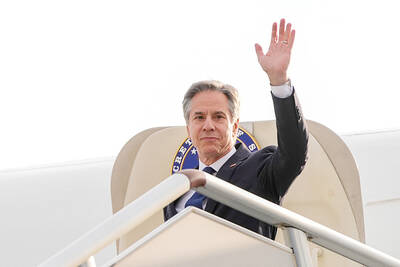
‘IN A DIFFERENT PLACE’: The envoy first visited Shanghai, where he attended a Chinese basketball playoff match, and is to meet top officials in Beijing tomorrow US Secretary of State Antony Blinken yesterday arrived in China on his second visit in a year as the US ramps up pressure on its rival over its support for Russia while also seeking to manage tensions with Beijing. The US diplomat tomorrow is to meet China’s top brass in Beijing, where he is also expected to plead for restraint as Taiwan inaugurates president-elect William Lai (賴清德), and to raise US concerns on Chinese trade practices. However, Blinken is also seeking to stabilize ties, with tensions between the world’s two largest economies easing since his previous visit in June last year. At the
Nearly half of China’s major cities are suffering “moderate to severe” levels of subsidence, putting millions of people at risk of flooding, especially as sea levels rise, according to a study of nationwide satellite data released yesterday. The authors of the paper, published by the journal Science, found that 45 percent of China’s urban land was sinking faster than 3mm per year, with 16 percent at more than 10mm per year, driven not only by declining water tables, but also the sheer weight of the built environment. With China’s urban population already in excess of 900 million people, “even a small portion

UNSETTLING IMAGES: The scene took place in front of TV crews covering the Trump trial, with a CNN anchor calling it an ‘emotional and unbelievably disturbing moment’ A man who doused himself in an accelerant and set himself on fire outside the courthouse where former US president Donald Trump is on trial has died, police said yesterday. The New York City Police Department (NYPD) said the man was declared dead by staff at an area hospital. The man was in Collect Pond Park at about 1:30pm on Friday when he took out pamphlets espousing conspiracy theories, tossed them around, then doused himself in an accelerant and set himself on fire, officials and witnesses said. A large number of police officers were nearby when it happened. Some officers and bystanders rushed

Beijing is continuing to commit genocide and crimes against humanity against Uyghurs and other Muslim minorities in its western Xinjiang province, U.S. Secretary of State Antony Blinken said in a report published on Monday, ahead of his planned visit to China this week. The State Department’s annual human rights report, which documents abuses recorded all over the world during the previous calendar year, repeated language from previous years on the treatment of Muslims in Xinjiang, but the publication raises the issue ahead of delicate talks, including on the war in Ukraine and global trade, between the top U.S. diplomat and Chinese


 RSS
RSS