


The UN received substantial offers of troops for Lebanon that may enable it to field an advance force of 3,500 in two weeks, despite France's refusal to provide a large contingent.
"I would say the show is on the road," said Mark Malloch Brown, the UN deputy secretary-general, after a meeting of more than 40 potential troop contributing nations on Thursday.
Deployments by Italy, Spain and Belgium are key because they can move their forces into Lebanon quickly to meet the 15-day UN deadline for the advance contingent. All three nations are studying the draft rules of engagement that were presented at the meeting, participants reported.
The Italian government yesterday formally approved the deployment of troops to Lebanon as part of a UN force meant to secure peace between Israel and Hezbollah after a month-long war.
A Cabinet meeting did not specify how many soldiers Rome would contribute to the UN mission, but officials have said Italy was ready to deploy up to 3,000 troops, which would make it one of the biggest contributors.
UN Resolution
A UN Security Council resolution adopted on Friday last week called for a truce and a peacekeeping force to help the Lebanese army supervise the pullout of Israeli troops from southern Lebanon that came after 34 days of fighting between Israel and Hezbollah guerrillas. Most of the fighting stopped on Monday.
UN Resolution 1701 authorized up to 13,000 well-armed troops to augment the 2,000-member UN force now in Lebanon, which is known as UNIFIL.
Germany and Denmark have offered maritime and border patrols and Indonesia, Malaysia and Nepal, among others, offered ground troops, the participants said.
The US will aid in planning and logistical support, Alejandro Wolff, the deputy US ambassador said.
French President Jacques Chirac said he would dispatch only 200 army engineers in addition to the 200 already part of UNIFIL, which is commanded by a French general. He said 1,700 troops were offshore but would not be put under UN command. France had been expected to be the backbone of the force.
"We had hoped -- we make no secret of it -- that there would be a stronger French contribution," Malloch Brown said. "Others have come forward and we are pretty convinced we've got the elements here of a strong force."
Lebanese troops
In Lebanon, Lebanese government troops took up position in the heavily bombed border town of Khiam yesterday as they pressed their historic deployment in Hezbollah's longtime bastion in the south.
Correspondents saw a dozen military trucks and armored personnel carriers roll into the hilltop town where last month four UN peacekeepers were killed in an Israeli air raid that sparked an international outcry.
The troops, from the army's 10th Brigade, took up position outside a school in the town of 35,000 people just 7km from the Israeli border.
The town, site of a notorious prison run by Israel's proxy South Lebanon Army militia during its last occupation of Lebanon, was turned almost to rubble by heavy Israeli bombardment during the latest conflict.
Hezbollah fighters melted away as Lebanese troops crossed the Litani River, some 20km from the Israeli border, to take over a region the army has not controlled for decades.
Dozens of people lined roads, waving red and white Lebanese flags and throwing rice and flowers in celebration.
More than 200,000 Lebanese refugees have returned to the shattered south without waiting for the Israelis to complete their pullout and despite unexploded munitions.
At least 1,110 people in Lebanon and 157 Israelis were killed in the conflict that erupted after Hezbollah captured two Israeli soldiers in a cross-border raid last month.
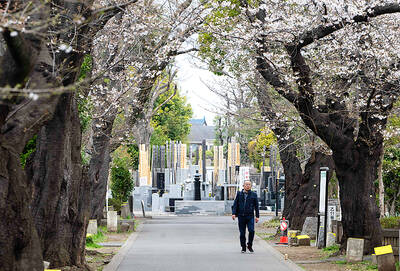
ROCKY RELATIONS: The figures on residents come as Chinese tourist numbers drop following Beijing’s warnings to avoid traveling to Japan The number of Chinese residents in Japan has continued to rise, even as ties between the two countries have become increasingly fractious, data released on Friday showed. As of the end of December last year, the number of Chinese residents had increased by 6.5 percent from the previous year to 930,428. Chinese people accounted for 22.6 percent of all foreign residents in Japan, making them by far the largest group, Japanese Ministry of Justice data showed. Beijing has criticized Tokyo in increasingly strident terms since Japanese Prime Minister Sanae Takaichi last year suggested that a military conflict around Taiwan could

A retired US colonel behind a privately financed rocket launch site in the Dominican Republic sees the project as a response to China’s dominance of the space race in Latin America. Florida-based Launch on Demand is slated to begin building a US$600 million facility in a remote region near the border with Haiti late this year. The project is designed to meet surging demand for the heavy-lift rockets needed to put clusters of satellites into orbit. It is also an answer to China’s growing presence in the region, said CEO Burton Catledge, a former commander of the US Air Force’s 45th Operations

Germany is considering Australia’s Ghost Bat robot fighter as it looks to select a combat drone to modernize its air force, German Minister of Defense Boris Pistorius said yesterday. Germany has said it wants to field hundreds of uncrewed fighter jets by 2029, and would make a decision soon as it considers a range of German, European and US projects developing so-called “collaborative combat aircraft.” Australia has said it will integrate the Ghost Bat, jointly developed by Boeing Australia and the Royal Australian Air Force, into its military after a successful weapons test last year. After inspecting the Ghost Bat in Queensland yesterday,
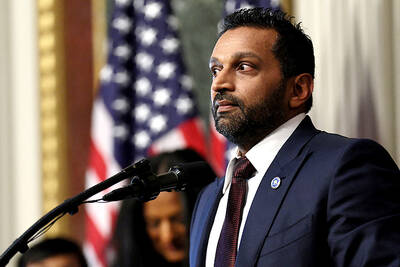
A pro-Iran hacking group claimed to breach FBI Director Kash Patel’s personal e-mail inbox and posted some of the contents online. The e-mails provided by the hacking group include travel details, correspondence with leasing agents in Washington and global entry, and loyalty account numbers. The e-mail address the hackers claim to have compromised has been previously tied to Patel’s personal details, and the leaked e-mails contain photos of Patel and others, in addition to correspondence with family members and colleagues. “The FBI is aware of malicious actors targeting Director Patel’s personal email information,” the agency said in a statement on


 RSS
RSS