


The future of Israeli Prime Minister Ehud Olmert on Saturday night was hanging on how successfully he could sell his citizens the idea that the country had been "victorious" in the "war in the north" as criticism of his shaky performance began to escalate amid the first calls for his resignation.
While the prime minister's allies and government officials lined up to express satisfaction about the outcome of the UN ceasefire resolution passed while the fighting continued, attempts to present a "victory" to the Israeli public could not disguise the deep sense of disquiet over the operation's failures and fears that Hezbollah might manage to emerge "victorious" in the coming days.
For most of the past month as he has prosecuted his war, the Israeli leader has enjoyed high approval ratings and almost unanimous political support across the political spectrum. On Friday he received a call in his office from former prime minister Benjamin Netanyahu, head of the Likud party, who has been generally supportive of the government's actions against Hezbollah, saying he would support the campaign as long as the government did not show signs of weakness and finished the job.

PHOTO: AP
Netanyahu told Olmert that as long as fighting continued the right-wing opposition was fully behind him.
But some on the right have begun to portray the UN resolution and Israel's expected approval of it as a capitulation by Olmert's government. They included Limor Livnat, a former education minister and current Likud member of parliament, and on Friday, former agriculture minister Yisrael Katz, also of the Likud party, became the first parliamentarian to openly call on Olmert to resign.
Katz's demand came on the back of a groundswell of outspoken and often scathing criticism of the government's performance from leading Israeli commentators published in this weekend's newspapers.
In a front-page story headlined "Olmert must go," Ari Shavit, a respected commentator in the daily Haaretz, tore into the prime minister, saying he had left Israeli appearing weak and vulnerable in the face of an increasingly confident Hezbollah. In more than 300 responses on the newspaper's Web site, the comments, many from Israeli Jews, were mostly supportive of Shavit's critique.
Shavit scoffed at a new ground offensive -- launched even as the UN ceasefire resolution was signed -- as a publicity gimmick and raised the question of whether the government has a future.
"I think once a truce is installed you will have political turmoil in Israel and you will have a very serious process of soul searching which will also have political expression," he said.
"If Prime Minister Olmert is to survive, he will have to make a major reshuffle. Things will not go back to where they were before."
"This has been a terrible shock. This has been a very dramatic event in Israel's history and it is still too early to tell what the full political implications will be. I find it improbable to believe that the government as it is will remain in power for many years. If there is no significant achievement for Israel at the very last moment, Olmert will find it very difficult to tell people we went to war for certain aims and failed to achieve them. He desperately needs some last-minute achievement and that's why we see the Israeli troops moving north," Shavit said.
According to a poll in Haaretz on Friday, only about 20 percent of Israelis thought they were winning the war, while 43 percent believed the conflict would end in stalemate. Only 48 percent of those polled supported Olmert's handling of the conflict with Hezbollah -- down from 75 percent at the beginning of hostilities only four weeks ago.
A poll in the mass-circulation daily Yedioth Ahronoth showed a smaller margin of slippage, with support for the Olmert falling from 73 percent to 66 percent.
Israeli commentators have noted that people expected that the war would soon be over and the army would deal a crushing blow to Hezbollah -- but the perception has been that the conflict has already lasted a month with no sign of this happening.
In a sign of the unrest, the head of Israel's Northern Command, responsible for ground operations in Lebanon, was replaced last week, and there has been mounting criticism of the massive bombing by Israel's air force, which has so far been unable to deliver a crushing blow to Hezbollah's ability to launch rockets into Israel.
Olmert has also faced pressure from the Israeli military to continue the campaign as Israeli newspapers and television have reported that commanders in the Israel Defense Forces (IDF) have expressed grave misgivings over the proposed UN ceasefire.
All last week he faced squabbles in his Cabinet over what direction to take. In a sign of unrest at the highest level, Olmert barred Foreign Minister Tzipi Livni from attending the UN Security Council sessions and, according to reports, brought his animosity towards Livni out into the open, sending Deputy Prime Minister Shimon Peres for diplomatic talks overseas, leaving Israel as the only major player without a foreign minister in New York.
Livni is said to have objected to continuing with the military operation and voiced opposition during early stages of the campaign, apparently protesting over some of the bombing in Beirut.
At the Cabinet meeting last Wednesday, Livni made it clear to the IDF chiefs, who proposed an operation that would take a month or two, that if a political way out was found in a few days they would have to stop in their tracks.

‘IN A DIFFERENT PLACE’: The envoy first visited Shanghai, where he attended a Chinese basketball playoff match, and is to meet top officials in Beijing tomorrow US Secretary of State Antony Blinken yesterday arrived in China on his second visit in a year as the US ramps up pressure on its rival over its support for Russia while also seeking to manage tensions with Beijing. The US diplomat tomorrow is to meet China’s top brass in Beijing, where he is also expected to plead for restraint as Taiwan inaugurates president-elect William Lai (賴清德), and to raise US concerns on Chinese trade practices. However, Blinken is also seeking to stabilize ties, with tensions between the world’s two largest economies easing since his previous visit in June last year. At the
Nearly half of China’s major cities are suffering “moderate to severe” levels of subsidence, putting millions of people at risk of flooding, especially as sea levels rise, according to a study of nationwide satellite data released yesterday. The authors of the paper, published by the journal Science, found that 45 percent of China’s urban land was sinking faster than 3mm per year, with 16 percent at more than 10mm per year, driven not only by declining water tables, but also the sheer weight of the built environment. With China’s urban population already in excess of 900 million people, “even a small portion

UNSETTLING IMAGES: The scene took place in front of TV crews covering the Trump trial, with a CNN anchor calling it an ‘emotional and unbelievably disturbing moment’ A man who doused himself in an accelerant and set himself on fire outside the courthouse where former US president Donald Trump is on trial has died, police said yesterday. The New York City Police Department (NYPD) said the man was declared dead by staff at an area hospital. The man was in Collect Pond Park at about 1:30pm on Friday when he took out pamphlets espousing conspiracy theories, tossed them around, then doused himself in an accelerant and set himself on fire, officials and witnesses said. A large number of police officers were nearby when it happened. Some officers and bystanders rushed
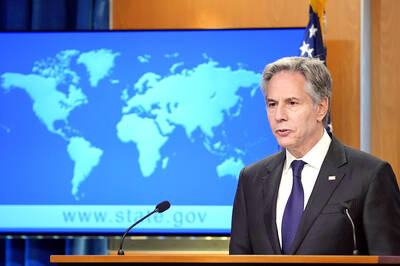
Beijing is continuing to commit genocide and crimes against humanity against Uyghurs and other Muslim minorities in its western Xinjiang province, U.S. Secretary of State Antony Blinken said in a report published on Monday, ahead of his planned visit to China this week. The State Department’s annual human rights report, which documents abuses recorded all over the world during the previous calendar year, repeated language from previous years on the treatment of Muslims in Xinjiang, but the publication raises the issue ahead of delicate talks, including on the war in Ukraine and global trade, between the top U.S. diplomat and Chinese


 RSS
RSS