


When elite Israeli troops crossed into Lebanon to clear booby-trapped Hezbollah positions along the border this week, they expected little resistance. Instead, they found fighters waiting for them with mortars and anti-tank weapons.
These small, cautious incursions have proved relatively costly to the army, a warning to Israel of the heavy fighting that awaits any major operation.
In the Palestinian territories, the army comes up against an enemy armed with little more than Kalashnikovs.
Hezbollah, by contrast, has a well-quipped arsenal: its 2,000-5,000 men have access to missiles, artillery, anti-aircraft guns, and anti-tank weapons.
And there are surprises, such as the Chinese-designed Silkworm cruise missile which appears to have struck an Israeli warship.
When Israel invaded Lebanon in 1982, it lost an estimated 675 soldiers. Israel has fought this war so far almost exclusively from the air. When it has gone in on the ground, even on a limited basis, it has taken casualties.
On Wednesday, two soldiers were killed and nine were injured in fighting over the border from Avivim.
On Thursday, another four were killed by mortar fire, and five were injured in prolonged clashes near the same Lebanese town of Maroun al-Ras.
If Israel is intent on clearing a 1.5km-wide zone in southern Lebanon, it may require the deployment of large numbers of troops a long way further, perhaps up to the Litani river, 20km inside Lebanon, or even beyond.
Hezbollah has two basic options if Israeli troops cross the border in force: attack, an option that would be bloody for the army but even bloodier for Hezbollah; or retreat, redeploy, and return to mount a hit-and-run campaign.
Antony Cordesman, a military analyst at the Washington-based Center for Strategic and International Studies who is familiar with Hezbollah, predicts the latter. He described a ground invasion as "a recipe for a low level war of attrition that neither side can win."
Jonathan Eyal, director of studies at the London-based Royal United Services Institute, said that in such a war, the price would be higher for the army.
"The question is, how much Israelis are prepared to pay for this buffer zone in terms of hand-to-hand fighting? I am not sure that Israel is prepared to pay the price," he said.
"That is the reason they have been so so slow to move in, the reason they have been so cautious. They are desperate to avoid as many casualties as possible. They want to avoid shattering the consensus [of support for the war within Israel]," Eyal said.
Eyal said he expected Israel to go into the buffer zone deployed in large columns to minimize the risk of attack, and to bomb villages -- hopefully free of civilians -- rather than engage in street fighting.
Civilians have been warned by leaflets, text messages and recorded Arabic-language hone messages to leave their homes in the south, perhaps in preparation for a major operation.
Fighting on the ground with Hezbollah carries a further risk: Syria might be drawn in. The Israel-Lebanon border is small and close to Syria, which is a sponsor of Hezbollah, along with Iran.
Israeli planes have occasionally attacked radar sites and other targets inside Syria since Bashar Assad became president following the death of his father in 2000 -- without any response coming from Syrian forces, an embarrassment for the president.
Eyal said that his assessment was that neither Israel nor Syria wanted war.
"The question is whether Assad can afford to sit quietly as his last instrument in Lebanon [Hezbollah] is removed. It is 50-50 either way," he said.
"He would like to keep a presence in Lebanon, but hasty involvement in the conflict could see most of his military hardware go," Eyal said.
Brigadier-General Ido Nehushtan, the Israeli military's planning and policy chief, told journalists this week that Israel had no choice but to confront the threat posed by Hezbollah.
"We want to change the situation along the border, a situation that we find to be impossible." Nehushtan said.
"Our ground forces are prepared and ready for whatever orders are given," he said.

‘IN A DIFFERENT PLACE’: The envoy first visited Shanghai, where he attended a Chinese basketball playoff match, and is to meet top officials in Beijing tomorrow US Secretary of State Antony Blinken yesterday arrived in China on his second visit in a year as the US ramps up pressure on its rival over its support for Russia while also seeking to manage tensions with Beijing. The US diplomat tomorrow is to meet China’s top brass in Beijing, where he is also expected to plead for restraint as Taiwan inaugurates president-elect William Lai (賴清德), and to raise US concerns on Chinese trade practices. However, Blinken is also seeking to stabilize ties, with tensions between the world’s two largest economies easing since his previous visit in June last year. At the

UNSETTLING IMAGES: The scene took place in front of TV crews covering the Trump trial, with a CNN anchor calling it an ‘emotional and unbelievably disturbing moment’ A man who doused himself in an accelerant and set himself on fire outside the courthouse where former US president Donald Trump is on trial has died, police said yesterday. The New York City Police Department (NYPD) said the man was declared dead by staff at an area hospital. The man was in Collect Pond Park at about 1:30pm on Friday when he took out pamphlets espousing conspiracy theories, tossed them around, then doused himself in an accelerant and set himself on fire, officials and witnesses said. A large number of police officers were nearby when it happened. Some officers and bystanders rushed

Beijing is continuing to commit genocide and crimes against humanity against Uyghurs and other Muslim minorities in its western Xinjiang province, U.S. Secretary of State Antony Blinken said in a report published on Monday, ahead of his planned visit to China this week. The State Department’s annual human rights report, which documents abuses recorded all over the world during the previous calendar year, repeated language from previous years on the treatment of Muslims in Xinjiang, but the publication raises the issue ahead of delicate talks, including on the war in Ukraine and global trade, between the top U.S. diplomat and Chinese
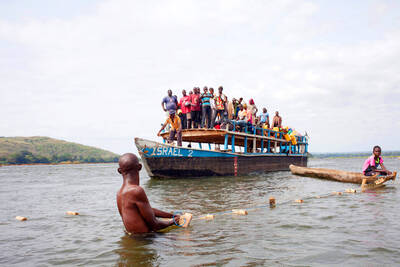
RIVER TRAGEDY: Local fishers and residents helped rescue people after the vessel capsized, while motorbike taxis evacuated some of the injured At least 58 people going to a funeral died after their overloaded river boat capsized in the Central African Republic’s (CAR) capital, Bangui, the head of civil protection said on Saturday. “We were able to extract 58 lifeless bodies,” Thomas Djimasse told Radio Guira. “We don’t know the total number of people who are underwater. According to witnesses and videos on social media, the wooden boat was carrying more than 300 people — some standing and others perched on wooden structures — when it sank on the Mpoko River on Friday. The vessel was heading to the funeral of a village chief in


 RSS
RSS