


Angry Indian Muslim leaders claim their community is the target of a witch hunt by police investigating the Mumbai train bombings last week which killed 183 people and wounded 800.
They say Muslims are being targeted by authorities, who have rounded up hundreds of people for questioning from different parts of the country, although police deny Muslims are being singled out.
The crackdown follows investigators saying the attacks bore the hallmarks of Lashkar-e-Taiba, an Islamic militant group fighting Indian rule in Kashmir.
The group is being scrutinized along with a banned Mumbai-based organization called the Students Islamic Movement of India.
And some within India's intelligence community reportedly suspect the blasts to be the handiwork of Muslims wanting revenge for sectarian riots in western Gujarat State in 2002, in which some 2,000 members of their community were killed.
Police said on Friday that they had arrested three people as part of the inquiry, the first since the July 11 blasts, but raids in Muslim-dominated areas continue.
The apparent close scrutiny Muslims are coming under has not gone unnoticed by leaders of India's 135 million to 140 million strong Islamic community.
"Of course this is a deliberate targeting of Muslims," said Imam Syed Ahmed Bukhari, the chief cleric of India's largest and most famous mosque -- the Jama Masjid in New Delhi.
Bukhari's views are echoed by Rahat Mehmood Choudhury, a Muslim leader from India's most populous state of Uttar Pradesh.
"The investigating agencies are not being fair. There is [still] no evidence to suggest who carried out the blasts. But Muslims are being detained for questioning," he said.
In Maharashtra, of which Mumbai is the capital, the police have rounded up hundreds of suspects but freed most after questioning to try to prevent further attacks and tensions in a city with a history of communal clashes.
Anees Durrani, a former member of India's Haj Committee, said the Maharashtra police are "very biased against Muslims."
"You can see that very plainly by the way the investigations are proceeding. Leaders of Indian Muslims have condemned the Mumbai blasts and others before July 11. No one knows who carried out the blasts but the needle of suspicion is always pointed towards us," he said.
In the northeastern state of Assam, police this week arrested six Muslims on suspicion of having links with groups planning attacks in the state.
But they were also being investigated for possible involvement in the Mumbai blasts, police spokesman Rajen Singh said.
In neighboring Tripura State, 39 people were detained for questioning including 11 from Maharashtra who said they were in Tripura on a mission to preach Islam. The 11 were interrogated for a week by special anti-terrorist officers and released after the Tripura government confirmed they were "genuine preachers" and "not involved in unlawful activities."
The other 28 have also been released but remain under surveillance.
In the Andaman Islands, police this week rounded up 20 supposed Bangladeshi nationals and were questioning them for possible links with the Mumbai blasts, Jaspal Singh, superintendent of police in the Andamans, said.
Mumbai's joint commissioner of police Arup Patnaik said complaints of discrimination were not new to the force after a series of bombings in 1993 that left more than 250 dead was blamed on a nexus of underworld figures and Islamic militants.
He said round-up operations were continuing after the Mumbai train blasts alongside the main probe but were not specifically targeting Muslims.
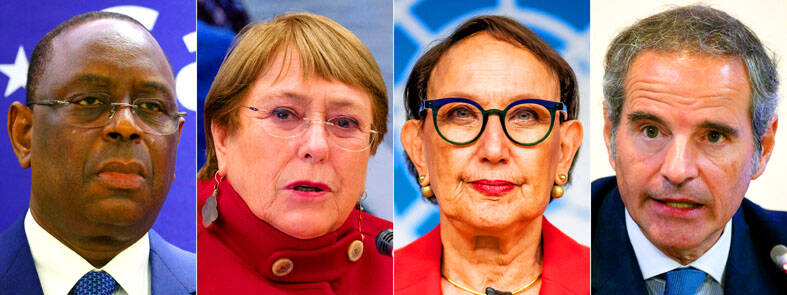
Four contenders are squaring up to succeed Antonio Guterres as secretary-general of the UN, which faces unprecedented global instability, wars and its own crushing budget crisis. Chile’s Michelle Bachelet, Argentina’s Rafael Grossi, Costa Rica’s Rebeca Grynspan and Senegal’s Macky Sall are each to face grillings by 193 member states and non-governmental organizations for three hours today and tomorrow. It is only the second time the UN has held a public question-and-answer, a format created in 2016 to boost transparency. Ultimately the five permanent members of the UN’s top body, the Security Council, hold the power, wielding vetoes over who leads the
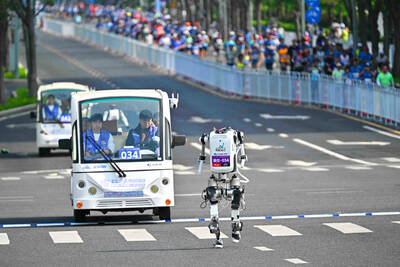
A humanoid robot that won a half-marathon race for robots in Beijing on Sunday ran faster than the human world record in a show of China’s technological leaps. The winner from Honor, a Chinese smartphone maker, completed the 21km race in 50 minutes and 26 seconds, said a WeChat post by the Beijing Economic-Technological Development Area, also known as Beijing E-Town, where the race began. That was faster than the human world record holder, Ugandan Jacob Kiplimo, who finished the same distance in about 57 minutes in March at the Lisbon road race. The performance by the robot marked a significant step forward

An earthquake registering a preliminary magnitude of 7.7 off northern Japan on Monday prompted a short-lived tsunami alert and the advisory of a higher risk of a possible mega-quake for coastal areas there. The Cabinet Office and the Japan Meteorological Agency said there was a 1% chance for a mega-quake, compared to a 0.1% chance during normal times, in the next week or so following the powerful quake near the Chishima and Japan trenches. Officials said the advisory was not a quake prediction but urged residents in 182 towns along the northeastern coasts to raise their preparedness while continuing their daily lives. Prime
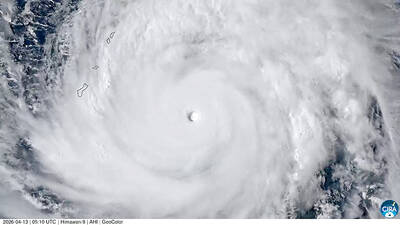
HAZARDOUS CONDITION: The typhoon’s sheer size, with winds extending 443km from its center, slowed down the ability of responders to help communities, an official said The US Coast Guard was searching for six people after losing contact with their disabled boat off the coast of Guam following Typhoon Sinlaku. The crew of the 44m dry cargo vessel, the US-registered Mariana, on Wednesday notified the coast guard that the boat had lost its starboard engine and needed assistance, Petty Officer 3rd Class Avery Tibbets said yesterday. The coast guard set up a one-hour communication schedule with the vessel, but lost contact on Thursday. A Coast Guard HC-130 Hercules aircraft was launched to search for the six people on board, but it had to return to Guam because of


 RSS
RSS