


Tens of thousands of workers rallied in cities across Australia yesterday, demanding Prime Minister John Howard's conservative government repeal its controversial new labor laws.
"Johnny, Johnny, Johnny, out, out, out," chanted protesters, as they brought the southern city of Melbourne to a standstill.
In Sydney, firemen, health workers and teachers were among demonstrators marching against the laws, which strip power from trade unions in favour of individual workplace contracts.

PHOTO: AFP
"Less talk, more strike," read one banner held high above the crowd.
The legislation, which came into force three months ago, has become a defining political issue in Australia ahead of next year's national election.
Howard warned yesterday that unions were holding a "dagger at the throat" of Australia's booming resources sector and suggested that scrapping the laws would see a surge of industrial action.
He insists the laws will strengthen the national economy.
But opposition Labor party leader Kim Beazley, who has struggled to find traction with voters, vowed to scrap the legislation if his party wins office in 18 months' time, saying the laws erode job security and wages.
"This is a battle for ordinary Australian life. This is a battle for Australian families," Beazley told a crowd of workers in Melbourne.
Police estimated that 80,000 people rallied in Melbourne and some 30,000 marched in western Sydney. Several thousand people also protested in smaller towns and cities throughout the country.
Howard, who has been in power for a decade, has long argued that collective bargaining by powerful unions has strangled productivity.
The same argument was championed by former British prime minister Margaret Thatcher, who set out to break Britain's trade union movement in the 1980s.
Howard's previous attempts at reform were blocked by the Senate.
But he successfully pushed the legislation through last year when his ruling Liberal-National coalition took control of both houses of parliament -- making him the most powerful Australian leader in a generation.
During a trade trip to China yesterday, Howard warned against repealing the laws.
"Labor and the unions' industrial relations changes are a dagger at the throat of the successful resource sector in this country," he told reporters.
Critics of the laws, however, say they reduce rights to holidays, rest breaks, bonuses and allowances as well as eroding job security and wages.
Since the laws came into force, the Australian media has been awash with stories about workers sacked and re-hired on individual contracts on lower pay.
Addressing the rally in Sydney, union leader John Robertson said the legislation stripped away 100 years of workers' rights.
"These laws are direct attacks on hard-working Australians who are trying to pay off a home, provide for their kids' futures and have a bit of economic security," said Robertson, who is secretary of Unions New South Wales.
The Australian Chamber of Commerce and Industry, which supports the legislation, said unions had mustered only 10 percent of their members for the protests.
"There's no doubt that we've got the mother of all scare campaigns going on," said chief executive Peter Hendy.
Australian unions have already lost much of the power they once had, with only one in four full-time employees in a union.

‘IN A DIFFERENT PLACE’: The envoy first visited Shanghai, where he attended a Chinese basketball playoff match, and is to meet top officials in Beijing tomorrow US Secretary of State Antony Blinken yesterday arrived in China on his second visit in a year as the US ramps up pressure on its rival over its support for Russia while also seeking to manage tensions with Beijing. The US diplomat tomorrow is to meet China’s top brass in Beijing, where he is also expected to plead for restraint as Taiwan inaugurates president-elect William Lai (賴清德), and to raise US concerns on Chinese trade practices. However, Blinken is also seeking to stabilize ties, with tensions between the world’s two largest economies easing since his previous visit in June last year. At the
Nearly half of China’s major cities are suffering “moderate to severe” levels of subsidence, putting millions of people at risk of flooding, especially as sea levels rise, according to a study of nationwide satellite data released yesterday. The authors of the paper, published by the journal Science, found that 45 percent of China’s urban land was sinking faster than 3mm per year, with 16 percent at more than 10mm per year, driven not only by declining water tables, but also the sheer weight of the built environment. With China’s urban population already in excess of 900 million people, “even a small portion

UNSETTLING IMAGES: The scene took place in front of TV crews covering the Trump trial, with a CNN anchor calling it an ‘emotional and unbelievably disturbing moment’ A man who doused himself in an accelerant and set himself on fire outside the courthouse where former US president Donald Trump is on trial has died, police said yesterday. The New York City Police Department (NYPD) said the man was declared dead by staff at an area hospital. The man was in Collect Pond Park at about 1:30pm on Friday when he took out pamphlets espousing conspiracy theories, tossed them around, then doused himself in an accelerant and set himself on fire, officials and witnesses said. A large number of police officers were nearby when it happened. Some officers and bystanders rushed
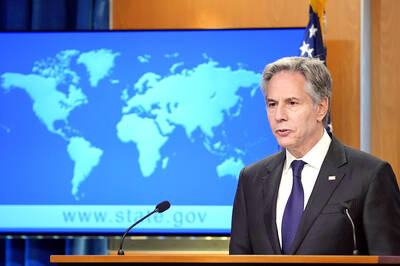
Beijing is continuing to commit genocide and crimes against humanity against Uyghurs and other Muslim minorities in its western Xinjiang province, U.S. Secretary of State Antony Blinken said in a report published on Monday, ahead of his planned visit to China this week. The State Department’s annual human rights report, which documents abuses recorded all over the world during the previous calendar year, repeated language from previous years on the treatment of Muslims in Xinjiang, but the publication raises the issue ahead of delicate talks, including on the war in Ukraine and global trade, between the top U.S. diplomat and Chinese


 RSS
RSS