


The car slid to a stop on a sun-baked road, drawing the attention of wary soldiers squinting through sand blown by a hot wind. Nearby, someone started running and soldiers started shooting.
In seconds, a woman was screaming her boy had been shot and a crowd of villagers surged forward as troops tried to clear an area for their medic to work. A soldier shoved a woman with his M4 carbine. More shots. Another civilian went down. Local police began arguing with US troops.
Things had gotten very bad, very fast -- just the way the Army wanted it.
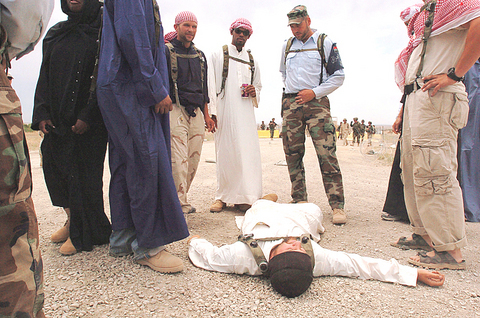
PHOTO: AP
Thousands of soldiers have just spent 16 days on the dusty plains of southeastern Colorado, thrust into situations their commanders designed to resemble what they will face in Iraq, complete with mock villages, mock villagers and real, itchy-trigger-finger tension. The hope is that the troops at the Pinon Canyon training site learn how to make the right decisions and not end up dead or defending themselves against accusations like those surrounding the Marines stationed in Haditha last fall.
The soldiers repeatedly heard the importance of staying calm.
"Don't start lazin' and blazin'," Sergeant Shawn Farnsworth barked to his troops before a night raid. "Know what you're shooting at. Do not be rough with the people in the town!"
Lieutenant Stuart Smothers, commanding 39 veterans back from Iraq, said his team learned in the real world how civilians in Iraq react to US troops. Back in the States, Smothers and other veterans become trainers, sharing tips with the next wave of troops.
Smothers said he and other trainers tell the troops that in Iraq, upsetting the acting mayor or cleric can cost the lives of the troops who replace them.
That, Smothers said, is how it is in this new kind of war. Everyone pays for mistakes.
"This is no longer the old Army where you see a bad guy, you automatically shoot them," said Command Sergeant Major Terrance McWilliams, a 30-year veteran. "You're trying to maintain the calm with the villagers and at the same time weed out the insurgents."
It is training that has had to evolve since US troops arrived in Iraq three years ago. Army warfare is changing from full-on frontal assaults to dodging roadside bombs and finding shadowy insurgents in cramped, confusing Iraqi cities.
"We were prepared for the Cold War and what we thought that was going to be," said Lieutenant Colonel Richard Harms, who helps training bases comply with the new goals of the Army's Combat Training Center Directorate. "When the Cold War was over, we looked around and said, `Who are we going to fight next?' It took us a couple of shots to the gut to kind of figure that out."
For this war, veterans of Iraq say, training includes learning how to tell when something's just not right.
"If there's kids around, that's probably a good sign," said Smothers, who returned from Iraq this year. He said even insurgents seem to avoid killing their neighbors' children.
Harms said he needs fighters, but he also needs soldiers who can learn how to act as negotiator, counselor and project manager, all while keeping a cool head.
Back at the dirt road, McWilliams and his trainers tried to sort out why the sudden appearance of that silver car caused so much chaos.
The "boy" who was shot -- a solider playing the role of a mentally retarded child who panicked -- had nothing to do with the car. But when he ran, a soldier instinctively fired his rifle, equipped with blanks.
In the investigation there were allegations that soldiers planted a weapon next to the boy. Other soldiers complained that trainers had stashed guns in a mock mosque.
It was only a drill, but in the real world, a mistake like that could be a disaster.
"Something that small can have a devastating effect," McWilliams said. "The troops here understand it."
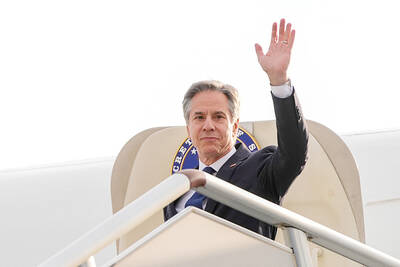
‘IN A DIFFERENT PLACE’: The envoy first visited Shanghai, where he attended a Chinese basketball playoff match, and is to meet top officials in Beijing tomorrow US Secretary of State Antony Blinken yesterday arrived in China on his second visit in a year as the US ramps up pressure on its rival over its support for Russia while also seeking to manage tensions with Beijing. The US diplomat tomorrow is to meet China’s top brass in Beijing, where he is also expected to plead for restraint as Taiwan inaugurates president-elect William Lai (賴清德), and to raise US concerns on Chinese trade practices. However, Blinken is also seeking to stabilize ties, with tensions between the world’s two largest economies easing since his previous visit in June last year. At the
Nearly half of China’s major cities are suffering “moderate to severe” levels of subsidence, putting millions of people at risk of flooding, especially as sea levels rise, according to a study of nationwide satellite data released yesterday. The authors of the paper, published by the journal Science, found that 45 percent of China’s urban land was sinking faster than 3mm per year, with 16 percent at more than 10mm per year, driven not only by declining water tables, but also the sheer weight of the built environment. With China’s urban population already in excess of 900 million people, “even a small portion

UNSETTLING IMAGES: The scene took place in front of TV crews covering the Trump trial, with a CNN anchor calling it an ‘emotional and unbelievably disturbing moment’ A man who doused himself in an accelerant and set himself on fire outside the courthouse where former US president Donald Trump is on trial has died, police said yesterday. The New York City Police Department (NYPD) said the man was declared dead by staff at an area hospital. The man was in Collect Pond Park at about 1:30pm on Friday when he took out pamphlets espousing conspiracy theories, tossed them around, then doused himself in an accelerant and set himself on fire, officials and witnesses said. A large number of police officers were nearby when it happened. Some officers and bystanders rushed
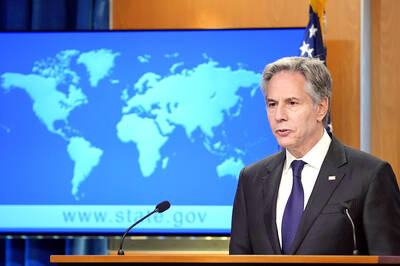
Beijing is continuing to commit genocide and crimes against humanity against Uyghurs and other Muslim minorities in its western Xinjiang province, U.S. Secretary of State Antony Blinken said in a report published on Monday, ahead of his planned visit to China this week. The State Department’s annual human rights report, which documents abuses recorded all over the world during the previous calendar year, repeated language from previous years on the treatment of Muslims in Xinjiang, but the publication raises the issue ahead of delicate talks, including on the war in Ukraine and global trade, between the top U.S. diplomat and Chinese


 RSS
RSS