


Chinese Premier Wen Jiabao (
Wen arrived back in China yesterday morning after concluding his whirlwind official visits to Egypt, Ghana, the Republic of Congo, Angola, South Africa, Tanzania and Uganda, the Xinhua news agency reported.
Wen's trip -- the third high-level Chinese diplomatic visit to Africa in less than six months -- follows visits earlier this year by Foreign Minister Li Zhaoxing (李肇星) and President Hu Jintao (胡錦濤), who clinched important oil exploration deals in several states.
The tour to the world's poorest continent has aroused concern that Beijing's diplomatic offensive was aimed at countering the US and sparked criticism that China's hunt for natural resources was in disregard of human rights.
Wen rejected those criticisms and stressed that China followed a policy of non-interference in other countries' affairs.
Instead, he talked optimistically of a new strategic partnership with Africa which would enhance political equality and mutual trust as well as promoting economic and political ties.
"The Chinese government, guided by the principle of sincerity, friendship, equality, mutual benefit and common development, is committed to building a new type of strategic partnership with Africa," Wen said in South Africa.
Trade between China and Africa reached around US$40 billion last year, a rise of 35 percent from a year earlier and almost four times higher than in 2001.
In addition, China has given US$5.5 billion in assistance to Africa, sent 16,000 health workers to 43 different countries on the continent and reduced or cancelled the debt of 31 nations over the past 50 years.
It has also promised steps to expand economic and trade ties and help Africa by offering zero-tariff treatment for some exports and increased aid and debt relief, while at the same time helping to build infrastructure.
In Wen's last stop, Uganda, agreements signed include economic and technical cooperation, energy and infrastructure, mining, textiles, oil exploration and tourism.
In South Africa, the two sides signed agreements to restrict the importation of Chinese textiles to protect local industries, as well as boost peaceful nuclear cooperation and a major deal with the country's petroleum giant to explore the possibility of turning coal into oil.
China's growing thirst for oil also saw the country enter a joint venture early this year with Angola, Wen's third stop during the tour, which has since become China's top crude oil source, surpassing Saudi Arabia.
In exchange, Beijing is funding the construction of a railroad linking the west coast city of Benguela to the mineral-rich area on Angola's eastern border with the Democratic Republic of Congo among other projects.
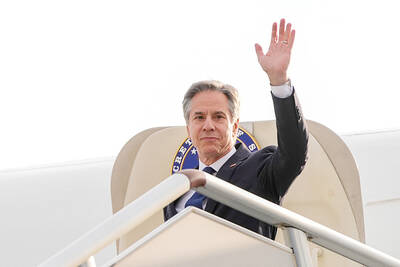
‘IN A DIFFERENT PLACE’: The envoy first visited Shanghai, where he attended a Chinese basketball playoff match, and is to meet top officials in Beijing tomorrow US Secretary of State Antony Blinken yesterday arrived in China on his second visit in a year as the US ramps up pressure on its rival over its support for Russia while also seeking to manage tensions with Beijing. The US diplomat tomorrow is to meet China’s top brass in Beijing, where he is also expected to plead for restraint as Taiwan inaugurates president-elect William Lai (賴清德), and to raise US concerns on Chinese trade practices. However, Blinken is also seeking to stabilize ties, with tensions between the world’s two largest economies easing since his previous visit in June last year. At the
Nearly half of China’s major cities are suffering “moderate to severe” levels of subsidence, putting millions of people at risk of flooding, especially as sea levels rise, according to a study of nationwide satellite data released yesterday. The authors of the paper, published by the journal Science, found that 45 percent of China’s urban land was sinking faster than 3mm per year, with 16 percent at more than 10mm per year, driven not only by declining water tables, but also the sheer weight of the built environment. With China’s urban population already in excess of 900 million people, “even a small portion

UNSETTLING IMAGES: The scene took place in front of TV crews covering the Trump trial, with a CNN anchor calling it an ‘emotional and unbelievably disturbing moment’ A man who doused himself in an accelerant and set himself on fire outside the courthouse where former US president Donald Trump is on trial has died, police said yesterday. The New York City Police Department (NYPD) said the man was declared dead by staff at an area hospital. The man was in Collect Pond Park at about 1:30pm on Friday when he took out pamphlets espousing conspiracy theories, tossed them around, then doused himself in an accelerant and set himself on fire, officials and witnesses said. A large number of police officers were nearby when it happened. Some officers and bystanders rushed

Beijing is continuing to commit genocide and crimes against humanity against Uyghurs and other Muslim minorities in its western Xinjiang province, U.S. Secretary of State Antony Blinken said in a report published on Monday, ahead of his planned visit to China this week. The State Department’s annual human rights report, which documents abuses recorded all over the world during the previous calendar year, repeated language from previous years on the treatment of Muslims in Xinjiang, but the publication raises the issue ahead of delicate talks, including on the war in Ukraine and global trade, between the top U.S. diplomat and Chinese


 RSS
RSS