


North Korea hinted yesterday that it would halt any plans to test a long-range missile if the US agreed to direct talks, as a former South Korean president scrapped plans to visit the North.
Tensions in the region have soared following intelligence reports that North Korea has fueled a ballistic missile believed capable of reaching US territory. The US and Japan have said they could consider sanctions against the impoverished country if it goes ahead.
Yesterday, a spokesman for former South Korean President Kim Dae-jung cited the missile crisis as the reason for canceling a trip next week to the North that could have offered a rare chance for talks to soothe regional tensions.
North Korea said in comments published yesterday that its self-imposed moratorium on testing long-range missiles no longer applies because it's not in direct dialogue with Washington, suggesting it would hold off on any launch if Washington agreed to new talks.
"Some say our missile test launch is a violation of the moratorium, but this is not the case," Han Song-ryol, deputy chief of North Korea's mission to the UN, told Yonhap news agency in an interview from New York.
"North Korea as a sovereign state has the right to develop, deploy, test fire and export a missile," he said. "We are aware of the US concerns about our missile test-launch. So our position is that we should resolve the issue through negotiations."
Japan, which was shocked by a North Korean missile launch over its territory and into the sea in 1998, disputed the North's position on lifting the missile moratorium, arguing that the North committed itself to the ban in an accord with Tokyo in 2002.
"If the missile is launched, it is clear the act will violate the Japan-North Korea Pyongyang Declaration," Japan's Chief Cabinet Secretary Shinzo Abe said in Tokyo. "It will also breach promises with the international community."
Meanwhile, conditions for Kim Dae-jung's trip to North Korea have "become difficult," Jeong Se-hyun, a former minister of unification, told a Seoul news conference. Jeong said the trip would be possible only once the missile crisis is resolved.
South Korea's Kim met North Korea's Kim Jong-il in June 2000 in the first-and-only summit between leaders of the divided Koreas. The two Kims had been expected to meet again during the scheduled four-day visit.
The meeting had raised hopes of dialogue as concerns grow over intelligence reports that the North has fueled a Taepodong-2 missile with a firing range experts estimate could be up to 15,000km -- making it capable of reaching parts of the continental US.
North Korea imposed its own moratorium in 1999 amid friendlier relations with the US during the Clinton administration. During a 2002 summit with Japan, North Korean leader Kim Jong-il signed an agreement to extend the moratorium until at least 2003 -- and reaffirmed the launch ban at another summit in 2004.
It was not immediately clear whether North Korea would consider the stalled six-nation talks on its nuclear program, which include the US, as "dialogue" with Washington. The North has refused to return to nuclear talks since November, in anger over a US crackdown on the country's alleged illicit financial activity.
Pyongyang has consistently pressed for direct dialogue with the US, while Washington insists it will only speak to the North at the six-nation nuclear talks.
Australia, New Zealand and France have in recent days joined countries demanding that North Korea refrain from a missile launch.
UN Secretary-General Kofi Annan said the North should "listen to and hear what the world is saying. We are all worried."
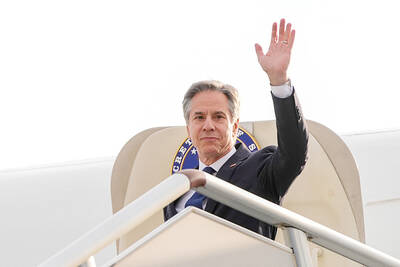
‘IN A DIFFERENT PLACE’: The envoy first visited Shanghai, where he attended a Chinese basketball playoff match, and is to meet top officials in Beijing tomorrow US Secretary of State Antony Blinken yesterday arrived in China on his second visit in a year as the US ramps up pressure on its rival over its support for Russia while also seeking to manage tensions with Beijing. The US diplomat tomorrow is to meet China’s top brass in Beijing, where he is also expected to plead for restraint as Taiwan inaugurates president-elect William Lai (賴清德), and to raise US concerns on Chinese trade practices. However, Blinken is also seeking to stabilize ties, with tensions between the world’s two largest economies easing since his previous visit in June last year. At the
Nearly half of China’s major cities are suffering “moderate to severe” levels of subsidence, putting millions of people at risk of flooding, especially as sea levels rise, according to a study of nationwide satellite data released yesterday. The authors of the paper, published by the journal Science, found that 45 percent of China’s urban land was sinking faster than 3mm per year, with 16 percent at more than 10mm per year, driven not only by declining water tables, but also the sheer weight of the built environment. With China’s urban population already in excess of 900 million people, “even a small portion

UNSETTLING IMAGES: The scene took place in front of TV crews covering the Trump trial, with a CNN anchor calling it an ‘emotional and unbelievably disturbing moment’ A man who doused himself in an accelerant and set himself on fire outside the courthouse where former US president Donald Trump is on trial has died, police said yesterday. The New York City Police Department (NYPD) said the man was declared dead by staff at an area hospital. The man was in Collect Pond Park at about 1:30pm on Friday when he took out pamphlets espousing conspiracy theories, tossed them around, then doused himself in an accelerant and set himself on fire, officials and witnesses said. A large number of police officers were nearby when it happened. Some officers and bystanders rushed

Beijing is continuing to commit genocide and crimes against humanity against Uyghurs and other Muslim minorities in its western Xinjiang province, U.S. Secretary of State Antony Blinken said in a report published on Monday, ahead of his planned visit to China this week. The State Department’s annual human rights report, which documents abuses recorded all over the world during the previous calendar year, repeated language from previous years on the treatment of Muslims in Xinjiang, but the publication raises the issue ahead of delicate talks, including on the war in Ukraine and global trade, between the top U.S. diplomat and Chinese


 RSS
RSS