


Tamil Tiger rebels attacked a Sri Lankan naval base yesterday, killing six sailors, while rapid retaliation from the navy and air force left up to 30 guerrilla fighters dead, further heightening fears of a return to full-scale civil war.
Separately, alert fishermen captured two suspected Tamil Tiger rebels on an apparent suicide mission yesterday near the Sri Lankan capital, Deputy Inspector General of Police, N.J. Illangakoon and a witness said.
The rebels' sea attack took place in the northwest district of Mannar, parts of which are under government control, and where the navy maintains several small bases. The rebels operate from jungles and the adjoining district of Mullaittivu, a rebel stronghold.
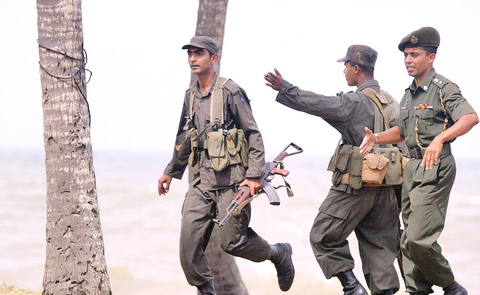
PHOTO: AP
At least six navy sailors and between 25-30 rebels were killed in the attack, navy spokesman D.L.P. Dassanayake said.
"We destroyed eight of the 11 boats that came for the attack," said Dassanayake, adding that each boat usually carries three to four rebel fighters.
Three of the navy's boats were also damaged, he said.
After the attack, the navy requested backup and an unspecified number of air force helicopters also engaged rebel boats, he said.
Meanwhile, pro-rebel Web site TamilNet called the incident a clash between the Sea Tigers, the naval wing of the rebels, and the navy. TamilNet said 30 civilians were wounded in the firing and hundreds of others have fled the area and taken shelter in churches.
The rebel attack came after Sri Lanka's military unleashed two days of retaliatory strikes on Thursday and Friday on rebel Tamil Tiger positions after a bus bombing killed 64 people.
The government blamed the Tigers for the bus attack, which killed 64 people, including over a dozen schoolchildren, and was the worst single act of violence since a 2002 ceasefire. The rebels denied they were involved and insisted the air and artillery strikes near a key rebel stronghold showed the military was on a war footing.
Separately, witness Paul Jayamaha said he heard two blasts coming from the sea off the coast near Ja-Ela, about 15km north of Colombo, when he went to buy fish nearby.
"Then I saw two men swimming toward the shore. They were caught by the fishermen," he said, adding that he also heard a second blast.
Both men swallowed cyanide capsules and were admitted to hospital where they are in critical condition, police officer Illangakoon said. Tamil Tiger rebels are known to carry cyanide capsules around their neck to prevent capture.
Police recovered oxygen bottles and underwater swimming equipment that washed on the shore, Jayamaha said.
The discovery of the equipment and the explosions suggested the men were on a suicide attack mission, Illangakoon said.
The rebels began fighting in the 1970s for a separate homeland in the north and the east, where most of the 3.2 million Hindu Tamils live, complaining of discrimination by the country's 14 million Singhalese, who are largely Buddhist.
The struggle intensified after anti-Tamil riots in 1983, and more than 65,000 people were killed before the ceasefire.
Peace talks to build on the truce quickly faltered, and sporadic shootings and bombings in and around Tiger strongholds have in the past four years built into near daily violence.

‘IN A DIFFERENT PLACE’: The envoy first visited Shanghai, where he attended a Chinese basketball playoff match, and is to meet top officials in Beijing tomorrow US Secretary of State Antony Blinken yesterday arrived in China on his second visit in a year as the US ramps up pressure on its rival over its support for Russia while also seeking to manage tensions with Beijing. The US diplomat tomorrow is to meet China’s top brass in Beijing, where he is also expected to plead for restraint as Taiwan inaugurates president-elect William Lai (賴清德), and to raise US concerns on Chinese trade practices. However, Blinken is also seeking to stabilize ties, with tensions between the world’s two largest economies easing since his previous visit in June last year. At the
Nearly half of China’s major cities are suffering “moderate to severe” levels of subsidence, putting millions of people at risk of flooding, especially as sea levels rise, according to a study of nationwide satellite data released yesterday. The authors of the paper, published by the journal Science, found that 45 percent of China’s urban land was sinking faster than 3mm per year, with 16 percent at more than 10mm per year, driven not only by declining water tables, but also the sheer weight of the built environment. With China’s urban population already in excess of 900 million people, “even a small portion

UNSETTLING IMAGES: The scene took place in front of TV crews covering the Trump trial, with a CNN anchor calling it an ‘emotional and unbelievably disturbing moment’ A man who doused himself in an accelerant and set himself on fire outside the courthouse where former US president Donald Trump is on trial has died, police said yesterday. The New York City Police Department (NYPD) said the man was declared dead by staff at an area hospital. The man was in Collect Pond Park at about 1:30pm on Friday when he took out pamphlets espousing conspiracy theories, tossed them around, then doused himself in an accelerant and set himself on fire, officials and witnesses said. A large number of police officers were nearby when it happened. Some officers and bystanders rushed

Beijing is continuing to commit genocide and crimes against humanity against Uyghurs and other Muslim minorities in its western Xinjiang province, U.S. Secretary of State Antony Blinken said in a report published on Monday, ahead of his planned visit to China this week. The State Department’s annual human rights report, which documents abuses recorded all over the world during the previous calendar year, repeated language from previous years on the treatment of Muslims in Xinjiang, but the publication raises the issue ahead of delicate talks, including on the war in Ukraine and global trade, between the top U.S. diplomat and Chinese


 RSS
RSS