


The UN-backed court probing war crimes in Darfur has documented thousands of civilian deaths, hundreds of alleged rapes and a "significant number" of massacres that killed hundreds of people in the western Sudanese province, the top prosecutor said on Wednesday.
Many witnesses and victims have reported that three ethnic groups in particular -- the Fur, Massalit and Zaghawa -- had been singled out for attack in Darfur, Luis Moreno Ocampo said in a report to the Security Council.
Those details are among the strongest indication so far that Moreno Ocampo, the chief prosecutor with the International Criminal Court (ICC), has uncovered substantial evidence of ethnic cleansing and crimes against humanity in Darfur.
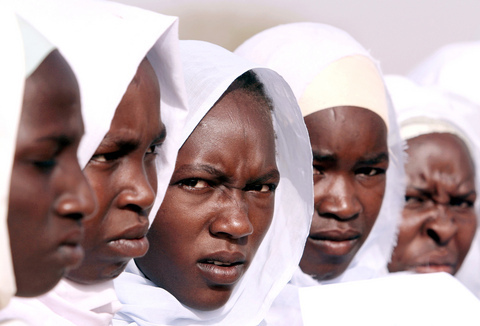
PHOTO: AP
"In most of the incidents ... there are eyewitness accounts that the perpetrators made statements reinforcing the targeted nature of the attacks, such as `we will kill all the black' and 'we will drive you out of this land,'" his report said.
A special UN investigative commission concluded in January 2005 that crimes against humanity had occurred in Darfur, where some 180,000 people have died and 2 million have been forced to flee their homes as a result of violence that erupted in 2003. Three months later, the Security Council charged the Hague-based ICC, the world's first permanent war crimes tribunal, with prosecuting those behind the slaughter.
The US has opposed the ICC but agreed to let the referral go forward. US Ambassador John Bolton, who in the past had strongly criticized the ICC, did not attend Moreno Ocampo's briefing because he was meeting with the UN Staff Union.
In his report to the council, Moreno Ocampo said his office had received reports of hundreds of rapes, but that it had evidence of significant under-reporting as well.
The three black tribes that Moreno Ocampo mentioned were among those that rebelled against what they regarded as unjust treatment by the Sudanese government in February 2003.
The government is accused of backing Arab militias known as Janjaweed in attacking villagers from those tribes in Darfur. The government denies supporting the Janjaweed but agreed under a May 5 peace agreement with the largest rebel group to disarm and disband the militias.
Moreno Ocampo also laid out his strategy for prosecuting the perpetrators, saying he would focus on several incidents of mass killings for detailed study and then bring forth cases for prosecution as each one is finished.
"My office currently anticipates the investigation and prosecution of a series of cases, rather than a single case dealing with the situation in Darfur as a whole," he said.
In addition, Sudan's national courts have shown little desire to investigate alleged crimes against humanity, despite Khartoum's claims that they would pursue those allegations. Sudan has repeatedly insisted that there is no need for Moreno Ocampo to get involved in Darfur.
One of Sudan's courts, for example, has held just six trials of fewer than 30 people -- and they were charged with robbery, possessing weapons without a license and receiving stolen goods. Only two faced allegations of murder and one of rape.
"The president of the special court has stated that no cases involving violations of international humanitarian law were ready for trial," Moreno Ocampo said.
Sudan's Ambassador to the UN, Elfatih Mohamed Ahmed Erwa insisted that his country's judicial system was bringing perpetrators of crimes in Darfur to justice.
"Special courts have been established which have issued many sentences in many specific crimes" with sentences ranging up to life imprisonment and execution, Erwa said.
Nonetheless, Moreno Ocampo said Sudan had cooperated by granting interview requests and allowing his team to visit southern Sudan. He also planned to send investigators to do more interviews in August.

‘IN A DIFFERENT PLACE’: The envoy first visited Shanghai, where he attended a Chinese basketball playoff match, and is to meet top officials in Beijing tomorrow US Secretary of State Antony Blinken yesterday arrived in China on his second visit in a year as the US ramps up pressure on its rival over its support for Russia while also seeking to manage tensions with Beijing. The US diplomat tomorrow is to meet China’s top brass in Beijing, where he is also expected to plead for restraint as Taiwan inaugurates president-elect William Lai (賴清德), and to raise US concerns on Chinese trade practices. However, Blinken is also seeking to stabilize ties, with tensions between the world’s two largest economies easing since his previous visit in June last year. At the

UNSETTLING IMAGES: The scene took place in front of TV crews covering the Trump trial, with a CNN anchor calling it an ‘emotional and unbelievably disturbing moment’ A man who doused himself in an accelerant and set himself on fire outside the courthouse where former US president Donald Trump is on trial has died, police said yesterday. The New York City Police Department (NYPD) said the man was declared dead by staff at an area hospital. The man was in Collect Pond Park at about 1:30pm on Friday when he took out pamphlets espousing conspiracy theories, tossed them around, then doused himself in an accelerant and set himself on fire, officials and witnesses said. A large number of police officers were nearby when it happened. Some officers and bystanders rushed

Beijing is continuing to commit genocide and crimes against humanity against Uyghurs and other Muslim minorities in its western Xinjiang province, U.S. Secretary of State Antony Blinken said in a report published on Monday, ahead of his planned visit to China this week. The State Department’s annual human rights report, which documents abuses recorded all over the world during the previous calendar year, repeated language from previous years on the treatment of Muslims in Xinjiang, but the publication raises the issue ahead of delicate talks, including on the war in Ukraine and global trade, between the top U.S. diplomat and Chinese
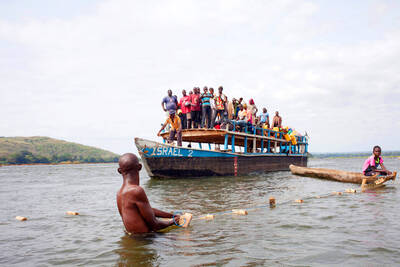
RIVER TRAGEDY: Local fishers and residents helped rescue people after the vessel capsized, while motorbike taxis evacuated some of the injured At least 58 people going to a funeral died after their overloaded river boat capsized in the Central African Republic’s (CAR) capital, Bangui, the head of civil protection said on Saturday. “We were able to extract 58 lifeless bodies,” Thomas Djimasse told Radio Guira. “We don’t know the total number of people who are underwater. According to witnesses and videos on social media, the wooden boat was carrying more than 300 people — some standing and others perched on wooden structures — when it sank on the Mpoko River on Friday. The vessel was heading to the funeral of a village chief in


 RSS
RSS