


Encouraged by the death of a top terrorist leader and a new government in Iraq, US President George W. Bush was gathering his top military and civilian war advisers yesterday to plan the US role in the country's future.
The president planned two days of meetings at the mountainous Camp David presidential retreat, with national security advisers on hand and top commanders in Iraq connected by videoconference.
White House officials have said announcements of force reductions are not expected. Yet the top US commander in Baghdad predicted on the eve of the meeting that coalition troops will gradually move out of the country in the coming months.
General George Casey said he thinks it will be possible to withdraw some of the 130,000 US forces in the months ahead as long as Iraq's government and security forces make progress.
Casey would not say whether he planned to advise Bush on a troop reduction plan yesterday. But the general hinted the time soon may come for such a recommendation.
"I was waiting until we got a government seated before I gave the president another recommendation so we have some sense of what we've got," Casey said on Sunday on CBS' Face the Nation.
Iraqi Prime Minister Nouri al-Maliki took office last month and appointed the key final ministers last week.
Bush has said the new government marks a new chapter in the US relationship with Iraq. With Republicans worried about losing control of Congress in November's midterm elections and most Americans saying they would like some troops to come home, Bush is under pressure. Only a third of respondents to a poll early this month supported Bush's handling of the situation -- an all-time low.
But he has been careful not to signal any troop reductions yet, continuing to say he will make those decisions when commanders in the field advise him to do so.
Casey said reductions could be coming soon, albeit slowly.
"I think as long as the Iraqi security forces continue to progress and as long as this national unity government continues to operate that way and move the country forward, I think we're going to be able to see continued gradual reductions of coalition forces over the coming months and into next year," Casey said.
Iraq's national security adviser said on Sunday that he believed the number of coalition forces would drop below 100,000 by year's end. Mouwafak al-Rubaie also said the majority of coalition forces would leave before mid-2008.
Bush announced the Camp David meetings last week, as he applauded US forces for conducting an airstrike that killed Abu Musab al-Zarqawi, the leader of al-Qaeda in Iraq.
The re-evaluation of the administration's Iraq policy was due to start with a long day of meetings for Bush, his national security team and the military commanders. It was due to continue with a luncheon attended by outside experts and dinner last night.
Today, the sessions are due to conclude with a joint meeting via videoconference with Bush's Cabinet and top ministers in al-Maliki's new government.
Among the most immediate concerns is how to buttress security operations in and around Baghdad. Some suggest that could involve short-term troop increases
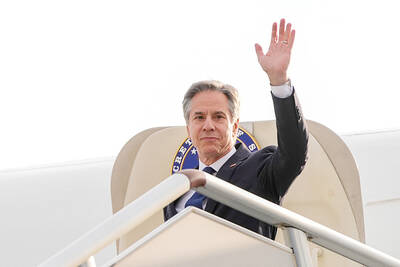
‘IN A DIFFERENT PLACE’: The envoy first visited Shanghai, where he attended a Chinese basketball playoff match, and is to meet top officials in Beijing tomorrow US Secretary of State Antony Blinken yesterday arrived in China on his second visit in a year as the US ramps up pressure on its rival over its support for Russia while also seeking to manage tensions with Beijing. The US diplomat tomorrow is to meet China’s top brass in Beijing, where he is also expected to plead for restraint as Taiwan inaugurates president-elect William Lai (賴清德), and to raise US concerns on Chinese trade practices. However, Blinken is also seeking to stabilize ties, with tensions between the world’s two largest economies easing since his previous visit in June last year. At the

UNSETTLING IMAGES: The scene took place in front of TV crews covering the Trump trial, with a CNN anchor calling it an ‘emotional and unbelievably disturbing moment’ A man who doused himself in an accelerant and set himself on fire outside the courthouse where former US president Donald Trump is on trial has died, police said yesterday. The New York City Police Department (NYPD) said the man was declared dead by staff at an area hospital. The man was in Collect Pond Park at about 1:30pm on Friday when he took out pamphlets espousing conspiracy theories, tossed them around, then doused himself in an accelerant and set himself on fire, officials and witnesses said. A large number of police officers were nearby when it happened. Some officers and bystanders rushed

Beijing is continuing to commit genocide and crimes against humanity against Uyghurs and other Muslim minorities in its western Xinjiang province, U.S. Secretary of State Antony Blinken said in a report published on Monday, ahead of his planned visit to China this week. The State Department’s annual human rights report, which documents abuses recorded all over the world during the previous calendar year, repeated language from previous years on the treatment of Muslims in Xinjiang, but the publication raises the issue ahead of delicate talks, including on the war in Ukraine and global trade, between the top U.S. diplomat and Chinese
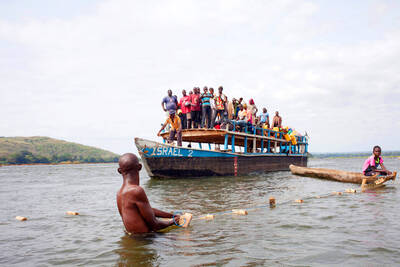
RIVER TRAGEDY: Local fishers and residents helped rescue people after the vessel capsized, while motorbike taxis evacuated some of the injured At least 58 people going to a funeral died after their overloaded river boat capsized in the Central African Republic’s (CAR) capital, Bangui, the head of civil protection said on Saturday. “We were able to extract 58 lifeless bodies,” Thomas Djimasse told Radio Guira. “We don’t know the total number of people who are underwater. According to witnesses and videos on social media, the wooden boat was carrying more than 300 people — some standing and others perched on wooden structures — when it sank on the Mpoko River on Friday. The vessel was heading to the funeral of a village chief in


 RSS
RSS