


Thousands of people will gather in a Hong Kong park today to light candles and sing solemn songs as they remember the bloody crackdown on the Tiananmen Square protests in Beijing 17 years ago.
It's an annual tradition, the only such public vigil allowed in China marking the anniversary of the June 4, 1989, killings. But in recent months, there's been a new twist in how the pro-democracy forces in Hong Kong deal with Tiananmen.
A new pro-democracy political group, the Civic Party, has been formed by several widely respected lawmakers who have decided not to mention Tiananmen in their party's mission statement.
In stark contrast, the bigger Democratic Party's platform condemns the "atrocity" and demands punishment for the officials who ordered the military crackdown.
Some have accused the Civic Party members of sacrificing their principles for the sake of better relations with communist rulers in Beijing. But the party's leaders argue they're just being practical and their revulsion and outrage about Tiananmen haven't changed.
"You don't have strong feelings about June 4 today, then lose those strong feelings when you join a political party," said Audrey Eu (
Hong Kongers can't directly elect their leader, who's chosen by an 800-member committee loyal to Beijing. And they can only elect half of the 60-seat legislature. The other half is picked by groups representing professional sectors.
Like other pro-democracy parties, the Civic Party's manifesto calls for full democracy. But it's silent about Tiananmen.
Political scientist James Sung (宋立功) at the City University of Hong Kong said the Civic Party isn't bringing up Tiananmen because it wants to avoid the problems the more-established Democratic Party is having with Beijing. Chinese leaders have blacklisted many of the Democratic Party's leaders partly because of their outspoken, long-standing positions on the crackdown.
"They [Civic Party] want to have a better relationship, so they think that if they can leave out this hot issue, they can have a good relationship with Beijing," he said.
Sung said the party hopes to get more support from business.
"Many of the business sector people don't think political parties should insist that the June 4 incident be reviewed, and the Civic Party wants to please the business sector," he said.
But Civic Party lawmaker Ronny Tong (湯家驊) said his group wasn't trying to curry favor with Beijing and big business. He said Tiananmen was left out of the manifesto because it was beyond the scope of the party's interests.
"We take the view that the Tiananmen incident is a matter that transcends the local boundary. It's a national matter," Tong said. "The Civic Party is a local party and concentrates on local matters."

Indonesia and Malaysia have become the first countries to block Grok, the artificial intelligence (AI) chatbot developed by Elon Musk’s xAI, after authorities said it was being misused to generate sexually explicit and nonconsensual images. The moves reflect growing global concern over generative AI tools that can produce realistic images, sound and text, while existing safeguards fail to prevent their abuse. The Grok chatbot, which is accessed through Musk’s social media platform X, has been criticized for generating manipulated images, including depictions of women in bikinis or sexually explicit poses, as well as images involving children. Regulators in the two Southeast Asian

Yemen’s separatist leader has vowed to keep working for an independent state in the country’s south, in his first social media post since he disappeared earlier this month after his group briefly seized swathes of territory. Aidarous al-Zubaidi’s United Arab Emirates (UAE)-backed Southern Transitional Council (STC) forces last month captured two Yemeni provinces in an offensive that was rolled back by Saudi strikes and Riyadh’s allied forces on the ground. Al-Zubaidi then disappeared after he failed to board a flight to Riyadh for talks earlier this month, with Saudi Arabia accusing him of fleeing to Abu Dhabi, while supporters insisted he was
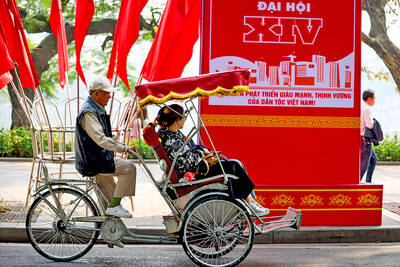
COMMUNIST ALIGNMENT: To Lam wants to combine party chief and state presidency roles, with the decision resting on the election of 200 new party delegates next week Communist Party of Vietnam General Secretary To Lam is seeking to combine his party role with the state presidency, officials said, in a move that would align Vietnam’s political structure more closely to China’s, where President Xi Jinping (習近平) heads the party and state. Next week about 1,600 delegates are to gather in Hanoi to commence a week-long communist party congress, held every five years to select new leaders and set policy goals for the single-party state. Lam, 68, bade for both top positions at a party meeting last month, seeking initial party approval ahead of the congress, three people briefed by

The Chinese Embassy in Manila yesterday said it has filed a diplomatic protest against a Philippine Coast Guard spokesman over a social media post that included cartoonish images of Chinese President Xi Jinping (習近平). Philippine Coast Guard spokesman Jay Tarriela and an embassy official had been trading barbs since last week over issues concerning the disputed South China Sea. The crucial waterway, which Beijing claims historic rights to despite an international ruling that its assertion has no legal basis, has been the site of repeated clashes between Chinese and Philippine vessels. Tarriela’s Facebook post on Wednesday included a photo of him giving a


 RSS
RSS