


Chinese fugitive Lai Changxing (賴昌星), the alleged boss of a multibillion-dollar smuggling ring who faces possible deportation today, will be spared execution if he is returned to China, a Canadian government lawyer said on Wednesday.
Beijing sent a diplomatic note on May 26 to Canadian officials saying it would honor previous assurances given to Ottawa that Lai "would not face the death penalty ... or be tortured" if repatriated, Esta Resnick, a government lawyer, told a federal court.
Lai has been fighting to stay in Canada since fleeing China in 1999 with his wife and their three children after China cracked down on what the state claimed was a smuggling ring.
In June 2000, the five family members lodged refugee claims in a bid to stay in Canada.
Lai's lawyer David Matas appealed to Canada's Federal Court on Wednesday to quash a deportation order because he said Lai would face persecution and certain death if he was sent home.
Canadian law prevents the deportation of people to face trial in countries where they could be executed.
Chinese authorities allege the former ditch digger with merely a grade six education was the mastermind behind a smuggling ring that imported up to US$10 billion in luxury goods and bribed government officials.
It is alleged he once drove along Chinese streets in a bulletproof Mercedes-Benz, an image that is hard to reconcile with Lai's small stature and apparent down-to-earth persona.
In his rare public appearances -- Lai lives under strict conditions imposed by the authorities that restrict his movements and is barred from visiting casinos -- he remains apparently unable to speak in English.
The Federal Court's judgment, expected yesterday, would likely be the last word in a six-year legal saga involving several human rights lawyers who questioned China's human rights record and cast doubt on its diplomatic promises.
If the court rules against Lai, Resnick said he could be deported as soon as Friday.
Matas said that Lai may yet appeal to the UN High Commissioner for Human Rights to intervene, but it is uncertain if that agency could act quickly enough to block any deportation.
Canadian foreign affairs department spokeswoman Pamela Green-well said it was "premature" to say if Ottawa would respect a possible opinion from the UN body in the case.
Prime Minister Stephen Harper has already indicated Lai's case is a criminal matter, not a political issue, and has refused to get involved.
In a number of hearings by immigration boards and courts, adjudicators and judges have ruled against Lai.
Resnick called him "a common criminal fugitive from justice" and warned that Canada could become a haven for fugitives if Lai won his bid to stay.
Matas alleged that Ottawa wanted to extradite Lai to thaw relations with Beijing, which had cooled over this case.
"We have concerns about relations with China superseding Mr. Lai's rights," he told the Federal Court.
China has repeatedly brought up Lai's presence in Canada even in economic and political discussions, but Resnick called the allegations: "grand hearsay, grand speculation."
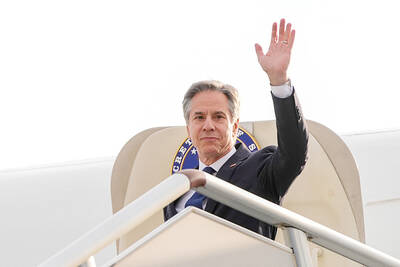
‘IN A DIFFERENT PLACE’: The envoy first visited Shanghai, where he attended a Chinese basketball playoff match, and is to meet top officials in Beijing tomorrow US Secretary of State Antony Blinken yesterday arrived in China on his second visit in a year as the US ramps up pressure on its rival over its support for Russia while also seeking to manage tensions with Beijing. The US diplomat tomorrow is to meet China’s top brass in Beijing, where he is also expected to plead for restraint as Taiwan inaugurates president-elect William Lai (賴清德), and to raise US concerns on Chinese trade practices. However, Blinken is also seeking to stabilize ties, with tensions between the world’s two largest economies easing since his previous visit in June last year. At the

UNSETTLING IMAGES: The scene took place in front of TV crews covering the Trump trial, with a CNN anchor calling it an ‘emotional and unbelievably disturbing moment’ A man who doused himself in an accelerant and set himself on fire outside the courthouse where former US president Donald Trump is on trial has died, police said yesterday. The New York City Police Department (NYPD) said the man was declared dead by staff at an area hospital. The man was in Collect Pond Park at about 1:30pm on Friday when he took out pamphlets espousing conspiracy theories, tossed them around, then doused himself in an accelerant and set himself on fire, officials and witnesses said. A large number of police officers were nearby when it happened. Some officers and bystanders rushed

Beijing is continuing to commit genocide and crimes against humanity against Uyghurs and other Muslim minorities in its western Xinjiang province, U.S. Secretary of State Antony Blinken said in a report published on Monday, ahead of his planned visit to China this week. The State Department’s annual human rights report, which documents abuses recorded all over the world during the previous calendar year, repeated language from previous years on the treatment of Muslims in Xinjiang, but the publication raises the issue ahead of delicate talks, including on the war in Ukraine and global trade, between the top U.S. diplomat and Chinese

RIVER TRAGEDY: Local fishers and residents helped rescue people after the vessel capsized, while motorbike taxis evacuated some of the injured At least 58 people going to a funeral died after their overloaded river boat capsized in the Central African Republic’s (CAR) capital, Bangui, the head of civil protection said on Saturday. “We were able to extract 58 lifeless bodies,” Thomas Djimasse told Radio Guira. “We don’t know the total number of people who are underwater. According to witnesses and videos on social media, the wooden boat was carrying more than 300 people — some standing and others perched on wooden structures — when it sank on the Mpoko River on Friday. The vessel was heading to the funeral of a village chief in


 RSS
RSS