


One of Indonesia's most famous tourist attractions, the Prambanan Hindu temple complex, is likely to be closed for months after being badly damaged in the earthquake, a conservation expert predicted.
It is unclear what impact the earthquake will have on the tourism industry in a region that was considered to be Indonesia's second most popular destination after Bali.
Prambanan, which was built between the eighth and 10th centuries and is dedicated to the Hindu god Shiva, lies 16km east of Yogyakarta.
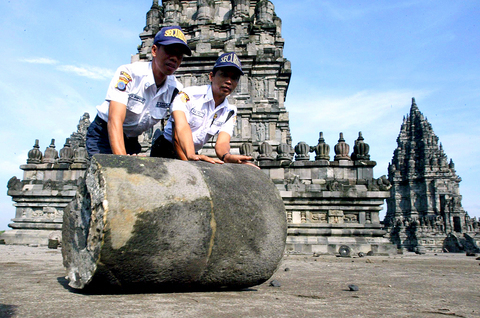
PHOTO: EPA
On Sunday large chunks of the temple could be seen scattered on the ground around its eight shrines.
Agus Waluyo, the head of the Yogyakarta Archaeological Conservation Agency, said the damage was significant.
"It will take months to identify the precise damage," he said.
He said the UN world heritage site would remain closed during this assessment process.
The region's other great religious monument, the massive Buddhist Borobudur stupa built between 750 and 850, was not damaged because it is 24km northwest of Yogyakarta, well outside the affected area.
Thamrin Bachri, Indonesia's deputy tourism minister, said a recovery strategy was being planned.
"Of course we're expecting a drop in arrivals in the short term because they do not yet consider Yogyakarta safe," he said.
"We are already preparing a communication and promotion strategy to explain to overseas markets that they should not cross the area off their lists," he said. "From an image perspective we expect to rehabilitate Yogyakarta in six months."
But last night, hoteliers were pessimistic about the next few months.
"Hopefully we'll see an increase in domestic arrivals in sympathy for the people's plight here but I expect foreigners to stay away," said one hotel general manager who asked not to be named.

An American scientist convicted of lying to US authorities about payments from China while he was at Harvard University has rebuilt his research lab in Shenzhen, China, to pursue technology the Chinese government has identified as a national priority: embedding electronics into the human brain. Charles Lieber, 67, is among the world’s leading researchers in brain-computer interfaces. The technology has shown promise in treating conditions such as amyotrophic lateral sclerosis and restoring movement in paralyzed people. It also has potential military applications: Scientists at the Chinese People’s Liberation Army have investigated brain interfaces as a way to engineer super soldiers by boosting

Indonesian police have arrested 13 people after shocking images of alleged abuse against small children at a daycare center went viral, sparking outrage across the nation, officials said on Monday. Police on Friday last week raided Little Aresha, a daycare center in Yogyakarta on Java island, following a report from a former employee. CCTV footage circulating on social media showed children, most younger than two, lying on the floor wearing only diapers, their hands and feet bound with rags. The police have confirmed that the footage is authentic. Police said they also found 20 children crammed into a room just 3m by 3m. “So

Jailed media entrepreneur Jimmy Lai (黎智英) has been awarded Deutsche Welle’s (DW) freedom of speech award for his contribution to Hong Kong’s pro-democracy movement. The German public broadcaster on Thursday said Lai would be presented in absentia with the 12th iteration of the award on June 23 at the DW Global Media Forum in Bonn. Deutsche Welle director-general Barbara Massing praised the 78-year-old founder of the now-shuttered news outlet Apple Daily for standing “unwaveringly for press freedom in Hong Kong at great personal risk.” “With Apple Daily, he gave journalists a platform for free reporting and a voice to the democracy movement in

PHILIPPINE COMMITTEE: The head of the committee that made the decision said: ‘If there is nothing to hide, there is no reason to hide, there is no reason to obstruct’ A Philippine congressional committee on Wednesday ruled that there was “probable cause” to impeach Philippine Vice President Sara Duterte after hearing allegations of unexplained wealth, misuse of state funds and threats to have the president assassinated. The unanimous decision of the 53-member committee in the Philippine House of Representatives sends the two impeachment complaints to deliberations and voting by the entire lower chamber, which has more than 300 lawmakers. The complaints centered on Duterte’s alleged illegal use and mishandling of intelligence funds from the vice president’s office, and from her time as education secretary under Philippine President Ferdinand Marcos Jr. Duterte and the


 RSS
RSS