


Former Red Guard Lu Li'an (魯禮安) was serving his eighth year in prison when he swore to someday again take up the pen that led to his incarceration on "counter-revolutionary" charges during China's tumultuous Cultural Revolution.
"After a vicious beating that day, it was snowing heavily at night and I kneeled and screamed out to the sky and swore that if there was a day that I had an opportunity to be free and use a pen, I would write about my experience," Lu, 60, told reporters.
"I swore to use my pen to forever nail to the cross of shame those who destroyed me," he said.
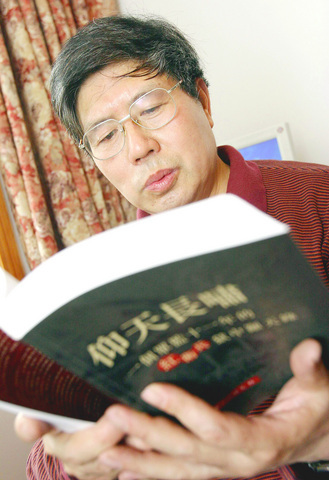
PHOTO: AFP
Lu, now a fit man whose apparent health belies the 11 years he served in solitary confinement, fulfilled his vow last year by publishing in Hong Kong a voluminous personal account of his participation in the Cultural Revolution.
The book: Outcry from a Red Guard Imprisoned during the Cultural Revolution, tells of how Lu and a nation blinded by cult-like adulation for Mao Zedong (毛澤東) allowed the horrors of the events from 1966 to 1976 occur.
Widely seen as China's most shameful and destructive period since the Chinese Communist Party swept to power in 1949, the Cultural Revolution was a mass movement Mao engineered to challenge his political rivals.
It was to unravel into a disaster which claimed millions of lives and pushed China to the brink of economic and social collapse.
As a fervent supporter of Mao and communism, Lu, then a marine engineering freshman in university in Wuhan in Hubei Province, embraced the campaign.
"It was not a choice about whether or not to become a Red Guard -- everyone wanted to become a Red Guard," Lu said.
With the acquiescence of Mao, students and later workers, farmers and professional soldiers formed bands of Red Guards, whose objective was to punish those identified as belonging to the old political, cultural and intellectual guard.
"The Red Guard's were like God's army, they were Chairman Mao's soldiers," Lu said of the millions who joined the movement.
The Red Guards harassed, tortured and killed countless people, mainly in the first few years of the revolution before Mao finally brought them under control.
Lu estimated that in Hubei alone, 30,000 were killed, among them ordinary citizens beaten merely for their perceived disloyalty to the party as well as intra-factional fighting.
"The streets were raucous with marches and groups fighting, just like small battles -- it was really violent and intense," said Lu of the initial period when he was so supportive that he tried to acquire weapons for his classmates.
Lu said he never took part in the fighting, preferring instead to incite classmates to armed-struggle in his writings of "big-character posters" and publicly posted articles.
But his loyalty to the Mao and revolution began to fade after about a year when Lu realized that people were dying for no reason.
Among them he counted eight schoolmates and two teachers, whom, unable to stand the abuse, committed suicide -- one by slicing her belly open.
"I witnessed a father crying over his dead child after a street fight and I thought: `Aren't we suppose to be like a family, why are we killing each other under Mao's flag?,'" Lu said.
Lu soon founded a magazine called Yangtze Review, which criticized many of the worst excesses of the Red Guards and Mao. It was not long before authorities took action.
Lu was taken away and thrown down a mining well, where guards trying to force him to recant his criticism of Mao, beat him with metal pipes. He refused and two months later -- in July 1968 -- his 11-year stint in jail began.
That Lu even survived to write his book is a twist of fate nearly as irrational as how the movement plunged an entire nation into its campaign of violence, brutality and paranoia.
In 1977 -- after a decade in prison -- Lu was suddenly exonerated when just one day away from a final hearing that would have sealed his execution.
"The central government sent down a notice saying the case could not proceed," Lu said.
Lu said he did not feel regret when he reflects on his role as a Red Guard.
"I just feel ashamed. I should have been able to see the real purpose of the Cultural Revolution," he said.

‘IN A DIFFERENT PLACE’: The envoy first visited Shanghai, where he attended a Chinese basketball playoff match, and is to meet top officials in Beijing tomorrow US Secretary of State Antony Blinken yesterday arrived in China on his second visit in a year as the US ramps up pressure on its rival over its support for Russia while also seeking to manage tensions with Beijing. The US diplomat tomorrow is to meet China’s top brass in Beijing, where he is also expected to plead for restraint as Taiwan inaugurates president-elect William Lai (賴清德), and to raise US concerns on Chinese trade practices. However, Blinken is also seeking to stabilize ties, with tensions between the world’s two largest economies easing since his previous visit in June last year. At the

UNSETTLING IMAGES: The scene took place in front of TV crews covering the Trump trial, with a CNN anchor calling it an ‘emotional and unbelievably disturbing moment’ A man who doused himself in an accelerant and set himself on fire outside the courthouse where former US president Donald Trump is on trial has died, police said yesterday. The New York City Police Department (NYPD) said the man was declared dead by staff at an area hospital. The man was in Collect Pond Park at about 1:30pm on Friday when he took out pamphlets espousing conspiracy theories, tossed them around, then doused himself in an accelerant and set himself on fire, officials and witnesses said. A large number of police officers were nearby when it happened. Some officers and bystanders rushed

Beijing is continuing to commit genocide and crimes against humanity against Uyghurs and other Muslim minorities in its western Xinjiang province, U.S. Secretary of State Antony Blinken said in a report published on Monday, ahead of his planned visit to China this week. The State Department’s annual human rights report, which documents abuses recorded all over the world during the previous calendar year, repeated language from previous years on the treatment of Muslims in Xinjiang, but the publication raises the issue ahead of delicate talks, including on the war in Ukraine and global trade, between the top U.S. diplomat and Chinese

RIVER TRAGEDY: Local fishers and residents helped rescue people after the vessel capsized, while motorbike taxis evacuated some of the injured At least 58 people going to a funeral died after their overloaded river boat capsized in the Central African Republic’s (CAR) capital, Bangui, the head of civil protection said on Saturday. “We were able to extract 58 lifeless bodies,” Thomas Djimasse told Radio Guira. “We don’t know the total number of people who are underwater. According to witnesses and videos on social media, the wooden boat was carrying more than 300 people — some standing and others perched on wooden structures — when it sank on the Mpoko River on Friday. The vessel was heading to the funeral of a village chief in


 RSS
RSS