


An armed confrontation between two Iraqi army units left one soldier and one civilian dead, raising questions about the US-trained force's ability to maintain control at a time when sectarian and ethnic tensions are running high.
The incident on Friday near Duluiyah, about 70km north of Baghdad, illustrates the command and control problems facing the new Iraqi army, which the US hopes can take over security in most of the country by the end of the year. It also shows that divisions within the military mirror those of Iraqi society at large.
The trouble started when a roadside bomb struck an Iraqi army convoy, which police said was made up of Kurdish soldiers. Four soldiers were killed and three were wounded, police said. US military officials put the casualty figure at one dead and 12 wounded.
The wounded were rushed to the civilian Balad Hospital. Police said that as the Kurdish soldiers drove to the hospital, they fired weapons to clear the way, and one Iraqi Shiite civilian was killed.
Shiite soldiers from another Iraqi unit based in Balad rushed to the scene, and the Kurds decided to take their wounded elsewhere, Iraqi police said. Iraqi troops tried to stop them and shots were fired, killing one Shiite soldier, Iraqi police said.
The US account said an Iraqi soldier from the 3rd Battalion, 1st Brigade was killed in a "confrontation" as the other Iraqi troops were trying to remove their wounded from the hospital.
A third Iraqi army unit set up a roadblock in the area and stopped the soldiers who were leaving with their wounded, the US statement said. US troops intervened at the roadblock and calmed the situation.
The US said the Iraqi army was investigating the incident.
Thousands of Kurdish militiamen were integrated into the Iraqi army and provide security in areas with large Kurdish populations, some of which are located near Shiite and Sunni Arab communities.
Shiites, who comprise an estimated 60 percent of Iraq's 27 million people, dominate the ranks of the army. Efforts are under way to recruit more Sunni Arabs, especially for duty in Sunni-dominated areas.
Sunni community leaders complain that the presence of Shiite soldiers fuels resentment of the government, which is trying to lure Sunni Arabs away from the insurgency.
The effort to reach out to the Sunnis is taking place against a backdrop of sharp tensions between the two Muslim sects, fueled by tit-for-tat assassinations, many of them blamed on militias.
In Basra, gunmen killed a Sunni Arab cleric and his son as they left a Friday prayer service -- the second assassination in three days of Sunni leaders in the predominantly Shiite south.
Their deaths occurred after Iraq's top Shiite cleric Grand Ayatollah Ali al-Sistani ordered the three-day closure of Shiite mosques in the nearby southern town of Zubayr to protest the assassination this week of another Sunni cleric and two of his associates there.
On Friday, US President George W. Bush singled out Iraq's militias as the biggest impediment to restoring stability in Iraq, saying "it's going to be up to the government to step up and take care of that militia so that the Iraqi people are confident in the security of their country."
Bush, whose popularity has suffered because of his policy in Iraq, spoke at the White House, where he met with 10 former secretaries of state and defense from both Republican and Democratic administrations to discuss Iraq and the broader Middle East.

FAKE NEWS? ‘When the government demands the press become a state mouthpiece under the threat of punishment, something has gone very wrong,’ a civic group said The top US broadcast regulator on Saturday threatened media outlets over negative coverage of the Middle East war, after US President Donald Trump slammed critical headlines from the “Fake News Media.” The US president since his first term has derided mainstream media as “fake news” and has sued major outlets over what he sees as unfair coverage. Brendan Carr, head of the US Federal Communications Commission — which oversees the nation’s radio, television and Internet media — said broadcasters risked losing their licenses over news coverage. “The law is clear. Broadcasters must operate in the public interest, and they will

INFLUTENTIAL THEORIST: Habermas was particularly critical of the ‘limited interest’ shown by German politicians in ‘shaping a politically effective Europe Jurgen Habermas, whose work on communication, rationality and sociology made him one of the world’s most influential philosophers and a key intellectual figure in his native Germany, has died. He was 96. Habermas’ publisher, Suhrkamp, said he died on Saturday in Starnberg, near Munich. Habermas frequently weighed in on political matters over several decades. His extensive writing crossed the boundaries of academic and philosophical disciplines, providing a vision of modern society and social interaction. His best-known works included the two-volume Theory of Communicative Action. Habermas, who was 15 at the time of Nazi Germany’s defeat, later recalled the dawn of

The Chinese public maintains relatively warm sentiments toward Taiwan and strongly prefers non-military paths to improving cross-strait relations, a recent survey conducted by the Atlanta, Georgia-based Carter Center and Emory University showed. The “China Pulse” research project, which polled 2,506 adults between Oct. 27 last year and Jan. 1 this year, found that 86 percent of respondents support strengthening cultural ties, while 81 percent favor deepening economic interaction. The report, co-authored by political scientists at Emory University and advisors at the Carter Center, indicates that the Chinese public views Taiwan’s importance through a lens of shared history and culture rather than geopolitical
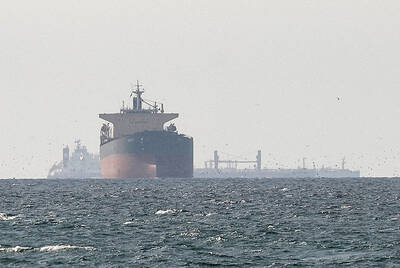
A ship that appears to be taking on the identity of a scrapped gas carrier exited the Strait of Hormuz on Friday, showing how strategies to get through the waterway are evolving as the Middle East war progresses. The vessel identifying as liquefied natural gas (LNG) carrier Jamal left the Strait on Friday morning, ship-tracking data show. However, the same tanker was also recorded as having beached at an Indian demolition yard in October last year, where it is being broken up, according to market participants and port agent’s reports. The ship claiming to be Jamal is likely a zombie vessel that


 RSS
RSS