


Hong Kong media experts yesterday expressed fears for freedom of speech after the government unveiled plans to set up an audit team to monitor the territory's public broadcaster.
The Audit Commission released a damning report on Radio Television Hong Kong (RTHK) on Wednesday highlighting its poor financial controls, management problems and its failure to comply with government rules and procedures.
The internal audit team, which includes audit staff members from the government-funded broadcaster, will be led by the Hong Kong Treasury and the Audit Commission.
RTHK has long been under pressure from the pro-Beijing camp for not defending or strongly promoting government policies.
They had also attacked RTHK's satirical programs for poking fun at government officials.
While government officials dismissed any political motives behind the moves, local media experts were worried that the government could move to tighten its grip on RTHK following its decision in January to launch a review of public broadcasting policy.
They also raised fears for the broadcaster's editorial independence and expressed concern that it could be transformed into a government propaganda tool.
"There's a danger ... that it will creep into that direction. If RTHK are subject to the criticism, they will spend more time complying with official requirements. They will feel less independent," said Tim Hamlett, professor of journalism at Hong Kong Baptist University.
"This is bound to raise concerns for the freedom of speech here because the mainland don't have it," he said.
Associate journalism professor Louise Leung (梁永熾) said: "The government must be cautious and advised not to add additional constraints rigidly that is to kill creativity and narrow down the latitude of press freedom."
The former British colony returned to Chinese sovereignty in 1997 with Beijing's promise that it would continue to enjoy those liberties.
However, watchdogs say some media firms practise self-censorship of news items critical of China.
Six months ago RTHK was forced to axe its decades-old horse-racing radio commentary following criticism by Chief Executive Donald Tsang (
The new report includes complaints that news teams did not get management approval to work overtime before covering a breaking story.
Cheung Ping-ling (
"The commission had never set up any special committees in any organizations that made mistakes that led to losses of millions of dollars ... I question why the government is putting such pressure on RTHK," she said.
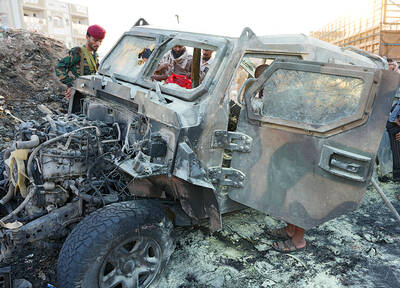
‘TERRORIST ATTACK’: The convoy of Brigadier General Hamdi Shukri resulted in the ‘martyrdom of five of our armed forces,’ the Presidential Leadership Council said A blast targeting the convoy of a Saudi Arabian-backed armed group killed five in Yemen’s southern city of Aden and injured the commander of the government-allied unit, officials said on Wednesday. “The treacherous terrorist attack targeting the convoy of Brigadier General Hamdi Shukri, commander of the Second Giants Brigade, resulted in the martyrdom of five of our armed forces heroes and the injury of three others,” Yemen’s Saudi Arabia-backed Presidential Leadership Council said in a statement published by Yemeni news agency Saba. A security source told reporters that a car bomb on the side of the road in the Ja’awla area in
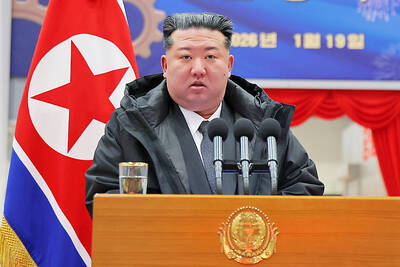
‘SHOCK TACTIC’: The dismissal of Yang mirrors past cases such as Jang Song-thaek, Kim’s uncle, who was executed after being accused of plotting to overthrow his nephew North Korean leader Kim Jong-un has fired his vice premier, compared him to a goat and railed against “incompetent” officials, state media reported yesterday, in a rare and very public broadside against apparatchiks at the opening of a critical factory. Vice Premier Yang Sung-ho was sacked “on the spot,” the state-run Korean Central News Agency said, in a speech in which Kim attacked “irresponsible, rude and incompetent leading officials.” “Please, comrade vice premier, resign by yourself when you can do it on your own before it is too late,” Kim reportedly said. “He is ineligible for an important duty. Put simply, it was
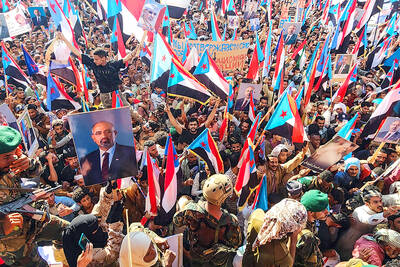
Yemen’s separatist leader has vowed to keep working for an independent state in the country’s south, in his first social media post since he disappeared earlier this month after his group briefly seized swathes of territory. Aidarous al-Zubaidi’s United Arab Emirates (UAE)-backed Southern Transitional Council (STC) forces last month captured two Yemeni provinces in an offensive that was rolled back by Saudi strikes and Riyadh’s allied forces on the ground. Al-Zubaidi then disappeared after he failed to board a flight to Riyadh for talks earlier this month, with Saudi Arabia accusing him of fleeing to Abu Dhabi, while supporters insisted he was
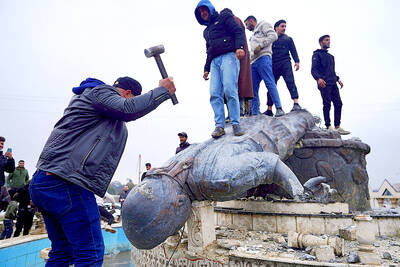
Syrian President Ahmed al-Sharaa on Sunday announced a deal with the chief of Kurdish-led forces that includes a ceasefire, after government troops advanced across Kurdish-held areas of the country’s north and east. Syrian Kurdish leader Mazloum Abdi said he had agreed to the deal to avoid a broader war. He made the decision after deadly clashes in the Syrian city of Raqa on Sunday between Kurdish-led forces and local fighters loyal to Damascus, and fighting this month between the Kurds and government forces. The agreement would also see the Kurdish administration and forces integrate into the state after months of stalled negotiations on


 RSS
RSS