


Mine attacks killed two navy sailors and wounded two commandos in northern Sri Lanka yesterday in the latest in a barrage of violence posing the biggest danger yet to the country's four-year-old ceasefire.
This week's bloodshed, including two days of government air strikes against Tamil rebel positions, threatens to wreck a 2002 truce that ended two decades of fighting between the government and rebels seeking a separate state in the north of the island.
While both sides in the conflict and the European team overseeing the agreement say it still holds, analysts predict that more violence in the coming days could lead to its total collapse.
The Tamil Tiger rebel group says the airstrikes on Tuesday and Wednesday near the northeastern port of Trincomalee killed a dozen people and forced 40,000 people -- mostly ethnic Tamils -- to flee their homes.
Damage inspection
The chief ceasefire monitor, Ulf Henricsson of Sweden, traveled yesterday to those areas to inspect damages caused by the airstrikes and to meet with local rebel leaders, spokeswoman Helen Olafsdottir said. She gave no further details.
The government blamed both of yesterday's mine attacks on the rebels.
The two sailors were killed when a mine exploded as they rode on a motorcycle on the Kayts islet in northern Jaffna Peninsula, the navy's media unit said.
Earlier, two members of a government commando unit formed to help the military in its battle against Tigers were wounded in a mine attack on a fortified truck in northwestern Mannar district, the Defense Ministry said.
The two wounded commandos were taken to a hospital. The extent of their injuries was not immediately known.
The Defense Ministry said no new strikes were launched yesterday following two days of air attacks that were the government's biggest military operation since 2002.
Those strikes were ordered hours after an ethnic Tamil suicide bomber targeted the top government military commander in Colombo, wounding the officer and killing nine other people. They also came in response to Tamil rebel attacks on navy ships, the military said.
Military spokesman Brigadier Prasad Samarasinghe said the only highway linking the south with the north -- blocked by the government on Wednesday due to security concerns -- reopened yesterday.
Blockade
The government blockade of the A9 highway stopped deliveries of petroleum products to the north leading to shortages in the Jaffna Peninsula, the traditional home of Sri Lanka's 3.2 million Tamils.
The rebels, formally known as the Liberation Tigers of Tamil Eelam (LTTE), said 40,000 people, almost all Tamils, have fled their homes in the northeast and that the rebel movement would seek to provide them shelter. Twelve people were killed by the strikes, the group said.
There was no way of verifying the claims.
"This terror atmosphere that has been created throughout the Tamil homeland has shattered the Tamil people," the rebels said in a statement. "LTTE had protected Tamil people ... for many years. Today, Tamil people are seeking and expecting protection from our movement."
Despite violations on both sides, the European monitoring team said that the accord still stands.
"Certainly, we still have a valid ceasefire. No one has abrogated it," Henricsson said on Wednesday. However, he said that "what is going on is a serious violation of the agreement."
At least 65,000 people were killed in the two-decade civil war.
The 2002 Norway-brokered truce halted large-scale fighting, but disputes over postwar power-sharing have hindered peace talks, and sporadic violence has raised tensions in recent months.

‘IN A DIFFERENT PLACE’: The envoy first visited Shanghai, where he attended a Chinese basketball playoff match, and is to meet top officials in Beijing tomorrow US Secretary of State Antony Blinken yesterday arrived in China on his second visit in a year as the US ramps up pressure on its rival over its support for Russia while also seeking to manage tensions with Beijing. The US diplomat tomorrow is to meet China’s top brass in Beijing, where he is also expected to plead for restraint as Taiwan inaugurates president-elect William Lai (賴清德), and to raise US concerns on Chinese trade practices. However, Blinken is also seeking to stabilize ties, with tensions between the world’s two largest economies easing since his previous visit in June last year. At the

UNSETTLING IMAGES: The scene took place in front of TV crews covering the Trump trial, with a CNN anchor calling it an ‘emotional and unbelievably disturbing moment’ A man who doused himself in an accelerant and set himself on fire outside the courthouse where former US president Donald Trump is on trial has died, police said yesterday. The New York City Police Department (NYPD) said the man was declared dead by staff at an area hospital. The man was in Collect Pond Park at about 1:30pm on Friday when he took out pamphlets espousing conspiracy theories, tossed them around, then doused himself in an accelerant and set himself on fire, officials and witnesses said. A large number of police officers were nearby when it happened. Some officers and bystanders rushed

Beijing is continuing to commit genocide and crimes against humanity against Uyghurs and other Muslim minorities in its western Xinjiang province, U.S. Secretary of State Antony Blinken said in a report published on Monday, ahead of his planned visit to China this week. The State Department’s annual human rights report, which documents abuses recorded all over the world during the previous calendar year, repeated language from previous years on the treatment of Muslims in Xinjiang, but the publication raises the issue ahead of delicate talks, including on the war in Ukraine and global trade, between the top U.S. diplomat and Chinese
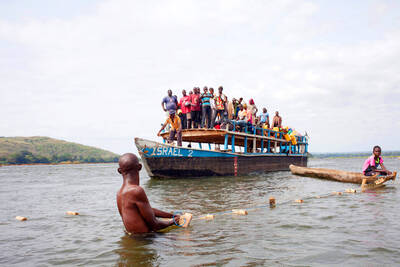
RIVER TRAGEDY: Local fishers and residents helped rescue people after the vessel capsized, while motorbike taxis evacuated some of the injured At least 58 people going to a funeral died after their overloaded river boat capsized in the Central African Republic’s (CAR) capital, Bangui, the head of civil protection said on Saturday. “We were able to extract 58 lifeless bodies,” Thomas Djimasse told Radio Guira. “We don’t know the total number of people who are underwater. According to witnesses and videos on social media, the wooden boat was carrying more than 300 people — some standing and others perched on wooden structures — when it sank on the Mpoko River on Friday. The vessel was heading to the funeral of a village chief in


 RSS
RSS