


The Philippine president yesterday defended a decision to commute death sentences as religiously inspired, while an anti-crime activist warned that outraged victims' families may attempt to take revenge against inmates whose lives will be spared.
President Gloria Macapagal Arroyo's Easter announcement was applauded by the powerful Roman Catholic church and anti-death penalty crusaders, but her spokesman, Ignacio Bunye, said "the president was not seeking nor did she expect any political returns from her decision."
The decision "came after deep contemplation and reflection in the field of Christian values," Bunye said in a statement. "We understand the deep hurt inflicted upon the families of the victims of heinous crimes, but the president believes that learning to forgive without compromising criminal justice would be a good start for the nation to move on."
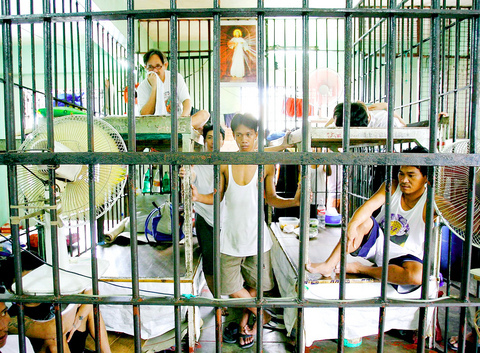
PHOTO: EPA
The move may save the lives of about 1,200 death convicts, including at least 11 al-Qaeda-linked militants, although prison chaplain Monsignor Roberto Olaguer said only about 100 whose sentences were affirmed by the Supreme Court will be affected immediately. The rest will have to wait until the court upholds their death sentences, he said.
"They're rejoicing. They're thankful to the president because they'll have a longer life," Olaguer said.
Arroyo's move, however, sent shockwaves through citizens' anti-crime groups, worried it will embolden criminals amid a resurgence in kidnappings. Most death row inmates have been convicted of kidnapping, rape, murder and drug trafficking.
Dante Jimenez, head of the Volunteers Against Crime and Corruption, said he had received phone calls from two families of victims who told him they would "just find a way to have those who committed heinous crimes against their loved ones killed in prison."
He didn't provide details.
"That's the implication. It will become a tooth for a tooth. It's saddening if victims will be victimized again because of this sweeping ... commutations," he said.
No execution has taken place since 2000 in the predominantly Catholic Philippines.
Arroyo's decision does not abolish the death penalty, which would require approval by Congress.

‘IN A DIFFERENT PLACE’: The envoy first visited Shanghai, where he attended a Chinese basketball playoff match, and is to meet top officials in Beijing tomorrow US Secretary of State Antony Blinken yesterday arrived in China on his second visit in a year as the US ramps up pressure on its rival over its support for Russia while also seeking to manage tensions with Beijing. The US diplomat tomorrow is to meet China’s top brass in Beijing, where he is also expected to plead for restraint as Taiwan inaugurates president-elect William Lai (賴清德), and to raise US concerns on Chinese trade practices. However, Blinken is also seeking to stabilize ties, with tensions between the world’s two largest economies easing since his previous visit in June last year. At the
Nearly half of China’s major cities are suffering “moderate to severe” levels of subsidence, putting millions of people at risk of flooding, especially as sea levels rise, according to a study of nationwide satellite data released yesterday. The authors of the paper, published by the journal Science, found that 45 percent of China’s urban land was sinking faster than 3mm per year, with 16 percent at more than 10mm per year, driven not only by declining water tables, but also the sheer weight of the built environment. With China’s urban population already in excess of 900 million people, “even a small portion

UNSETTLING IMAGES: The scene took place in front of TV crews covering the Trump trial, with a CNN anchor calling it an ‘emotional and unbelievably disturbing moment’ A man who doused himself in an accelerant and set himself on fire outside the courthouse where former US president Donald Trump is on trial has died, police said yesterday. The New York City Police Department (NYPD) said the man was declared dead by staff at an area hospital. The man was in Collect Pond Park at about 1:30pm on Friday when he took out pamphlets espousing conspiracy theories, tossed them around, then doused himself in an accelerant and set himself on fire, officials and witnesses said. A large number of police officers were nearby when it happened. Some officers and bystanders rushed
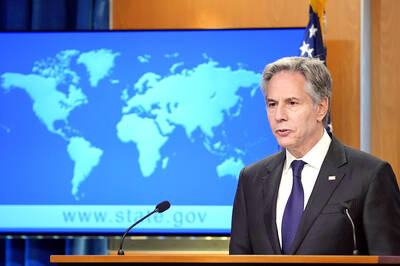
Beijing is continuing to commit genocide and crimes against humanity against Uyghurs and other Muslim minorities in its western Xinjiang province, U.S. Secretary of State Antony Blinken said in a report published on Monday, ahead of his planned visit to China this week. The State Department’s annual human rights report, which documents abuses recorded all over the world during the previous calendar year, repeated language from previous years on the treatment of Muslims in Xinjiang, but the publication raises the issue ahead of delicate talks, including on the war in Ukraine and global trade, between the top U.S. diplomat and Chinese


 RSS
RSS