


Shiite leaders from the powerful United Iraqi Alliance (UIA) failed yesterday to decide on the fate of Prime Minister Ibrahim Jaafari who has been given the thumbs down by Kurds and Sunni Arabs.
They broke off talks aimed at resolving Iraq's political impasse until tomorrow.
The alliance leaders met for about two hours but were unable to decide on whether or not to replace Jaafari after his candidacy as the next premier faced stiff opposition from the Kurdish and the Sunni factions.
"The meeting has ended," said Bassem Sharif, spokesman of the Fadhila party, part of the Shiite alliance. He said the "leaders will meet again Wednesday."
Sharif said the Shiite leaders heard the report of a three-member committee that had been mandated by the alliance to hold talks with the Kurdish, Sunni and the secularist groups over Jaafari's candidacy.
"Their report was heard," he said, adding that the secularists led by former premier Iyad Allawi "had reservations about the programs of the alliance and not about Jaafari himself."
On Monday, Allawi's group had rejected Jaafari's candidacy, along with the Kurds and the Sunni Arabs.
Earlier yesterday the Fadhila party stepped up pressure on the UIA by saying it was ready to offer a candidate to replace Jaafari if the Shiite alliance failed to pass his candidacy.
"If the UIA does not succeed in securing the candidacy of Mr Jaafari, the Fadhila party is ready to propose another candidate," Sharif told a press conference, without giving a name.
Fadhila had put forward Nadim Jabiri as a potential candidate for the premier's post in a February vote which saw Jaafari beat Vice President Adel Abdel Mahdi, but Jabibi later withdrew his candidacy.
Meanwhile, Iraq's parliament, which must approve any nominee for prime minister, will meet at a date likely to be announced tomorrow, an assembly spokesman said.
Acting Speaker Adnan Pachachi was expected to set the date for parliament's next session, the spokesman said yesterday.
He did not specify its agenda, but the announcement could signal movement in intense efforts to break a deadlock on forming a new unity government four months after elections.
Yesterday's meeting was also aimed at ending the almost four months of political deadlock in the violence-wracked country since legislative elections were held in mid-December.
Sectarian violence has surged across the country in recent weeks as political leaders battle to end the political impasse, with hundreds killed in a wave of bombings and shootings.
The dominant UIA, which won 128 out of 275 parliament seats in the December election, chose Jaafari by a single vote in February but his nomination has faced stiff resistance amid accusations he has failed to quell the violence.
The alliance lacks the overall majority in parliament needed to push through a nomination for prime minister on its own.
The deadlock over Jaafari has stalled the formation of a national unity government despite sustained pressure from the US which is looking to withdraw its troops from Iraq.
Iraqi state television al-Iraqiya said yesterday that UN Secretary General Kofi Annan had spoken to Jaafari and discussed the current political situation.
US President George W. Bush also called upon Iraqi leaders to resolve the political crisis.
"The longer Iraq's leaders delay in forming a unity government, the greater the risk that the terrorists and former regime elements will succeed in their efforts to foment division and to stop the progress of an Iraq democracy," Bush said on Monday in Washington.
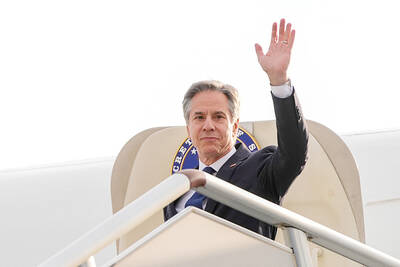
‘IN A DIFFERENT PLACE’: The envoy first visited Shanghai, where he attended a Chinese basketball playoff match, and is to meet top officials in Beijing tomorrow US Secretary of State Antony Blinken yesterday arrived in China on his second visit in a year as the US ramps up pressure on its rival over its support for Russia while also seeking to manage tensions with Beijing. The US diplomat tomorrow is to meet China’s top brass in Beijing, where he is also expected to plead for restraint as Taiwan inaugurates president-elect William Lai (賴清德), and to raise US concerns on Chinese trade practices. However, Blinken is also seeking to stabilize ties, with tensions between the world’s two largest economies easing since his previous visit in June last year. At the
Nearly half of China’s major cities are suffering “moderate to severe” levels of subsidence, putting millions of people at risk of flooding, especially as sea levels rise, according to a study of nationwide satellite data released yesterday. The authors of the paper, published by the journal Science, found that 45 percent of China’s urban land was sinking faster than 3mm per year, with 16 percent at more than 10mm per year, driven not only by declining water tables, but also the sheer weight of the built environment. With China’s urban population already in excess of 900 million people, “even a small portion

UNSETTLING IMAGES: The scene took place in front of TV crews covering the Trump trial, with a CNN anchor calling it an ‘emotional and unbelievably disturbing moment’ A man who doused himself in an accelerant and set himself on fire outside the courthouse where former US president Donald Trump is on trial has died, police said yesterday. The New York City Police Department (NYPD) said the man was declared dead by staff at an area hospital. The man was in Collect Pond Park at about 1:30pm on Friday when he took out pamphlets espousing conspiracy theories, tossed them around, then doused himself in an accelerant and set himself on fire, officials and witnesses said. A large number of police officers were nearby when it happened. Some officers and bystanders rushed
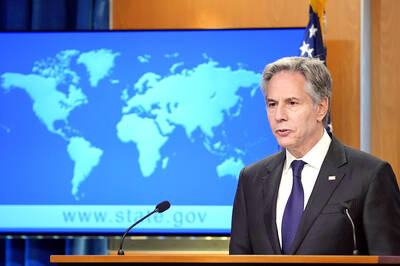
Beijing is continuing to commit genocide and crimes against humanity against Uyghurs and other Muslim minorities in its western Xinjiang province, U.S. Secretary of State Antony Blinken said in a report published on Monday, ahead of his planned visit to China this week. The State Department’s annual human rights report, which documents abuses recorded all over the world during the previous calendar year, repeated language from previous years on the treatment of Muslims in Xinjiang, but the publication raises the issue ahead of delicate talks, including on the war in Ukraine and global trade, between the top U.S. diplomat and Chinese


 RSS
RSS