


For Jacob Zuma, charismatic icon of South Africa's liberation struggle, the last year has been a series of shocks: fired as deputy president, ousted as the front-runner to succeed President Thabo Mbeki, indicted on bribery charges and, most recently, put on trial on charges of raping the daughter of a family friend.
Now Zuma has begun to fight back. And it is his critics' turn to be shocked.
Taking the stand for the first time last week in the rape trial, Zuma cast himself as the embodiment of a traditional Zulu male, with all the privileges that patriarchal Zulu traditions bestow on men. He said his accuser, a 31-year-old anti-AIDS advocate, had signaled a desire to have sex with him by wearing a knee-length skirt to his house and sitting with legs crossed, revealing her thigh.
Indeed, he said, he was actually obligated to have sex. His accuser was aroused, he said, and "in the Zulu culture, you cannot just leave a woman if she is ready."
To deny her sex, he said, would have been tantamount to rape.
Such arguments have stirred a storm, not because he insists that his accuser wanted sex but because he has clothed them in what he depicts as African mores about sex and male primacy.
Many experts call it a political Hail Mary, a desperate attempt to salvage the public career of a man accused of corruption and sex crimes. But nobody really knows what emotions lie seething behind South Africa's facade of political unity and equal rights.
Few are totally prepared to write Zuma off.
Revulsion at apartheid's brutality led the nation's founders to write one of the world's most enlightened constitutions, making equal rights a pillar of society.
But public support for that ideal has yet to undergo a test by fire of the sort Zuma could pose, at least in theory.
"I don't think one can simply be blase and say that these appeals don't have any appeal to anyone in this society," said Steven Friedman, a veteran analyst at the Center for Policy Studies in Johannesburg.
That Zuma is making a political appeal as well as a legal one seems indisputable. During this week's trial, he pointedly testified entirely in Zulu, although he speaks fluent English, the usual courtroom language. His remarks had to be translated for the English-speaking prosecutors.
Zuma's claims to a Zulu heritage are authentic. His father, a chief, was a confidante of a Zulu king. Press reports say Zuma has two wives, and he is sometimes reported to be engaged to a Swazi princess. He was also married to South Africa's foreign minister, Nkosazana Dlamini-Zuma; the two divorced in 1998.
The true story of the encounter between Zuma and the anti-AIDS campaigner last November remains murky.
The woman, who is HIV positive, says she was sleeping overnight in a guest room in Zuma's flat when he came to the room, offered her a massage, then raped her when she declined. She has said that she did not resist because she was too shocked to respond.
Police reports indicate that Zuma initially said the encounter occurred in the guest room. But he has since testified that the woman came to his bedroom, climbed into his bed and asked for a massage, and that he concluded she wanted sex.
Some South Africans are dismayed by Zuma's insistence that his testimony reflects traditional values.
"People do not want this kind of thing," Nomboniso Gasa, a political analyst who spent the 1980s in the ANC underground and later worked on gender-equality issues for the party, stated in an e-mail interview. "They find it repulsive. He has broken every socio-cultural rule."
Yet Gasa said Zuma was likely to retain broad support in parts of South African society, if only because much of the population remains deeply patriarchal.

‘IN A DIFFERENT PLACE’: The envoy first visited Shanghai, where he attended a Chinese basketball playoff match, and is to meet top officials in Beijing tomorrow US Secretary of State Antony Blinken yesterday arrived in China on his second visit in a year as the US ramps up pressure on its rival over its support for Russia while also seeking to manage tensions with Beijing. The US diplomat tomorrow is to meet China’s top brass in Beijing, where he is also expected to plead for restraint as Taiwan inaugurates president-elect William Lai (賴清德), and to raise US concerns on Chinese trade practices. However, Blinken is also seeking to stabilize ties, with tensions between the world’s two largest economies easing since his previous visit in June last year. At the

UNSETTLING IMAGES: The scene took place in front of TV crews covering the Trump trial, with a CNN anchor calling it an ‘emotional and unbelievably disturbing moment’ A man who doused himself in an accelerant and set himself on fire outside the courthouse where former US president Donald Trump is on trial has died, police said yesterday. The New York City Police Department (NYPD) said the man was declared dead by staff at an area hospital. The man was in Collect Pond Park at about 1:30pm on Friday when he took out pamphlets espousing conspiracy theories, tossed them around, then doused himself in an accelerant and set himself on fire, officials and witnesses said. A large number of police officers were nearby when it happened. Some officers and bystanders rushed

Beijing is continuing to commit genocide and crimes against humanity against Uyghurs and other Muslim minorities in its western Xinjiang province, U.S. Secretary of State Antony Blinken said in a report published on Monday, ahead of his planned visit to China this week. The State Department’s annual human rights report, which documents abuses recorded all over the world during the previous calendar year, repeated language from previous years on the treatment of Muslims in Xinjiang, but the publication raises the issue ahead of delicate talks, including on the war in Ukraine and global trade, between the top U.S. diplomat and Chinese
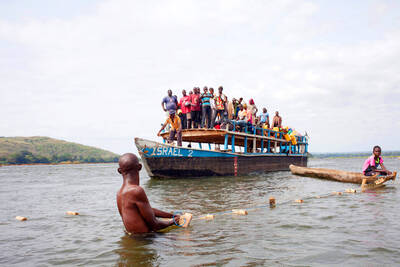
RIVER TRAGEDY: Local fishers and residents helped rescue people after the vessel capsized, while motorbike taxis evacuated some of the injured At least 58 people going to a funeral died after their overloaded river boat capsized in the Central African Republic’s (CAR) capital, Bangui, the head of civil protection said on Saturday. “We were able to extract 58 lifeless bodies,” Thomas Djimasse told Radio Guira. “We don’t know the total number of people who are underwater. According to witnesses and videos on social media, the wooden boat was carrying more than 300 people — some standing and others perched on wooden structures — when it sank on the Mpoko River on Friday. The vessel was heading to the funeral of a village chief in


 RSS
RSS