


A government decision to restrict political expression on the Internet during parliamentary elections drew criticism from an international reporters' group, but Singapore says the measure is necessary to ensure responsible campaigning.
"The Singapore government has always maintained that political debates should be premised on factual and objective presentation of issues and arguments," said K. Bhavani, a spokeswoman for the Ministry of Communication, Information and the Arts.
"The regulations governing Internet campaigning have served well to safeguard the seriousness of the electoral process," Bhavani said on Friday.
Reporters Without Borders has said Singapore's limits on online electioneering were an attempt to gag free speech.
"Once again the Singapore authorities are showing their determination to prevent the holding of a genuinely democratic debate on the Internet," the Paris-based journalism organization said in a statement on Wednesday.
Balaji Sadasivan, senior minister of state for information, communication and the arts, said this past week that new Internet technologies such as podcasting and videocasting cannot be used for campaigning during general elections. Bloggers can discuss politics but must register with the government if they regularly promote a political stance, he said.
Prime Minister Lee Hsien Loong (李顯龍) of the ruling People's Action Party is expected to call elections soon. Currently, two of 84 elected seats are opposition-held.
At least one opposition party has condemned the online restrictions.
The Singapore Democratic Party, or SDP, said in a statement the government's move was "specifically designed to curtail the free flow of information and stymie the SDP's most effective weapon to reach out to voters."
The party said it launched its first political podcast in August as a way to bypass local mainstream media, which it accuses of supporting the ruling party.
Political parties are allowed to campaign online, but within limits, according to laws introduced before the 2001 general elections. Permissible material includes a party's manifesto and photographs and biographies of candidates.
Balaji said bloggers and other managers of Web sites registered as political sites were not allowed to provide material online that constituted "election advertising" during the election period.
But Alex Au, political commentator and author of the online journal Yawning Bread, said the legal definition of "election advertising" was vague, as it was partly described as an act to "enhance the standing" of political parties or candidates.
"If I said an opposition party's candidate comes across as a credible candidate, have I enhanced the person's standing? Have I run afoul of the law?" Au asked.
Mark Cenite, a US media law expert in Singapore, said: "These developments vividly illustrate the contrast in approaches to political expression between Singapore and other democracies."
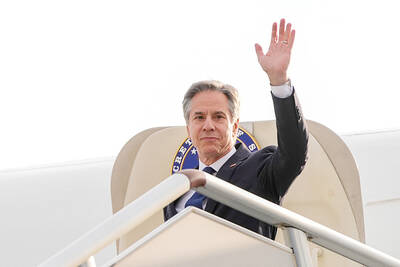
‘IN A DIFFERENT PLACE’: The envoy first visited Shanghai, where he attended a Chinese basketball playoff match, and is to meet top officials in Beijing tomorrow US Secretary of State Antony Blinken yesterday arrived in China on his second visit in a year as the US ramps up pressure on its rival over its support for Russia while also seeking to manage tensions with Beijing. The US diplomat tomorrow is to meet China’s top brass in Beijing, where he is also expected to plead for restraint as Taiwan inaugurates president-elect William Lai (賴清德), and to raise US concerns on Chinese trade practices. However, Blinken is also seeking to stabilize ties, with tensions between the world’s two largest economies easing since his previous visit in June last year. At the
Nearly half of China’s major cities are suffering “moderate to severe” levels of subsidence, putting millions of people at risk of flooding, especially as sea levels rise, according to a study of nationwide satellite data released yesterday. The authors of the paper, published by the journal Science, found that 45 percent of China’s urban land was sinking faster than 3mm per year, with 16 percent at more than 10mm per year, driven not only by declining water tables, but also the sheer weight of the built environment. With China’s urban population already in excess of 900 million people, “even a small portion

UNSETTLING IMAGES: The scene took place in front of TV crews covering the Trump trial, with a CNN anchor calling it an ‘emotional and unbelievably disturbing moment’ A man who doused himself in an accelerant and set himself on fire outside the courthouse where former US president Donald Trump is on trial has died, police said yesterday. The New York City Police Department (NYPD) said the man was declared dead by staff at an area hospital. The man was in Collect Pond Park at about 1:30pm on Friday when he took out pamphlets espousing conspiracy theories, tossed them around, then doused himself in an accelerant and set himself on fire, officials and witnesses said. A large number of police officers were nearby when it happened. Some officers and bystanders rushed
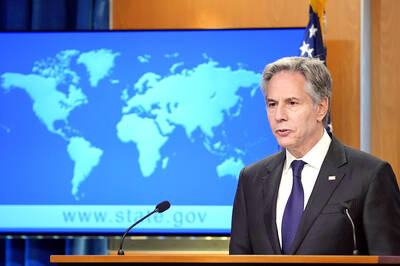
Beijing is continuing to commit genocide and crimes against humanity against Uyghurs and other Muslim minorities in its western Xinjiang province, U.S. Secretary of State Antony Blinken said in a report published on Monday, ahead of his planned visit to China this week. The State Department’s annual human rights report, which documents abuses recorded all over the world during the previous calendar year, repeated language from previous years on the treatment of Muslims in Xinjiang, but the publication raises the issue ahead of delicate talks, including on the war in Ukraine and global trade, between the top U.S. diplomat and Chinese


 RSS
RSS