


Iran conducted its second major test of a new missile within days, firing a high-speed torpedo that it said no submarine or warship can escape and boasting of its strength at a time of increased tensions with the US over its nuclear program.
The tests on Sunday came during war games that Iran's elite Revolutionary Guards have been holding in the Persian Gulf and the Arabian Sea since Friday.
On the maneuvers' first day, Iran said it successfully tested the Fajr-3 missile, which can avoid radars and hit several targets simultaneously using multiple warheads.
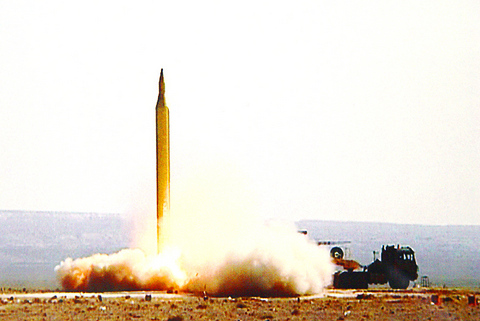
PHOTO: AP
The new torpedo, called the hoot or "whale," could raise concerns over Iran's power in the Gulf, a vital corridor for the world's oil supplies where the US Navy's 5th Fleet is based. During Iran's war with Iraq in the 1980s, Iranian ships attacked oil tankers in the Gulf and Iran and the US military engaged in limited clashes.
Iran's state television stopped its normal programs to break news of the torpedo test, showing it being launched from a ship into the Gulf waters, then hitting its target, a derelict ship.
General Ali Fadavi, deputy head of the Revolutionary Guards' Navy, said the ships that fire the Iranian-made hoot had radar-evading technology and that the torpedo -- moving at 360kph -- was too fast to elude.
"It has a very powerful warhead designed to hit big submarines. Even if enemy warship sensors identify the missile, no warship can escape from this missile because of its high speed," Fadavi told state television.
The hoot's speed would make it about three or four times faster than a normal torpedo and as fast as the world's fastest known underwater missile, the Russian-made VA-111 Shkval, developed in 1995. It was not immediately known if the hoot was based on the Shkval.
The new weapon gives Iran "superiority'' against any warship in the region, he said, in a veiled reference to US vessels in the Gulf. It was not immediately clear whether the torpedo can carry a nuclear warhead.
Commodore Jeff Breslau, spokesman for the US 5th Fleet based on the tiny Arab island nation of Bahrain in the Gulf, said no special measures were taken in reaction to the Iranian war games, even after the latest missile test.
Breslau would not comment on whether the new torpedo rep-resents a threat to US forces in the region.
"In general terms, no matter where we operate in the world, we're aware of other capabilities that exist and of other countries that aren't as friendly to the US, and we pay attention to those capabilities," he said.
Iran is now trying to show its strength amid worries of US military action over its nuclear program, which Washington says aims to produce nuclear weapons. Iran denies the accusation, saying it intends only to generate electricity.
Iran, which views the US as an arch foe and is concerned about the US military presence in neighboring Iraq and Afghanistan, says the maneuvers aim to develop the Guards' defensive capabilities.
The US and its Western allies have been watching in Iran's progress in missile capabilities with concern. Iran already possesses the Shahab-3 missile, capable of carrying a nuclear warhead and hitting US forces in the Middle East.
The upgraded version of the ballistic Shahab-3 missile can travel over 2,000km, putting Israel within its easy range.
Fadavi said Sunday's torpedo test was the outcome of six years of hard work at the Iranian Aero-space Industries, which is affiliated to the Defense Ministry.
More than 17,000 Revolutionary Guards forces are taking part in the weeklong maneuvers in the Gulf.
On Sunday, guards paratroops practiced a drop in an attack on a mock enemy position, and warships, jet fighters, helicopters and sophisticated electronic equipment were used in other exercises.
The television said Sunday's war games included measures to respond to electronic jams caused by a mock enemy.
Iran has routinely held war games over the past two decades to improve its combat readiness and test locally made equipment such as missiles, tanks and armored personnel carriers.

‘CROSSING THE LINE’: China’s embassy in Seoul criticized US Forces Korea Commander General Xavier Brunson, asking if his ‘hostile’ remarks were authorized by Washington South Korea and the US are in talks over recent public remarks by the commander of US Forces Korea, Seoul’s presidential office said yesterday, after the comments drew sharp criticism from China. In a recent podcast interview, US Forces Korea Commander General Xavier Brunson described South Korea as “the dagger in the heart of Asia” from China’s east coast, prompting the Chinese embassy in Seoul to say that he had “truly crossed the line.” The interview came amid growing speculation that Washington might seek to expand the role of US Forces Korea in countering the growing regional influence of China, a key

Through the noise of rushing papers and whirring belts at a print factory in Kyoto, two creators watch their photo essay come to life in broadsheet form — part of an effort to win new audiences in the age of artificial intelligence (AI). Despite the decline of the publishing industry, self-publication and handmade “zine” magazines are growing in popularity in Japan, reflecting the nation’s enduring love of paper in the digital era. While speaking to Agence France-Presse at the plant, his hands black with ink, one of the creators, Kazuma Obara, said: “I think [paper] is a medium that engages all five

Australian researchers have trained lab-grown brain cells on a silicon computer chip to play the 1990s shooter game Doom and said they are just scratching the surface of what the neurons could be capable of doing. It is the science-fiction work of biotech boffins at Cortical Labs, who researched and developed the technology that harnesses the workings of the brain’s networking system. Each so-called “biological computer” contains about 200,000 living human brain cells, grown from stem cells that were harvested from blood donations. Having mastered the simple computer game Pong, where a paddle is moved up and down to send a ball

France experienced its hottest spring on record, the French weather service said on Tuesday, after an exceptional early heat wave that also broke highs for the season in England and Wales. Meteo-France said the average nationwide temperature over March to May was 13.8°C — about 1.7°C above the norm, and surpassing records set in 2011 and 2020. “The warmest spring since records began in 1900,” it said in a bulletin. All three months were warmer than average, but the onset of an “unprecedented heatwave” late last month pushed the mercury to highs typically seen at the height of the summer. “Our country had never


 RSS
RSS