


By day, she amputated limbs and comforted the wounded. By night, she sought to heal herself, filling tiny notebooks with thoughts on suffering and love, the petty politics undermining the Communist Party and her hatred of US "pirates who drink the people's blood but don't smell the stench."
Thirty-five years after a US intelligence officer saved them from being burned, the poignant diaries of a North Vietnamese surgeon named Dang Thuy Tram have reconciled once bitter enemies.
Their publication has also become a sensation in Vietnam, opening the floodgates of memories in a nation long disciplined to take a sanitized, glorified view of the conflict.
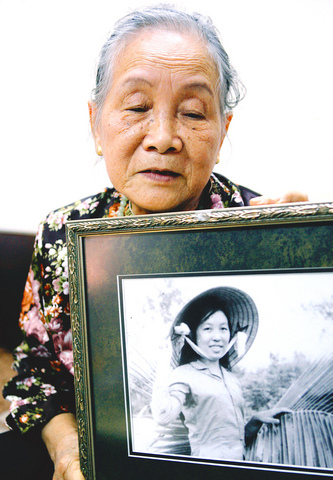
PHOTO: AP
Last month, in Quang Ngai Province where Tram perished in 1970 at age 27 after refusing to surrender to US troops during a skirmish, officials broke ground for a medical clinic, visitors' center and statue in her honor. Tomorrow she will be awarded a posthumous Hero of the People's Army medal.
For Frederick Whitehurst, the former officer who retrieved the diaries from Tram's gutted field hospital in what was then South Vietnam -- and decided at his translator's urging not to burn them -- she is more than a war hero.
"People will read her words as they read the words of Anne Frank," he wrote in an e-mail from his home in Bethel, North Carolina.
The diaries were written in tiny notebooks hand-crafted from medical supply packaging, and languished for more than three decades in Whitehurst's file cabinet after attempts to find Tram's family failed. But last year, Whitehurst, aided by his brother Robert, also a Vietnam veteran, donated them to the Vietnam Archives at Texas Tech University in Lubbock.
Within weeks, experts tracked down the family.
Tram's 81-year-old mother initially refused to believe the diaries were authentic.
"I was skeptical until I saw them with my own eyes, held them in my hands," said Doan Ngoc Tram, who traveled to Texas last October to see them.
"Reading the diaries was so painful, I couldn't finish them," she said in an interview at her Hanoi home. "It was a terrible shock to learn that her life was so full of pain, hardship and danger. Her letters from the front never spoke of that."
"The Whitehursts gave me my daughter back," she said, speaking French, the language of Vietnam's colonial rulers in her youth.
Written with surgical precision in black ink, the diaries are considered the most compelling, uncensored Vietnamese-language account of a conflict that killed up to 3 million Vietnamese as well as 58,000 Americans.
Until now, most Vietnamese first-person narratives were prettified, even invented. A mere mention of suffering was taboo. Now, in a country which averages about 2,000 book copies per printing, the Tram diaries have sold a record 400,000 copies.
They have made Tram and the Whitehursts household names, inspiring countless Vietnamese to come forward with memoirs, letters and documents. The Whitehurst brothers have made several visits to Vietnam, their appearances on national television and radio bringing some closure to the deeply scarred war generation.
They published Finding Thuy -- the title comes from Tram's given name -- in Vietnamese and were thanked publicly by Prime Minister Phan Van Khai.
Tram grew up in Hanoi. Fresh out of medical school, where she trained under her surgeon father, Tram volunteered for service as a civilian doctor with the North Vietnamese military in 1968 and was posted to Quang Ngai, scene of heavy combat because of its proximity to the demilitarized zone.
The journals capture the psychological and physical strain. In the 36 months covered in the journals, Tram was forced to dismantle and rebuild her operating theater six times, regrouping in increasingly remote, mountainous terrain, often carrying out the wounded on her back.
There are frightening accounts of hiding in foxholes, chest-deep in cold water, or nearly suffocating in underground bunkers.
She rages against the Communist Party for denying her and her mother party membership for years because of their "bourgeois origins."
"The saddest part of the hardship is that I still have not found fairness ... still have not won the struggle with the bad traits which dishonor the members of the Party and break the spirit of the people who work at the clinic," says an entry dated June 15, 1968.
A May 5 entry pines almost obsessively for the mysterious M whom she ultimately rejected.
"My dear M ... I still love you very much but love is mixed with hate and blame. ... You are not mine, but I would like to bring my love to rub your wounds. My wound never heals. I will carry this broken heart with me all my life," she wrote.
Interspersed with such words of love are epithets against then US president Richard Nixon and US soldiers -- "demons, devils, dogs, pirates and poisonous snakes."
Robert Whitehurst, 60, a tug boat captain from New Orleans, has done a rough translation of the diaries into English using skills learned during 18 months of language training in Vietnam, where he skippered a patrol boat in the Mekong Delta. They will be professionally translated and published next year in the US.
According to Tram's mother, a soldier who survived Tram's last battle said she laid down fire to cover the retreat of wounded soldiers, and US troops combing the hospital found the diaries.
Whitehurst says his research shows that Tram was well-known to the Americans.
"According to US intelligence reports, she was known as a skilled surgeon and protected by local resistance groups," he said on a visit to Hanoi. "The documents indicate that she was targeted for capture or elimination to strike a blow at enemy morale. She already was a hero back then."

‘IN A DIFFERENT PLACE’: The envoy first visited Shanghai, where he attended a Chinese basketball playoff match, and is to meet top officials in Beijing tomorrow US Secretary of State Antony Blinken yesterday arrived in China on his second visit in a year as the US ramps up pressure on its rival over its support for Russia while also seeking to manage tensions with Beijing. The US diplomat tomorrow is to meet China’s top brass in Beijing, where he is also expected to plead for restraint as Taiwan inaugurates president-elect William Lai (賴清德), and to raise US concerns on Chinese trade practices. However, Blinken is also seeking to stabilize ties, with tensions between the world’s two largest economies easing since his previous visit in June last year. At the

UNSETTLING IMAGES: The scene took place in front of TV crews covering the Trump trial, with a CNN anchor calling it an ‘emotional and unbelievably disturbing moment’ A man who doused himself in an accelerant and set himself on fire outside the courthouse where former US president Donald Trump is on trial has died, police said yesterday. The New York City Police Department (NYPD) said the man was declared dead by staff at an area hospital. The man was in Collect Pond Park at about 1:30pm on Friday when he took out pamphlets espousing conspiracy theories, tossed them around, then doused himself in an accelerant and set himself on fire, officials and witnesses said. A large number of police officers were nearby when it happened. Some officers and bystanders rushed

Beijing is continuing to commit genocide and crimes against humanity against Uyghurs and other Muslim minorities in its western Xinjiang province, U.S. Secretary of State Antony Blinken said in a report published on Monday, ahead of his planned visit to China this week. The State Department’s annual human rights report, which documents abuses recorded all over the world during the previous calendar year, repeated language from previous years on the treatment of Muslims in Xinjiang, but the publication raises the issue ahead of delicate talks, including on the war in Ukraine and global trade, between the top U.S. diplomat and Chinese
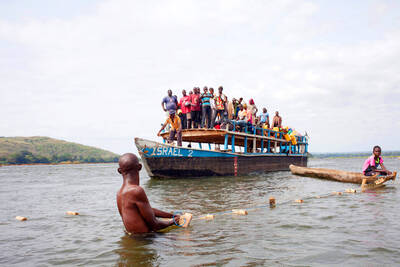
RIVER TRAGEDY: Local fishers and residents helped rescue people after the vessel capsized, while motorbike taxis evacuated some of the injured At least 58 people going to a funeral died after their overloaded river boat capsized in the Central African Republic’s (CAR) capital, Bangui, the head of civil protection said on Saturday. “We were able to extract 58 lifeless bodies,” Thomas Djimasse told Radio Guira. “We don’t know the total number of people who are underwater. According to witnesses and videos on social media, the wooden boat was carrying more than 300 people — some standing and others perched on wooden structures — when it sank on the Mpoko River on Friday. The vessel was heading to the funeral of a village chief in


 RSS
RSS