


Ousted president Joseph Estrada sharply denied yesterday that he took huge kickbacks in office, defending himself against capital charges of plunder and defiantly telling an anti-graft court that he was framed.
With hundreds of his backers rallying outside, the testimony capped five years of court proceed-ings that he hopes will vindicate him after the actor-turned-politician was toppled in a 2001 "people power" revolt.
"These are trumped-up charges, a frame-up," the 68-year-old Estrada said when questioned about kickback allegations.
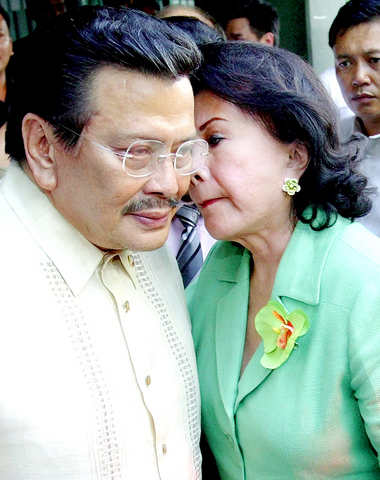
PHOTO: EPA
"That's a pack of lies," he added when asked about an allegation that he sought kickbacks from tobacco excise taxes in one province. "I don't have the conscience to steal money intended for farmers."
During a break at the heavily guarded Sandiganbayan anti-graft court, Estrada told ANC television that he was hoping for a fair trial.
"This is all political, you know," he said.
Presidential spokesman Ignacio Bunye countered that the government has been fair.
"The fact that former President Joseph Estrada was taking the witness stand is a clear proof that due process has been strictly observed in his case," Bunye said in a statement. "We call on all the sectors concerned to refrain from speculating as to the outcome of the trial and just let justice take its inexorable course."
The day turned into a slow slog as lawyers tangled over procedural technicalities and court clerks scoured voluminous files for bits of evidence. At one point, Estrada closed his eyes and appeared on the verge of dozing off.
Estrada was shown a check and Land Bank of the Philippines documents allegedly covering the transfer of 130 million pesos (US$2.5 million) worth of tobacco excise tax kickbacks from Ilocos Sur province to Estrada's camp.
"It's the first time I'm seeing this. I have no knowledge of this, your honor," Estrada replied.
His testimony was later adjourned for a week.
Estrada draped himself in symbolic patriotism, wearing a native Barong shirt, a Philippine flag lapel pin and his trademark white wristband with the presidential seal.
"I have mixed feelings. I welcome this opportunity to present my side because I was denied that right in the impeachment trial when prosecutors walked out," Estrada testified. "I was convicted in the streets."
Estrada's impeachment trial broke down in January 2001 when prosecutors were barred from presenting what they called a critical piece of evidence. Within hours, people massed for protests that forced him to leave the presidential palace.
Prosecutors allege Estrada amassed about 4 billion pesos (US$77 million) in illegal gambling payoffs, tax kickbacks and commissions stashed in secret bank accounts under the alias "Jose Velarde." He also faces a perjury charge for allegedly underreporting his assets in 1999.
"We expect justice to be ren-dered fairly," said Dante Jimenez, an anti-crime activist who sat inside the packed courtroom. "If there is a perception that it's not, the danger is this might again divide the nation and cause trouble. The country will be watching."
The protests that forced Estrada to step down were partly led by then-Vice President Gloria Macapagal Arroyo, who completed the remainder of his six-year term then won the 2004 election.
He blames his ouster on a "conspiracy of the elite, church leaders and thieving politicians."
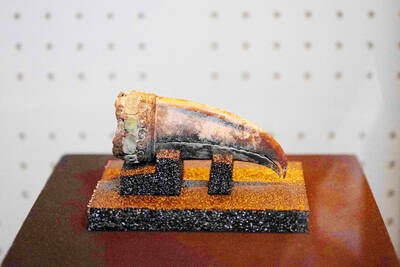
Archeologists in Peru on Thursday said they found the 5,000-year-old remains of a noblewoman at the sacred city of Caral, revealing the important role played by women in the oldest center of civilization in the Americas. “What has been discovered corresponds to a woman who apparently had elevated status, an elite woman,” archeologist David Palomino said. The mummy was found in Aspero, a sacred site within the city of Caral that was a garbage dump for more than 30 years until becoming an archeological site in the 1990s. Palomino said the carefully preserved remains, dating to 3,000BC, contained skin, part of the
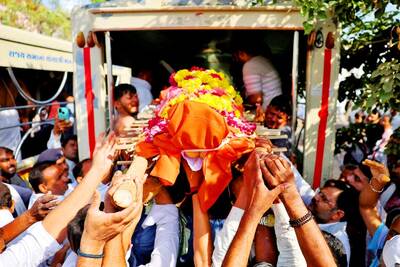
‘WATER WARFARE’: A Pakistani official called India’s suspension of a 65-year-old treaty on the sharing of waters from the Indus River ‘a cowardly, illegal move’ Pakistan yesterday canceled visas for Indian nationals, closed its airspace for all Indian-owned or operated airlines, and suspended all trade with India, including to and from any third country. The retaliatory measures follow India’s decision to suspend visas for Pakistani nationals in the aftermath of a deadly attack by shooters in Kashmir that killed 26 people, mostly tourists. The rare attack on civilians shocked and outraged India and prompted calls for action against their country’s archenemy, Pakistan. New Delhi did not publicly produce evidence connecting the attack to its neighbor, but said it had “cross-border” links to Pakistan. Pakistan denied any connection to

TRUMP EFFECT: The win capped one of the most dramatic turnarounds in Canadian political history after the Conservatives had led the Liberals by more than 20 points Canadian Prime Minister Mark Carney yesterday pledged to win US President Donald Trump’s trade war after winning Canada’s election and leading his Liberal Party to another term in power. Following a campaign dominated by Trump’s tariffs and annexation threats, Carney promised to chart “a new path forward” in a world “fundamentally changed” by a US that is newly hostile to free trade. “We are over the shock of the American betrayal, but we should never forget the lessons,” said Carney, who led the central banks of Canada and the UK before entering politics earlier this year. “We will win this trade war and
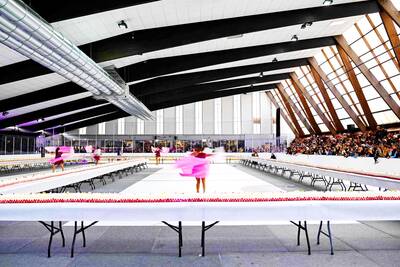
Armed with 4,000 eggs and a truckload of sugar and cream, French pastry chefs on Wednesday completed a 121.8m-long strawberry cake that they have claimed is the world’s longest ever made. Youssef El Gatou brought together 20 chefs to make the 1.2 tonne masterpiece that took a week to complete and was set out on tables in an ice rink in the Paris suburb town of Argenteuil for residents to inspect. The effort overtook a 100.48m-long strawberry cake made in the Italian town of San Mauro Torinese in 2019. El Gatou’s cake also used 350kg of strawberries, 150kg of sugar and 415kg of


 RSS
RSS