


When US President George W Bush launched a high-profile series of speeches last week aimed at calming nerves about the Iraq war he chose to do so in the heart of Washington. At George Washington University, he asked the US to stay the course through troubled times. It was a familiar message to an audience that had heard it all before.
What was new was the make-up of the crowd: only five Republican congressmen and one senator attended. As displays of loyalty go it left a lot to be desired. It seems Bush should worry less about the US abandoning Iraq and more about his party abandoning him.
Tarnished by the war and a never-ending flow of domestic scandals, Bush is increasingly being seen as a liability to Republicans facing November's mid-term elections. Many of the party's senior members are distancing themselves from their president with a new willingness to disobey orders from the White House.
The reason for the change is simple: disastrous polls. Four published last week put Bush's approval ratings at historically low levels. Gallup and NBC gave him 36 percent, while CBS had him at 34 percent and Pew on an anaemic 33 percent.
"When the president is above 50 percent then party unity follows. When you sink into the thirties it is every man and woman for themselves," said Larry Haas, a political commentator and former staffer in the Bill Clinton White House.
While Bush will never fight another election, that is not true for many members of his party running in the congressional ballots. The Republicans now control both Houses of Congress, but fear that Bush's sinking popularity could drag them down too. Most worrying for them was a poll of independent voters -- the political middle ground -- that showed Bush's approval rating at 23 percent, down from 54 percent when he first took office.
"The Republicans could be in real trouble if this election becomes a national vote about Bush," Haas said.
No wonder Republican complaints are starting to emerge from behind closed doors. Many senior party members blame Bush's horrific second term on his senior staff and say a shake-up is needed. Republican Senator Norm Coleman has called for precisely that.
"I have some concerns about the team that's around the president," he said. "We're not operating at the highest level of political sensitivity."
A year ago, fresh from the election victory of November 2004, such talk would have been brutally put down by Bush's senior adviser, Karl Rove. Now it is becoming common on a number of issues. Even Bush's fresh push on the war has met internal criticism, as Republican presidential hopefuls look at polls showing 80 percent of Americans believe Iraq is sliding into civil war and 52 percent think troops should pull out.
"We're in a lot of trouble in Iraq. The American people know it and we need to face up to it and talk about how we get out of it," said Senator Chuck Hagel, a possible Republican candidate for 2008.
The Republican abandonment of him has added to the woes of a presidential lame duck unable to pass fresh legislation. Several of his main aims for his second term, such as tax cuts, have been derailed. His future plans look equally hopeless. One was a guest worker program for the millions of illegal immigrants who keep the US' service industries going. But it stands little chance of success as Republican mid-term election candidates have found anti-immigration measures going down better with the electorate. Congress passed a bill mandating the building of a 3.7m-high wall along the Mexican border. No mention was made of a guest worker scheme.
"The desire is to make sure the borders are secure first," Republican Senator Arlen Specter said.
It has been the same on other issues. Bush has come under fire for supporting the now-scuppered ports deal with a firm from the United Arab Emirates, for being too soft on China economically and for not doing enough to protect jobs. And Republican fiscal conservatives have been appalled at the spiralling spending that has created record deficits.
All this has ensured there is no "Bush candidate" emerging in the next race for the White House. The obvious heirs, Vice President Dick Cheney and Florida Governor Jeb Bush, the President's brother, have ruled themselves out. Every other main candidate, from Senator John McCain to right-wing Senator George Allen, is running as a critic of much of that legacy.
The only bright spot in Bush's fortunes has been the continued infighting in the Democratic party, which is still failing to present a unified front to the public. Last week Democrat Senator Russ Feingold moved a motion to "censure" Bush over a secret service wire-tapping scandal. He wanted to raise the possibility of impeachment and the specter of a Watergate-style investigation.
But instead of gaining Democrat support, figures such as Senators John Kerry and Hillary Clinton refused to say if they backed the move.
Feingold lambasted his party for "cowering," as Republicans were provoked into a rare moment of unified support for Bush.
But it did not last. Bush's misfortunes had returned by the end of last week in the sort of spectacular snub late-night comics dream of.
The villain was not a rogue Republican but Jessica Simpson, a reality TV star. She declined to appear next to the president at a charity event for fear of "politicizing" the cause of the disabled. It dismayed Republicans.
"It's never been a problem for Bono," said Republican spokesman Carl Forti.
But the message was clear: when even Jessica Simpson does not want to be seen with you, you know you are in trouble.
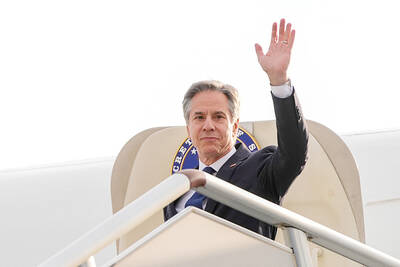
‘IN A DIFFERENT PLACE’: The envoy first visited Shanghai, where he attended a Chinese basketball playoff match, and is to meet top officials in Beijing tomorrow US Secretary of State Antony Blinken yesterday arrived in China on his second visit in a year as the US ramps up pressure on its rival over its support for Russia while also seeking to manage tensions with Beijing. The US diplomat tomorrow is to meet China’s top brass in Beijing, where he is also expected to plead for restraint as Taiwan inaugurates president-elect William Lai (賴清德), and to raise US concerns on Chinese trade practices. However, Blinken is also seeking to stabilize ties, with tensions between the world’s two largest economies easing since his previous visit in June last year. At the
Nearly half of China’s major cities are suffering “moderate to severe” levels of subsidence, putting millions of people at risk of flooding, especially as sea levels rise, according to a study of nationwide satellite data released yesterday. The authors of the paper, published by the journal Science, found that 45 percent of China’s urban land was sinking faster than 3mm per year, with 16 percent at more than 10mm per year, driven not only by declining water tables, but also the sheer weight of the built environment. With China’s urban population already in excess of 900 million people, “even a small portion

UNSETTLING IMAGES: The scene took place in front of TV crews covering the Trump trial, with a CNN anchor calling it an ‘emotional and unbelievably disturbing moment’ A man who doused himself in an accelerant and set himself on fire outside the courthouse where former US president Donald Trump is on trial has died, police said yesterday. The New York City Police Department (NYPD) said the man was declared dead by staff at an area hospital. The man was in Collect Pond Park at about 1:30pm on Friday when he took out pamphlets espousing conspiracy theories, tossed them around, then doused himself in an accelerant and set himself on fire, officials and witnesses said. A large number of police officers were nearby when it happened. Some officers and bystanders rushed
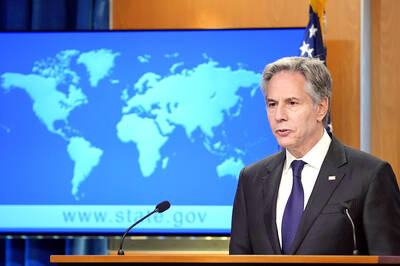
Beijing is continuing to commit genocide and crimes against humanity against Uyghurs and other Muslim minorities in its western Xinjiang province, U.S. Secretary of State Antony Blinken said in a report published on Monday, ahead of his planned visit to China this week. The State Department’s annual human rights report, which documents abuses recorded all over the world during the previous calendar year, repeated language from previous years on the treatment of Muslims in Xinjiang, but the publication raises the issue ahead of delicate talks, including on the war in Ukraine and global trade, between the top U.S. diplomat and Chinese


 RSS
RSS