


Liberian President Ellen Johnson Sirleaf said on Friday that she had asked Nigeria to extradite Charles Taylor, the former Liberian president, to face war crimes charges.
Johnson Sirleaf told the UN Security Council that she had made a formal request to Nigerian President Olusegun Obasanjo.
Taylor claimed asylum in Nigeria in August 2003 as part of an internationally brokered peace settlement ending 14 years of civil war in Liberia.
He was subsequently indicted on 17 counts of war crimes and crimes against humanity by a UN-backed court in neighboring Sierra Leone.
Taylor, 58, a warlord turned president, rampaged through his own country and much of West Africa during the 1990s, unleashing ruthless campaigns of torture, rape and dismemberment that convulsed civilian populations.
Even from exile, he has maintained influence in Liberia, with thousands of young combatants still loyal to him.
"Liberia's peace is fragile. There are many loyalists in our country to Mr Taylor, there are many business interests he has," Johnson Sirleaf said.
"Whatever decision is taken by the African leadership must ensure that the safety of the Liberian people and the stability of our nation is not undermined," she said.
She said Obasanjo would consult African leaders because they had been signatories to the deal that sent Taylor into exile and would need to agree to send Taylor to the court in Sierra Leone.
She said she also wanted to "ensure that in any proceedings, there is an environment that protects all, including the accused's, fundamental human rights."
She was not seeking Taylor's extradition to Liberia, she said, because he was not under indictment there. If he were sent to Liberia, UN peacekeepers there have been authorized by the Security Council to transfer him to the Sierra Leone tribunal.
Obasanjo has been under pressure to act on Taylor but had said he would await a request from a democratically elected Liberian president. Johnson Sirleaf was elected in November and inaugurated on Jan. 16.
She complained that the international community should have acted sooner to help Liberia free itself from Taylor's influence.
Corinne Dufka, a senior researcher for Human Rights Watch in Dakar, Senegal, who has followed the Taylor case closely, hailed the move as an "enormous step toward advancing justice in West Africa," but she said she was troubled over Obasanjo's decision to seek the approval of other African leaders.
"Obasanjo must now play his own part in the fight against impunity in West Africa," she said.
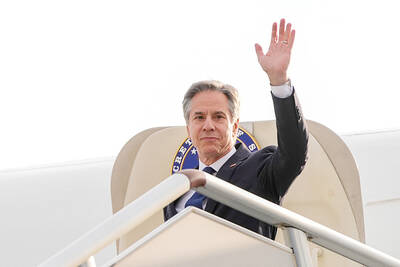
‘IN A DIFFERENT PLACE’: The envoy first visited Shanghai, where he attended a Chinese basketball playoff match, and is to meet top officials in Beijing tomorrow US Secretary of State Antony Blinken yesterday arrived in China on his second visit in a year as the US ramps up pressure on its rival over its support for Russia while also seeking to manage tensions with Beijing. The US diplomat tomorrow is to meet China’s top brass in Beijing, where he is also expected to plead for restraint as Taiwan inaugurates president-elect William Lai (賴清德), and to raise US concerns on Chinese trade practices. However, Blinken is also seeking to stabilize ties, with tensions between the world’s two largest economies easing since his previous visit in June last year. At the

UNSETTLING IMAGES: The scene took place in front of TV crews covering the Trump trial, with a CNN anchor calling it an ‘emotional and unbelievably disturbing moment’ A man who doused himself in an accelerant and set himself on fire outside the courthouse where former US president Donald Trump is on trial has died, police said yesterday. The New York City Police Department (NYPD) said the man was declared dead by staff at an area hospital. The man was in Collect Pond Park at about 1:30pm on Friday when he took out pamphlets espousing conspiracy theories, tossed them around, then doused himself in an accelerant and set himself on fire, officials and witnesses said. A large number of police officers were nearby when it happened. Some officers and bystanders rushed

Beijing is continuing to commit genocide and crimes against humanity against Uyghurs and other Muslim minorities in its western Xinjiang province, U.S. Secretary of State Antony Blinken said in a report published on Monday, ahead of his planned visit to China this week. The State Department’s annual human rights report, which documents abuses recorded all over the world during the previous calendar year, repeated language from previous years on the treatment of Muslims in Xinjiang, but the publication raises the issue ahead of delicate talks, including on the war in Ukraine and global trade, between the top U.S. diplomat and Chinese
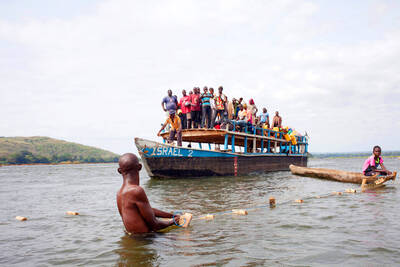
RIVER TRAGEDY: Local fishers and residents helped rescue people after the vessel capsized, while motorbike taxis evacuated some of the injured At least 58 people going to a funeral died after their overloaded river boat capsized in the Central African Republic’s (CAR) capital, Bangui, the head of civil protection said on Saturday. “We were able to extract 58 lifeless bodies,” Thomas Djimasse told Radio Guira. “We don’t know the total number of people who are underwater. According to witnesses and videos on social media, the wooden boat was carrying more than 300 people — some standing and others perched on wooden structures — when it sank on the Mpoko River on Friday. The vessel was heading to the funeral of a village chief in


 RSS
RSS