


During US Secretary of State Condoleezza Rice's meetings in Indonesia this week, she will touch on Washington's main concern about that nation, the world's most populous Muslim country: that it stick to the path of moderation.
She will visit an Islamic primary school, one of many schools in Indonesia now supported with US aid, where she will try to soften the image of the US as anti-Muslim. She will also give a speech praising Indonesia for its rapid switch to democracy.
But alongside what often seems like a one-note US agenda of fighting terrorism, Rice is expected to hear about another overriding interest for both Indonesia and Australia, her next stop. It can be summed up in one word: China.
For Indonesia and Australia, China is not just a rising power as it is often described in Washington, but has already arrived as the regional power that spreads economic benefit. China is driving intra-Asian economic integration through ASEAN, which excludes the US, and by 2010 the region's trade with China is likely to outstrip its trade with the US.
To sweeten the economic bonds, China has not been too pushy in other areas, stepping politely to address its strategic and diplomatic goals as it seeks the affections of surrounding countries, many of which have had longstanding relations with the US.
"China has now established itself as the paramount regional power in Southeast Asia," said Milton Osborne, a former Australian diplomat and scholar on the region at the Lowy Institute of International Affairs in Sydney. "This is widely recognized in Southeast Asia, however people choose to express the idea."
In Indonesia, China has turned on the charm, transforming a relationship that was once fraught with suspicion into a blossoming economic partnership. China's state energy companies have bought into Indonesian oil and natural gas fields in Java and Papua and are expected to bid on tenders for new power plants. Indonesian exports to China in 2004 increased by 232 percent from the previous year.
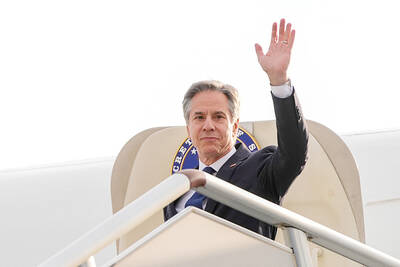
‘IN A DIFFERENT PLACE’: The envoy first visited Shanghai, where he attended a Chinese basketball playoff match, and is to meet top officials in Beijing tomorrow US Secretary of State Antony Blinken yesterday arrived in China on his second visit in a year as the US ramps up pressure on its rival over its support for Russia while also seeking to manage tensions with Beijing. The US diplomat tomorrow is to meet China’s top brass in Beijing, where he is also expected to plead for restraint as Taiwan inaugurates president-elect William Lai (賴清德), and to raise US concerns on Chinese trade practices. However, Blinken is also seeking to stabilize ties, with tensions between the world’s two largest economies easing since his previous visit in June last year. At the
Nearly half of China’s major cities are suffering “moderate to severe” levels of subsidence, putting millions of people at risk of flooding, especially as sea levels rise, according to a study of nationwide satellite data released yesterday. The authors of the paper, published by the journal Science, found that 45 percent of China’s urban land was sinking faster than 3mm per year, with 16 percent at more than 10mm per year, driven not only by declining water tables, but also the sheer weight of the built environment. With China’s urban population already in excess of 900 million people, “even a small portion

UNSETTLING IMAGES: The scene took place in front of TV crews covering the Trump trial, with a CNN anchor calling it an ‘emotional and unbelievably disturbing moment’ A man who doused himself in an accelerant and set himself on fire outside the courthouse where former US president Donald Trump is on trial has died, police said yesterday. The New York City Police Department (NYPD) said the man was declared dead by staff at an area hospital. The man was in Collect Pond Park at about 1:30pm on Friday when he took out pamphlets espousing conspiracy theories, tossed them around, then doused himself in an accelerant and set himself on fire, officials and witnesses said. A large number of police officers were nearby when it happened. Some officers and bystanders rushed
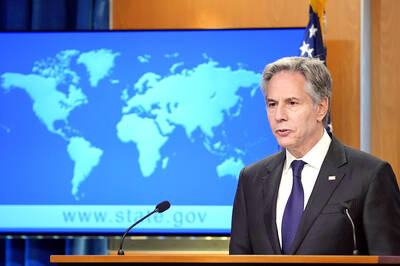
Beijing is continuing to commit genocide and crimes against humanity against Uyghurs and other Muslim minorities in its western Xinjiang province, U.S. Secretary of State Antony Blinken said in a report published on Monday, ahead of his planned visit to China this week. The State Department’s annual human rights report, which documents abuses recorded all over the world during the previous calendar year, repeated language from previous years on the treatment of Muslims in Xinjiang, but the publication raises the issue ahead of delicate talks, including on the war in Ukraine and global trade, between the top U.S. diplomat and Chinese


 RSS
RSS