


Former Serbian president Slobodan Milosevic, found dead in his prison bed on Saturday, defied international sanctions and NATO bombs over nearly a decade of strife in the former Yugoslavia and was unmoved by accusations of genocide, war crimes and crimes against humanity.
The "Butcher of the Balkans" stoked conflicts that left more than 200,000 people dead, up to three million homeless and the Serbian economy in ruins.
But he made no apologies for his actions in Croatia, Bosnia and Kosovo, where his drive for a Greater Serbia "cleansed" of Croats and Muslims sparked a rash of grisly massacres and finally a showdown with the West.
"I'm proud for everything I did in defending my country and my people," he told US television network Fox News in a phone interview in 2001 from his jail outside The Hague, where he was awaiting trial.
"All my decisions are legitimate and legal, based on the Constitution of Yugoslavia and based on the rights to self-defense."
Milosevic portrayed himself as a besieged statesman who struggled to keep the crumbling Yugoslav federation intact against separatists and "terrorists."
He started as a faceless Communist minion, later fashioned himself into a successful businessman and technocrat, and bullied his way into political prominence as a ruthless champion of the Serbian cause.
Western officials were often caught flatfooted by Milosevic, who was widely seen both as the source of Balkan tensions but also the key to regional peace in 1995.
Richard Holbrooke, who brokered the 1995 Dayton peace accords to end the Bosnian war remembered him as a negotiator who could be "smart, charming and evasive."
But the pendulum swung definitively after Milosevic's crackdown on ethnic Albanians in Kosovo in 1999. Many then adopted US Senator Joseph Biden's view that he was "one of the most dangerous and maniacal European leaders since Hitler."
Milosevic was born on August 20, 1941, in the eastern Serbian town of Pozarevac, the son of an Orthodox priest and ardently communist schoolteacher.
He graduated from Belgrade University with a law degree and climbed through the ruling ranks of Tito's Yugoslavia, developing a reputation as a communist "apparatchik's apparatchik."
Milosevic headed both the state-run gas company and the state-run bank. But he was still a relatively little-known official until April 24, 1987.
On that day he was summoned to help calm a crowd of Kosovar Serbs protesting mistreatment by the province's Albanian majority. As riot police beat back the throng, Milosevic was anything but calming.
"No one has the right to beat you. No one will ever beat you again," he raged from a nearby balcony. The Serb battle cry was born and ethnic hatreds that had been welling up since Tito's death in 1980 were unleashed.
Milosevic took over as president of the Serbian republic in 1989, quickly revoking Kosovo's autonomous status and ratcheting up the Serbs' jingoistic spirit as Yugoslavia broke apart in 1991.
As president of Serbia and later head of the rump Yugoslav republic that joined it with Montenegro, Milosevic was a cunning leader who used the state media to the hilt to inflame Serb passions and stifle dissent.
But after the wars in Croatia and Bosnia, the ethnic cleansing campaign in Kosovo and the 11 weeks of NATO airstrikes it prompted were the last straw for a beleaguered Yugoslav people.
Increasingly targeted by demonstrations and strikes, Milosevic ran for a new term as Yugoslav president but the machinery no longer worked for him. He conceded defeat and resigned on Oct. 7, 2000.
Six months later he was arrested on suspicion of abuse of power and misappropriation of state funds, surrendering only after holding a gun to his head and threatening to kill himself.
His transfer to the UN war crimes court in The Hague back in 2001 hardly produced a ripple in Belgrade.
His trial, which began in 2002, was frequently interrupted because of illness sparked by high blood pressure and heart problems.
It was due to resume tomorrow after a two-week break, caused this time by problems in scheduling witnesses.
Insisting on defending himself, Milosevic concentrated almost totally on events in Kosovo, hardly going into the charges related to the war in Croatia and the genocide charges against him over the war in Bosnia.
According to the last calculations Milosevic had already used up 85.11 percent of the 360 hours allotted to him for his defense, meaning he only had about a dozen court days left to complete his defense case.

‘IN A DIFFERENT PLACE’: The envoy first visited Shanghai, where he attended a Chinese basketball playoff match, and is to meet top officials in Beijing tomorrow US Secretary of State Antony Blinken yesterday arrived in China on his second visit in a year as the US ramps up pressure on its rival over its support for Russia while also seeking to manage tensions with Beijing. The US diplomat tomorrow is to meet China’s top brass in Beijing, where he is also expected to plead for restraint as Taiwan inaugurates president-elect William Lai (賴清德), and to raise US concerns on Chinese trade practices. However, Blinken is also seeking to stabilize ties, with tensions between the world’s two largest economies easing since his previous visit in June last year. At the

UNSETTLING IMAGES: The scene took place in front of TV crews covering the Trump trial, with a CNN anchor calling it an ‘emotional and unbelievably disturbing moment’ A man who doused himself in an accelerant and set himself on fire outside the courthouse where former US president Donald Trump is on trial has died, police said yesterday. The New York City Police Department (NYPD) said the man was declared dead by staff at an area hospital. The man was in Collect Pond Park at about 1:30pm on Friday when he took out pamphlets espousing conspiracy theories, tossed them around, then doused himself in an accelerant and set himself on fire, officials and witnesses said. A large number of police officers were nearby when it happened. Some officers and bystanders rushed

Beijing is continuing to commit genocide and crimes against humanity against Uyghurs and other Muslim minorities in its western Xinjiang province, U.S. Secretary of State Antony Blinken said in a report published on Monday, ahead of his planned visit to China this week. The State Department’s annual human rights report, which documents abuses recorded all over the world during the previous calendar year, repeated language from previous years on the treatment of Muslims in Xinjiang, but the publication raises the issue ahead of delicate talks, including on the war in Ukraine and global trade, between the top U.S. diplomat and Chinese
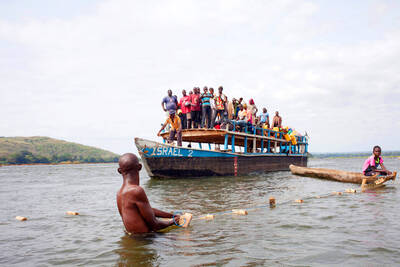
RIVER TRAGEDY: Local fishers and residents helped rescue people after the vessel capsized, while motorbike taxis evacuated some of the injured At least 58 people going to a funeral died after their overloaded river boat capsized in the Central African Republic’s (CAR) capital, Bangui, the head of civil protection said on Saturday. “We were able to extract 58 lifeless bodies,” Thomas Djimasse told Radio Guira. “We don’t know the total number of people who are underwater. According to witnesses and videos on social media, the wooden boat was carrying more than 300 people — some standing and others perched on wooden structures — when it sank on the Mpoko River on Friday. The vessel was heading to the funeral of a village chief in


 RSS
RSS