


Opponents of Thai Prime Minister Thaksin Shinawatra vowed yesterday not to end their protests until he resigns, as police warned of possible violence at demonstrations expected to draw tens of thousands of people.
"We will camp there until we get the answer from Thaksin," said Suriyasai Katasila, spokesman for the anti-Thaksin People's Alliance for Democracy.
"If the police don't allow us to stay at the venue, we have the right to disobey their orders," he warned.
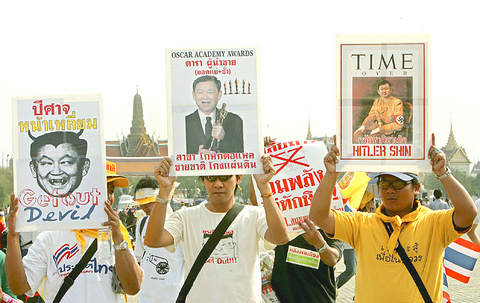
PHOTO: EPA
Tens of thousands of people are expected to join the protest from 4pm, with 5,000 police on hand and another 5,000 on alert.
Police set up checkpoints around Bangkok to search for weapons in buses and trucks taking people to the demonstration.
"Police are under instructions not to confront protesters or stop them, even if they march to the prime minister's home or Government House," Police Colonel Pinij Maneerat said, referring to Thaksin's office in central Bangkok.
Political tensions ran high in Bangkok this weekend as Thaksin and his rivals staged dueling mass rallies just two days apart in the same Sanam Luang field near the royal palace.
In a bid to ratchet up the pressure on Thaksin, a group of 99 academics and senators petitioned King Bhumibol Adulyadej yesterday to intervene by appointing a neutral interim government to supervise the poll.
"We cannot see any possible solution, other than to seek your gracious discretion in invoking Article 7 of the Constitution that grants people an interim government to be charged with the responsibility of amending the constitution and supervise a fair election," the petition said.
Organizers of the rally yesterday said they planned to march from Sanam Luang to Democracy Monument about 1km away, where Suriyasai said they would camp for days if necessary until Thaksin steps down.
"The chances of violence is highly likely and we would prefer for people to stay at home," said national police spokesman Ajirawid Subarnbhesaj.
Police estimated some 50,000 people would attend the rally.
"It is very difficult to prevent violence at a protest where a huge number of people is gathered, especially when they move from one place to another," he said.
Thaksin drew some 150,000 people late on Friday as he began his campaign for snap elections on April 2, and on Saturday he called for national unity and urged all protesters to remain peaceful.
Thaksin, who faces allegations of corruption and abuse of power, told his rally that he would refuse to take office if he takes less than half the vote, and vowed constitutional changes and new elections in about one year if he wins.
But the People's Alliance for Democracy party rejected his latest offer of political reforms on Saturday and vowed to stage demonstrations until the prime minister steps down.
"Our stance is that the constitutional changes and political reforms offered by Thaksin were only an empty promise so that Thaksin could try to stay in power," Suriyasai said.
After a month of street protests demanding his resignation, Thaksin abruptly dissolved parliament on Feb. 24 and called a general election three years ahead of schedule, in a bid to defuse the crisis.
But the country's main opposition Democrat Party and two other parties said they would boycott the polls, which analysts said would threaten their legitimacy and potentially throw the kingdom deeper into political turmoil.
Thaksin again called on the opposition parties at the Friday rally to join elections and said he would even accept a postponement of the election if they needed more time to find candidates.
Thaksin won his second term in office last year with an absolute majority in parliament, an historic victory that made him appear invincible.
But simmering discontent bubbled over in January when his family sold their shares in Shin Corp, the telecoms giant Thaksin founded before entering politics, for US$1.9 billion, tax free.
Anger at the deal, mostly among Bangkok's urban middle classes, has turned into weekly street protests since Feb. 4, drawing tens of thousands of people demanding his resignation.

South Korea’s air force yesterday apologized for a 2021 midair collision involving two fighter jets, a day after auditors said the pilots were taking selfies and filming during the flight and held them responsible for the accident. “We sincerely apologize to the public for the concern caused by the accident that occurred in 2021,” an air force spokesman told a news conference, adding that one of the pilots involved had been suspended from flying duties, received severe disciplinary action and has since left the military. The apology followed a report released on Wednesday by the South Korean Board of Audit and Inspection,

Indonesian police have arrested 13 people after shocking images of alleged abuse against small children at a daycare center went viral, sparking outrage across the nation, officials said on Monday. Police on Friday last week raided Little Aresha, a daycare center in Yogyakarta on Java island, following a report from a former employee. CCTV footage circulating on social media showed children, most younger than two, lying on the floor wearing only diapers, their hands and feet bound with rags. The police have confirmed that the footage is authentic. Police said they also found 20 children crammed into a room just 3m by 3m. “So

About 240 Indians claiming descent from a Biblical tribe landed at Tel Aviv airport on Thursday as part of a government operation to relocate them to Israel. The newcomers passed under a balloon arch in blue and white, the colors of the Israeli flag, as dozens of well-wishers welcomed them with a traditional Jewish song. They were the first “bnei Menashe” (“sons of Manasseh”) to arrive in Israel since the government in November last year announced funding for the immigration of about 6,000 members of the community from the states of Manipur and Mizoram in northeast India. The community claims to descend from

‘TROUBLING’: The firing of Phelan, who was an adviser to a nonprofit that supported the defense of Taiwan, was another example of ‘dysfunction’ under Trump, a US senator said US Secretary of the Navy John Phelan has been fired, a US official and a person familiar with the matter said on Wednesday, in another wartime shakeup at the Pentagon coming just weeks after US Secretary of Defense Pete Hegseth ousted the Army’s top general. The Pentagon announced his departure in a brief statement, saying he was leaving the administration “effective immediately,” but it did not provide a reason or say whether it was his decision to go. The sources, who spoke on condition of anonymity, said Phelan was dismissed in part because he was moving too slowly to implement reforms to


 RSS
RSS