


Japan, the world's top fish consumer, exceeded its catch quota for southern bluefin tuna by nearly 25 percent last year, forcing it to tighten fishing rules, officials said yesterday.
A voracious global appetite for fish, of which Japan's huge demand is a key part, has led to widespread overfishing and pushed many highly sought after species, including some varieties of bluefin tuna, close to the edge.
According to the UN, more than 70 percent of the world's commercially important fish stocks are either over-exploited, depleted, slowly recovering or close to the maximum sustainable level of exploitation.
Last year, Japan exceeded its 6,065 tonne quota of southern bluefin tuna by 1,500 tonnes, according to the Fisheries Agency, which blamed sloppy record-keeping for the disparity.
"There are some years where there's a sudden jump in catches just before the season ends, before we're able to declare the season over," he added. "Going over the quota a bit is actually not that uncommon, but this year the excess was quite large, making us think we need to revise our management system."
Quotas for each season's southern bluefin fishing are allotted by the Commission for Conservation of Southern Bluefin Tuna, comprising Japan, Australia, New Zealand, Taiwan and South Korea.
The fish are protected under guidelines laid down by the commission after years of heavy fishing, with the worldwide catch limited to 14,080 tons.
But Australia pointed out at the commission's annual meeting in October that as much as 99 percent of the world catch circulated in Japan, farm ministry official Shingo Kurohagi said.
Up to now, Japanese ships sent in periodic reports on their catches to the Fisheries Agency, which declared the season over when the quota was met.
"We checked the records, but it is true that we couldn't check every one," the fisheries official said.
Under the new rules, which take effect from April, each fishing company will be allotted a specific quota and will be required to tag each fish showing when and where it was caught.
Ships will also be permitted to unload their catch only at specific harbors. Violations will be punished by forbidding ships from leaving harbor, up to two years' jail and a fine of ¥500,000 (US$4,309).
Companies that buy and sell untagged and thus technically illegal fish could face punishment along with the fishing firms.
Last year, about 150,000 tonnes of tuna was consumed by Japanese households.
That tuna may be slightly pricier this year, however. In response for going over last year's quota, Japan's allotment this year will be cut by 1,500 tonnes.

Through the noise of rushing papers and whirring belts at a print factory in Kyoto, two creators watch their photo essay come to life in broadsheet form — part of an effort to win new audiences in the age of artificial intelligence (AI). Despite the decline of the publishing industry, self-publication and handmade “zine” magazines are growing in popularity in Japan, reflecting the nation’s enduring love of paper in the digital era. While speaking to Agence France-Presse at the plant, his hands black with ink, one of the creators, Kazuma Obara, said: “I think [paper] is a medium that engages all five
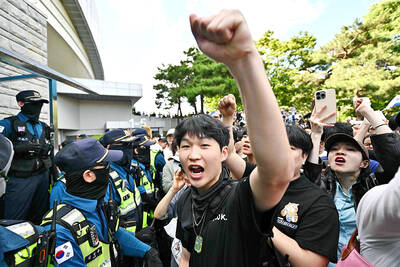
‘ABSURD MISTAKE’: The election commission said that there had been a failure to anticipate turnout after 14 polling stations ran short of ballot papers South Korean riot police yesterday cleared protesters from a Seoul polling station after a 35-hour blockade sparked by a shortage of ballot papers during local elections earlier this week. Wednesday’s election was the first nationwide vote since South Korean President Lee Jae-myung took office following the ouster of Yoon Suk-yeol over his short-lived martial law declaration. Lee’s ruling Democratic Party swept most races, but failed to flip the crucial Seoul mayoral seat. The South Korean National Election Commission apologized, blaming a failure to anticipate turnout after 14 polling stations in Seoul ran short of ballot papers. Some polling stations stayed open until 10pm to

Australian researchers have trained lab-grown brain cells on a silicon computer chip to play the 1990s shooter game Doom and said they are just scratching the surface of what the neurons could be capable of doing. It is the science-fiction work of biotech boffins at Cortical Labs, who researched and developed the technology that harnesses the workings of the brain’s networking system. Each so-called “biological computer” contains about 200,000 living human brain cells, grown from stem cells that were harvested from blood donations. Having mastered the simple computer game Pong, where a paddle is moved up and down to send a ball

France experienced its hottest spring on record, the French weather service said on Tuesday, after an exceptional early heat wave that also broke highs for the season in England and Wales. Meteo-France said the average nationwide temperature over March to May was 13.8°C — about 1.7°C above the norm, and surpassing records set in 2011 and 2020. “The warmest spring since records began in 1900,” it said in a bulletin. All three months were warmer than average, but the onset of an “unprecedented heatwave” late last month pushed the mercury to highs typically seen at the height of the summer. “Our country had never


 RSS
RSS