


The US will send an extra 15 diplomats to China, 15 to Latin America and 12 to India as part of a major rethink of its foreign policy for the next few decades.
US embassies in Europe will lose 38 diplomats in total, a reflection that the economic, political and religious frontlines have moved elsewhere.
US Secretary of State Condoleezza Rice said in January that hundreds of diplomats would be moved from Europe and Washington to Asia, the Middle East and Africa.
The shift of Washington's diplomatic weight comes after a Pentagon report last month which envisaged a "long war" against terrorism in which a major propaganda effort would be needed to win the hearts in the Muslim world.
The new postings indicate the countries identified by Washington as economic and political rivals or partners, such as China and India, as well as potential flashpoints.
The existing positions reflect the importance of Europe to the US during the cold war. Europe was also regarded as a relatively cushy posting for US diplomats, except for those based in Russia and eastern Europe before the fall of the Berlin Wall in 1989.
The state department list shows that the biggest reduction worldwide will be in Russia, where the US embassy will cut 10 posts.
Germany will lose seven, and countries such as Belgium, Poland, Italy and Spain will lose two or three each.
The increase in diplomats in China is an acknowledgement by Washington not only of its importance but its possible military threat to US interests in the Pacific Rim countries and elsewhere in Asia, and the danger posed by unresolved territorial issues such as Taiwan.
The other priority for the US is India, not least as a counterbalance to China. Relations between the US and India have frequently been strained since independence, with New Delhi a leader of the Non-Aligned Movement and often closer to Moscow than to Washington.
Bush and Rice will find there remains strong left-wing opposition in the government coalition and among the public towards the US. Thousands of protesters gathered in Mumbai yesterday, waving signs that read "Devil Bush Go Back."
Robert Pearson, who retired on Monday as director-general of the foreign service after a 30-year diplomatic career, said that demographics were a major element in most of the personnel changes.
He said the combined populations of North America and Europe would constitute no more than 10 percent of the world population by the middle of the century.
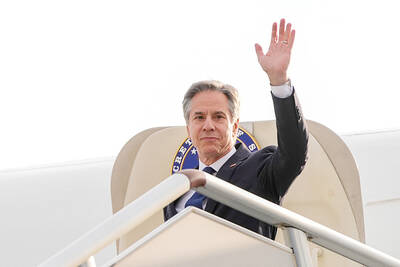
‘IN A DIFFERENT PLACE’: The envoy first visited Shanghai, where he attended a Chinese basketball playoff match, and is to meet top officials in Beijing tomorrow US Secretary of State Antony Blinken yesterday arrived in China on his second visit in a year as the US ramps up pressure on its rival over its support for Russia while also seeking to manage tensions with Beijing. The US diplomat tomorrow is to meet China’s top brass in Beijing, where he is also expected to plead for restraint as Taiwan inaugurates president-elect William Lai (賴清德), and to raise US concerns on Chinese trade practices. However, Blinken is also seeking to stabilize ties, with tensions between the world’s two largest economies easing since his previous visit in June last year. At the
Nearly half of China’s major cities are suffering “moderate to severe” levels of subsidence, putting millions of people at risk of flooding, especially as sea levels rise, according to a study of nationwide satellite data released yesterday. The authors of the paper, published by the journal Science, found that 45 percent of China’s urban land was sinking faster than 3mm per year, with 16 percent at more than 10mm per year, driven not only by declining water tables, but also the sheer weight of the built environment. With China’s urban population already in excess of 900 million people, “even a small portion

UNSETTLING IMAGES: The scene took place in front of TV crews covering the Trump trial, with a CNN anchor calling it an ‘emotional and unbelievably disturbing moment’ A man who doused himself in an accelerant and set himself on fire outside the courthouse where former US president Donald Trump is on trial has died, police said yesterday. The New York City Police Department (NYPD) said the man was declared dead by staff at an area hospital. The man was in Collect Pond Park at about 1:30pm on Friday when he took out pamphlets espousing conspiracy theories, tossed them around, then doused himself in an accelerant and set himself on fire, officials and witnesses said. A large number of police officers were nearby when it happened. Some officers and bystanders rushed

Beijing is continuing to commit genocide and crimes against humanity against Uyghurs and other Muslim minorities in its western Xinjiang province, U.S. Secretary of State Antony Blinken said in a report published on Monday, ahead of his planned visit to China this week. The State Department’s annual human rights report, which documents abuses recorded all over the world during the previous calendar year, repeated language from previous years on the treatment of Muslims in Xinjiang, but the publication raises the issue ahead of delicate talks, including on the war in Ukraine and global trade, between the top U.S. diplomat and Chinese


 RSS
RSS