


At precisely 2pm, Andrew Leppard settled into a now familiar role. The assistant chief constable of Kent, in southeast England, is now famous. Famous as the public face of Britain's biggest ever robbery.
On Saturday, hosting yet another press conference on day four of the police investigation into the whereabouts of the ?50 million (US$87 million) taken from a Securitas warehouse, he gave more details.
Details of the feelings of the warehouse manager kidnapped and bundled into the back of a fake police car. Details about further arrests as the police hope that the noose is tightening against "the firm" behind the Tonbridge Heist. Details of the burnt-out cars, the van and the discarded money that might lead to a breakthrough.
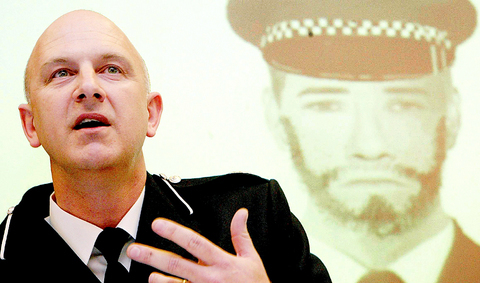
PHOTO: AP
It could have been worse. Although how much worse will not be known for several days, not until forensic scientists have finished combing the cash storage depot for clues. Banking sources have said that the gang that pulled off the heist did not take all the cash in the Securitas depot and that millions of pounds were left behind.
That the gang left some of the cash should be a concern to the detectives hunting them. The history of audacious robberies confirms that greed often undoes a criminal gang.
The Tonbridge gang appears different. Their subsequent decision to dump anything between ?1million and ?5 million in new, traceable, bank notes stored in the depot on behalf of the Bank of England, shows an unnerving awareness that, in terms of a successful robbery, less is sometimes more.
On Saturday police continued to search the van in which the traceable cash was found. It was discovered after a tip-off, opening up the possibility that the gang fled abroad on the Eurostar.
On Saturday night police were checking the train's passenger records in the hope of spotting a familiar name.
Of more concern to police is the whereabouts of the cash that wasn't owned by the Bank of England: the loose, used notes that were being sorted by the depot staff on behalf of banks and supermarkets in the Kent area.
The Securitas sorting team on duty on Tuesday night were sifting through the piles to see which notes were no longer fit for circulation. It is this money, which may total anything between ?20 million to ?30 million, that is the problem for police. It is virtually untraceable.
On Saturday Leppard remained confident that the criminals would be brought to book.
"We have had more than 800 calls from the public," he said.
During the conference a statement was read out on behalf of Colin Dixon, the Securitas manager who, along with his wife and son, was taken hostage by the gang.
"It was the worst night of my life," Dixon said, adding his family had been placed in "unimaginable danger."
Leppard's hopes of catching the gang were raised by a series of quick breakthroughs last week.
A number of vehicles linked to the gang were found scattered across locations in Kent. Then came two arrests. Michelle Hogg and Michael Demetris, make-up artists who specialize in false wigs and beards, were questioned on Friday. At least one member of the gang is thought to have worn a false beard when impersonating a police officer. Hogg and Demetris have been released on police bail without charge.
Then, on Saturday, two men were arrested in Kent under conspiracy to commit robbery.
Helped by regular news conferences which have slow-dripped developments in the investigation to the media, Leppard has given the impression the net is closing in.
The truth is, though, Leppard knows his best chance of a quick result is to play on what motivated the gang in the first place: greed.
He has offered a ?2 million reward to anyone willing to turn supergrass. For those fearful of underworld retribution, he has promised: "We will look after you."

PRECARIOUS RELATIONS: Commentators in Saudi Arabia accuse the UAE of growing too bold, backing forces at odds with Saudi interests in various conflicts A Saudi Arabian media campaign targeting the United Arab Emirates (UAE) has deepened the Gulf’s worst row in years, stoking fears of a damaging fall-out in the financial heart of the Middle East. Fiery accusations of rights abuses and betrayal have circulated for weeks in state-run and social media after a brief conflict in Yemen, where Saudi airstrikes quelled an offensive by UAE-backed separatists. The United Arab Emirates is “investing in chaos and supporting secessionists” from Libya to Yemen and the Horn of Africa, Saudi Arabia’s al-Ekhbariya TV charged in a report this week. Such invective has been unheard of
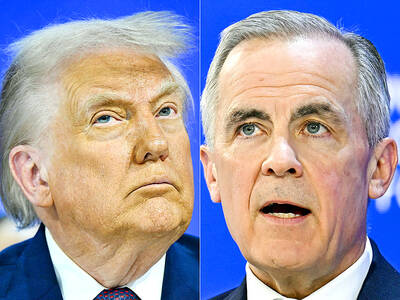
US President Donald Trump on Saturday warned Canada that if it concludes a trade deal with China, he would impose a 100 percent tariff on all goods coming over the border. Relations between the US and its northern neighbor have been rocky since Trump returned to the White House a year ago, with spats over trade and Canadian Prime Minister Mark Carney decrying a “rupture” in the US-led global order. During a visit to Beijing earlier this month, Carney hailed a “new strategic partnership” with China that resulted in a “preliminary, but landmark trade agreement” to reduce tariffs — but

Chinese President Xi Jinping’s (習近平) purge of his most senior general is driven by his effort to both secure “total control” of his military and root out corruption, US Ambassador to China David Perdue said told Bloomberg Television yesterday. The probe into Zhang Youxia (張又俠), Xi’s second-in-command, announced over the weekend, is a “major development,” Perdue said, citing the family connections the vice chair of China’s apex military commission has with Xi. Chinese authorities said Zhang was being investigated for suspected serious discipline and law violations, without disclosing further details. “I take him at his word that there’s a corruption effort under
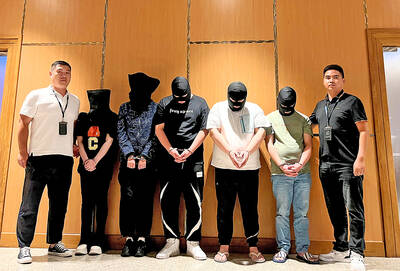
China executed 11 people linked to Myanmar criminal gangs, including “key members” of telecom scam operations, state media reported yesterday, as Beijing toughens its response to the sprawling, transnational industry. Fraud compounds where scammers lure Internet users into fake romantic relationships and cryptocurrency investments have flourished across Southeast Asia, including in Myanmar. Initially largely targeting Chinese speakers, the criminal groups behind the compounds have expanded operations into multiple languages to steal from victims around the world. Those conducting the scams are sometimes willing con artists, and other times trafficked foreign nationals forced to work. In the past few years, Beijing has stepped up cooperation


 RSS
RSS