


US-Venezuelan relations hit a new low Friday as Washington ordered a Venezuelan diplomat expelled in retaliation for Caracas' move to kick out a US naval attache on espionage charges.
State Department spokesman Sean McCormack said Washington had informed Venezuela by diplomatic note that it was declaring Jenny Figueredo Frias, a minister counselor at the embassy here, persona non grata.
"This decision is in response to the government of Venezuela's decision to yesterday expel Commander John Correa, US naval attache in the US embassy in Caracas," McCormack said.
McCormack said Figueredo, the chief of staff to Venezuela's ambassador, had 72 hours to leave. He did not accuse her of anything but said simply she was "the most appropriate" choice for expulsion.
"We don't like to get into tit-for-tat games like this with the Venezuelan government, but they initiated this and we were forced to respond," McCormack told the daily State Department briefing.
The US move drew fire from Venezuela's Vice Foreign Minister Pavel Rondon, who told Union Radio in Caracas that it was "incongruous and disproportionate."
Caracas's vice foreign minister for North America, Mari Pili Hernandez, insisted Figueredo was a "model" diplomat and called her expulsion a "reprisal of a political character."
But Venezuela would not follow Washington's move with the expulsion of a second US diplomat, she said.
"The decisions that Venezuela takes are taken based on facts and proof, not simply for retaliation," Hernandez said.
The decision by Venezuelan President Hugo Chavez to accuse the US naval officer of spying and order him out of the country brought diplomatic tensions between Washington and Caracas to a new high.
Chavez said on Monday that Venezuelan authorities infiltrated a group of military officers from the US embassy who he alleged had been spying on his government and preparing operations to arrest him.
US officials called Correa's expulsion unjustified. "None of the military attaches at the US embassy in Caracas was or is involved in inappropriate activities," said Julie Reside, a State Department spokeswoman.
Ties between the countries have gone downhill since the socialist Chavez came to power seven years ago. He frequently accuses Washington of plotting against him and charged it backed an aborted coup in 2002.
The administration of US President George W. Bush has regularly expressed concern about Chavez's influence in Latin America, particularly his alliance with Cuba's communist leader Fidel Castro.
Defense Secretary Donald Rumsfeld on Thursday likened Chavez's rise to power with Nazi leader Adolf Hitler. US intelligence chief John Negroponte accused him of seeking ties with Iran and North Korea, two members of Bush's "axis of evil."
In Havana, with Chavez on a visit, Castro on late Friday slammed Rumsfeld's assessment of his Venezuelan ally. Castro said Chavez had "made possible a new chapter in Latin America's history."
The Hitler comparison "is new and unexpected from those who, like Hitler, dreamed of a 1,000-year empire," Castro added.
Chavez for his part said: "Let the dogs of the empire (the United States) bark away. That is their job, to bark. Ours is to fight."
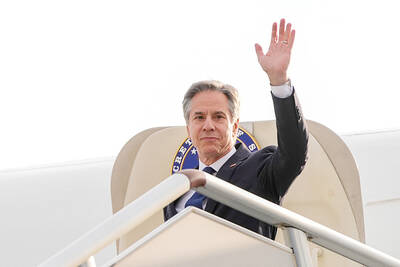
‘IN A DIFFERENT PLACE’: The envoy first visited Shanghai, where he attended a Chinese basketball playoff match, and is to meet top officials in Beijing tomorrow US Secretary of State Antony Blinken yesterday arrived in China on his second visit in a year as the US ramps up pressure on its rival over its support for Russia while also seeking to manage tensions with Beijing. The US diplomat tomorrow is to meet China’s top brass in Beijing, where he is also expected to plead for restraint as Taiwan inaugurates president-elect William Lai (賴清德), and to raise US concerns on Chinese trade practices. However, Blinken is also seeking to stabilize ties, with tensions between the world’s two largest economies easing since his previous visit in June last year. At the

UNSETTLING IMAGES: The scene took place in front of TV crews covering the Trump trial, with a CNN anchor calling it an ‘emotional and unbelievably disturbing moment’ A man who doused himself in an accelerant and set himself on fire outside the courthouse where former US president Donald Trump is on trial has died, police said yesterday. The New York City Police Department (NYPD) said the man was declared dead by staff at an area hospital. The man was in Collect Pond Park at about 1:30pm on Friday when he took out pamphlets espousing conspiracy theories, tossed them around, then doused himself in an accelerant and set himself on fire, officials and witnesses said. A large number of police officers were nearby when it happened. Some officers and bystanders rushed
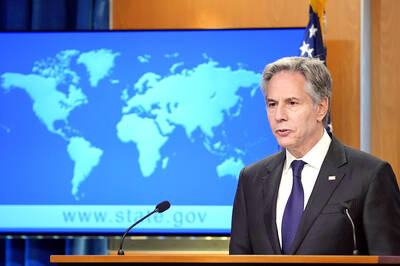
Beijing is continuing to commit genocide and crimes against humanity against Uyghurs and other Muslim minorities in its western Xinjiang province, U.S. Secretary of State Antony Blinken said in a report published on Monday, ahead of his planned visit to China this week. The State Department’s annual human rights report, which documents abuses recorded all over the world during the previous calendar year, repeated language from previous years on the treatment of Muslims in Xinjiang, but the publication raises the issue ahead of delicate talks, including on the war in Ukraine and global trade, between the top U.S. diplomat and Chinese
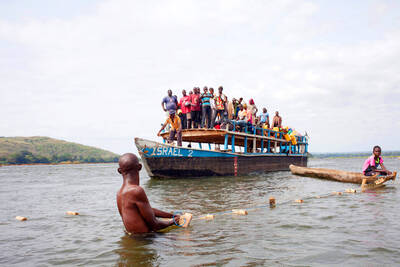
RIVER TRAGEDY: Local fishers and residents helped rescue people after the vessel capsized, while motorbike taxis evacuated some of the injured At least 58 people going to a funeral died after their overloaded river boat capsized in the Central African Republic’s (CAR) capital, Bangui, the head of civil protection said on Saturday. “We were able to extract 58 lifeless bodies,” Thomas Djimasse told Radio Guira. “We don’t know the total number of people who are underwater. According to witnesses and videos on social media, the wooden boat was carrying more than 300 people — some standing and others perched on wooden structures — when it sank on the Mpoko River on Friday. The vessel was heading to the funeral of a village chief in


 RSS
RSS