


The leading US-based Internet firms are showing little interest in attending a Congressional briefing on worries that the firms are bending to the wishes of China's censors.
Microsoft and Cisco Systems have refused to attend the event, while Google and Yahoo are non-committal, officials said.
The firms were asked to attend Wednesday's briefing by the Congressional Human Rights Caucus following uproar caused by search giant Google's decision last week to censor Web sites and content banned by China's propaganda chiefs.
"We have heard from Microsoft that no representative from the company will attend the briefing. So, with Cisco Systems, this makes two companies that have confirmed they're opting out," said Lynne Weil, spokeswoman for caucus co-chairman Democratic Representative Tom Lantos.
As the briefing date gets closer, "others are still unfortunately keeping us in suspense," she said.
"It is mystifying why these companies would not want to take part after all this is an opportunity to clear their names," she said.
Google agreed to censor Web sites and content in its search service launched Wednesday in China. The move followed similar actions by rivals Microsoft and Yahoo in cooperating with Chinese censorship.
Cisco's technology-savvy machinery allegedly censors Internet messages and helps Beijing track down Chinese cyber dissidents.
Americans believed Internet growth will bring about greater freedom of expression and political openness in China but instead of promoting these values, some US firms have been charged with aiding -- or at least complying -- with Chinese Internet censorship, said a statement by the Congressional Human Rights Caucus.
Its briefing is scheduled to be chaired by Democratic Representative Tim Ryan, lead sponsor of a legislation seeking to address China's "manipulation and undervaluation" of its currency.
Weil said all five non-governmental groups invited to the briefing had confirmed participation. They were media watchdog Reporters without Borders, Amnesty International, Human Rights Watch and Toronto University and Harvard Law School.
"It is a sham that the American Internet firms are refusing to be accountable to US Congress and at the same time working hand in glove with the Chinese authorities," said T. Kumar, Amnesty's advocacy director for Asia.
"It is also a paradox that while US multinational companies are for example prohibited from doing any business or trade with Myanmar following human rights sanctions there, Google and others are colluding with the Chinese government in human rights abuses," he said.
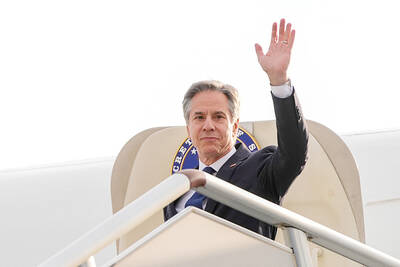
‘IN A DIFFERENT PLACE’: The envoy first visited Shanghai, where he attended a Chinese basketball playoff match, and is to meet top officials in Beijing tomorrow US Secretary of State Antony Blinken yesterday arrived in China on his second visit in a year as the US ramps up pressure on its rival over its support for Russia while also seeking to manage tensions with Beijing. The US diplomat tomorrow is to meet China’s top brass in Beijing, where he is also expected to plead for restraint as Taiwan inaugurates president-elect William Lai (賴清德), and to raise US concerns on Chinese trade practices. However, Blinken is also seeking to stabilize ties, with tensions between the world’s two largest economies easing since his previous visit in June last year. At the
Nearly half of China’s major cities are suffering “moderate to severe” levels of subsidence, putting millions of people at risk of flooding, especially as sea levels rise, according to a study of nationwide satellite data released yesterday. The authors of the paper, published by the journal Science, found that 45 percent of China’s urban land was sinking faster than 3mm per year, with 16 percent at more than 10mm per year, driven not only by declining water tables, but also the sheer weight of the built environment. With China’s urban population already in excess of 900 million people, “even a small portion

UNSETTLING IMAGES: The scene took place in front of TV crews covering the Trump trial, with a CNN anchor calling it an ‘emotional and unbelievably disturbing moment’ A man who doused himself in an accelerant and set himself on fire outside the courthouse where former US president Donald Trump is on trial has died, police said yesterday. The New York City Police Department (NYPD) said the man was declared dead by staff at an area hospital. The man was in Collect Pond Park at about 1:30pm on Friday when he took out pamphlets espousing conspiracy theories, tossed them around, then doused himself in an accelerant and set himself on fire, officials and witnesses said. A large number of police officers were nearby when it happened. Some officers and bystanders rushed

Beijing is continuing to commit genocide and crimes against humanity against Uyghurs and other Muslim minorities in its western Xinjiang province, U.S. Secretary of State Antony Blinken said in a report published on Monday, ahead of his planned visit to China this week. The State Department’s annual human rights report, which documents abuses recorded all over the world during the previous calendar year, repeated language from previous years on the treatment of Muslims in Xinjiang, but the publication raises the issue ahead of delicate talks, including on the war in Ukraine and global trade, between the top U.S. diplomat and Chinese


 RSS
RSS