


A senior wildlife official yesterday defended China's raising of bears on farms to make bile for traditional medicine, rejecting a European appeal to shut down the industry.
A campaign launched last year has ended many of the inhumane practices cited by environmentalists, while bile is still in high demand for medicine, said Wang Wei (
Members of the European Parliament issued a joint statement this week calling on China to phase out bear farms. Traditional Chinese doctors use the bitter, green bile drained from bear gallbladders to treat eye, liver and other ailments.
"We have introduced painless practices for extracting bear bile," Wang said at a news conference.
"Until we can find a good substitute for bear bile, we cannot accept the EU resolution that urges the elimination of bear farming," he said.
The founder of a group that runs a sanctuary in China for bears rescued from farms rejected Wang's claim that there is no alternative for bile.
"It's nonsense. Bear bile can easily and cheaply be replaced by herbal or synthetic materials," said Jill Robinson of the Hong Kong-based Animals Asia Foundation.
"This is the belief of many, many Chinese doctors who are working with us," Robinson said.
"They stress that this practice of bear farming really denigrates the principles of Chinese medicine because it's so cruel," she added.
China encouraged bear farming in the 1990s as a way to stop the hunting of endangered bears. But injuries and illness suffered by caged bears led to criticism by environmentalists.
According to Wang, China has closed most of its 480 bear farms but 68 that meet new standards will be allowed to continue operating. He said those farms have a total of about 7,000 bears.
Most of the bears farmed for bile in China are Asiatic black bears, which the government lists as an endangered species.
Environmentalists complain that farms hold bears in tiny cages and that the animals suffer infection and injuries from metal tubes that are surgically implanted to drain bile.
Wang said the state-approved farms still drain bile from bears, but he said it is done using tubes made of the bears' own tissue in an attempt to make the process painless. He said the authorized farms have exercise yards for the bears and breeding areas.
Wang complained that some environmentalists were circulating what he said were outdated pictures of bears in small cages and other practices that Chinese regulators have stamped out.
"This distorts the facts," he said.
Animals Asia opened its sanctuary in 2002 in a bamboo forest in the southwestern province of Sichuan.
The sanctuary has received 198 bears, and every one has had to have its damaged gallbladder removed, Robinson said.
"In 100 percent of cases, we have found pus, white blood cells, in the bile. And we wonder, `What is that pus doing to the end consumer?'" she said.
"So, far from healing people, it could be harming them," she added.
Environmentalists say bear farming began in North Korea in the 1980s and spread to China, Vietnam and South Korea.
Environmentalists say China's output of bear bile is up to twice its consumption, suggesting that bear farms are supplying a thriving foreign trade, though the government says it is not aware of any exports.
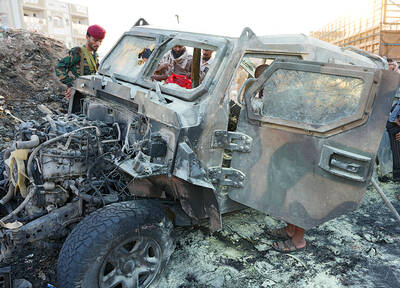
‘TERRORIST ATTACK’: The convoy of Brigadier General Hamdi Shukri resulted in the ‘martyrdom of five of our armed forces,’ the Presidential Leadership Council said A blast targeting the convoy of a Saudi Arabian-backed armed group killed five in Yemen’s southern city of Aden and injured the commander of the government-allied unit, officials said on Wednesday. “The treacherous terrorist attack targeting the convoy of Brigadier General Hamdi Shukri, commander of the Second Giants Brigade, resulted in the martyrdom of five of our armed forces heroes and the injury of three others,” Yemen’s Saudi Arabia-backed Presidential Leadership Council said in a statement published by Yemeni news agency Saba. A security source told reporters that a car bomb on the side of the road in the Ja’awla area in
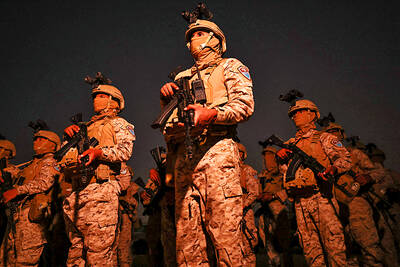
PRECARIOUS RELATIONS: Commentators in Saudi Arabia accuse the UAE of growing too bold, backing forces at odds with Saudi interests in various conflicts A Saudi Arabian media campaign targeting the United Arab Emirates (UAE) has deepened the Gulf’s worst row in years, stoking fears of a damaging fall-out in the financial heart of the Middle East. Fiery accusations of rights abuses and betrayal have circulated for weeks in state-run and social media after a brief conflict in Yemen, where Saudi airstrikes quelled an offensive by UAE-backed separatists. The United Arab Emirates is “investing in chaos and supporting secessionists” from Libya to Yemen and the Horn of Africa, Saudi Arabia’s al-Ekhbariya TV charged in a report this week. Such invective has been unheard of
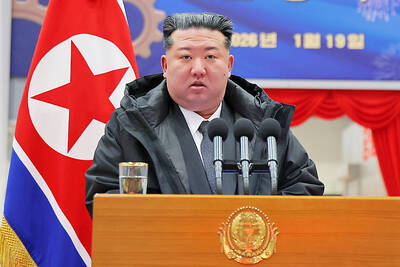
‘SHOCK TACTIC’: The dismissal of Yang mirrors past cases such as Jang Song-thaek, Kim’s uncle, who was executed after being accused of plotting to overthrow his nephew North Korean leader Kim Jong-un has fired his vice premier, compared him to a goat and railed against “incompetent” officials, state media reported yesterday, in a rare and very public broadside against apparatchiks at the opening of a critical factory. Vice Premier Yang Sung-ho was sacked “on the spot,” the state-run Korean Central News Agency said, in a speech in which Kim attacked “irresponsible, rude and incompetent leading officials.” “Please, comrade vice premier, resign by yourself when you can do it on your own before it is too late,” Kim reportedly said. “He is ineligible for an important duty. Put simply, it was
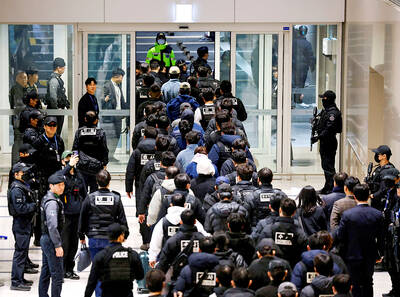
SCAM CLAMPDOWN: About 130 South Korean scam suspects have been sent home since October last year, and 60 more are still waiting for repatriation Dozens of South Koreans allegedly involved in online scams in Cambodia were yesterday returned to South Korea to face investigations in what was the largest group repatriation of Korean criminal suspects from abroad. The 73 South Korean suspects allegedly scammed fellow Koreans out of 48.6 billion won (US$33 million), South Korea said. Upon arrival in South Korea’s Incheon International Airport aboard a chartered plane, the suspects — 65 men and eight women — were sent to police stations. Local TV footage showed the suspects, in handcuffs and wearing masks, being escorted by police officers and boarding buses. They were among about 260 South


 RSS
RSS