


Leftist, anti-US politician Evo Morales claimed a stunning victory in Bolivia's presidential election on Sunday as exit polls showed him with 51 percent of the vote, on track to become the country's first indigenous head of state.
"We have won," he told thousands of cheering supporters, adding that two Latin American leaders already had congratulated him.
His right-wing rival, ex-president Jorge Quiroga conceded defeat.
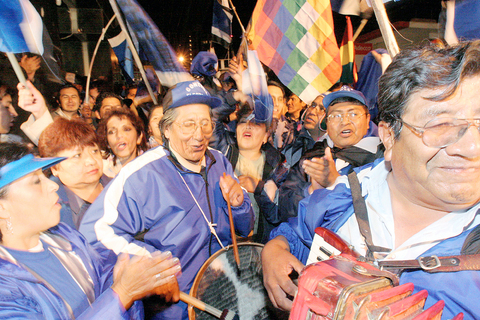
PHOTO: AFP
Morales, 46, highlighted that he will become the first indigenous president of South America's poorest nation, where Aymaras and Quechua people make up the majority of the 9.3 million population.
"The new history of Bolivia has started," he said in his Cochabamba stronghold amid shouts of "Evo president!"
Two separate exit polls showed Morales getting 51 percent of the vote, and a 20-point lead over Quiroga. Opinion polls before the election had given him about 35 percent of the vote.
"We already have 50 percent plus one," said Morales in a reference to the majority needed to win outright in the first round.
Even if official results -- which may only be announced today -- show he failed to reach that mark, the leftist leader of the coca farmers movement still looks certain to become president.
If the election goes to a second round, the newly elected Congress will pick between the two top vote-getters in January.
Exit polls show Morales' Movement Toward Socialism (MAS) party would control enough congressional seats to defeat his rival.
Morales has promised a radical shakeup of the country.
The leftist lawmaker has headed popular protests that played a key role in the collapse of two governments since 2002. His campaign was marked by anti-US slogans.
On Sunday, he reiterated his pledge to increase state control over Bolivia's natural gas resources and to protect coca plantations.
Bolivia is the world's third largest coca producer of coca leaf, the base ingredient of cocaine but also a medicinal plant popular with indigenous people.
Morales insists he opposes cocaine trafficking but defends the right to grow the coca leaf. He said on Sunday that under his administration, "there will be zero cocaine, zero drug trafficking but not zero coca."
Critics say that if Morales takes office, Washington might reconsider preferential trade agreements and aid to Bolivia.
Speaking after he cast his ballot in Villa Tunari, in the heart of Bolivia's coca-growing region, Morales said his government would cooperate closely with other "anti-imperialists," and reiterated his admiration for Cuba's communist President Fidel Castro.
In Venezuela, President Hugo Chavez, also a virulently anti-US leader, hailed the election, saying in a television address that Bolivia "is writing a new page in its history."
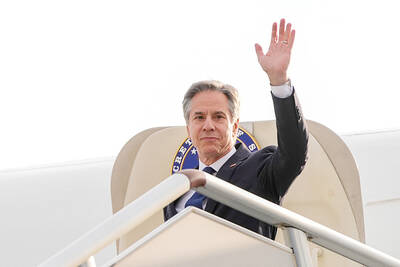
‘IN A DIFFERENT PLACE’: The envoy first visited Shanghai, where he attended a Chinese basketball playoff match, and is to meet top officials in Beijing tomorrow US Secretary of State Antony Blinken yesterday arrived in China on his second visit in a year as the US ramps up pressure on its rival over its support for Russia while also seeking to manage tensions with Beijing. The US diplomat tomorrow is to meet China’s top brass in Beijing, where he is also expected to plead for restraint as Taiwan inaugurates president-elect William Lai (賴清德), and to raise US concerns on Chinese trade practices. However, Blinken is also seeking to stabilize ties, with tensions between the world’s two largest economies easing since his previous visit in June last year. At the
Nearly half of China’s major cities are suffering “moderate to severe” levels of subsidence, putting millions of people at risk of flooding, especially as sea levels rise, according to a study of nationwide satellite data released yesterday. The authors of the paper, published by the journal Science, found that 45 percent of China’s urban land was sinking faster than 3mm per year, with 16 percent at more than 10mm per year, driven not only by declining water tables, but also the sheer weight of the built environment. With China’s urban population already in excess of 900 million people, “even a small portion

UNSETTLING IMAGES: The scene took place in front of TV crews covering the Trump trial, with a CNN anchor calling it an ‘emotional and unbelievably disturbing moment’ A man who doused himself in an accelerant and set himself on fire outside the courthouse where former US president Donald Trump is on trial has died, police said yesterday. The New York City Police Department (NYPD) said the man was declared dead by staff at an area hospital. The man was in Collect Pond Park at about 1:30pm on Friday when he took out pamphlets espousing conspiracy theories, tossed them around, then doused himself in an accelerant and set himself on fire, officials and witnesses said. A large number of police officers were nearby when it happened. Some officers and bystanders rushed

Beijing is continuing to commit genocide and crimes against humanity against Uyghurs and other Muslim minorities in its western Xinjiang province, U.S. Secretary of State Antony Blinken said in a report published on Monday, ahead of his planned visit to China this week. The State Department’s annual human rights report, which documents abuses recorded all over the world during the previous calendar year, repeated language from previous years on the treatment of Muslims in Xinjiang, but the publication raises the issue ahead of delicate talks, including on the war in Ukraine and global trade, between the top U.S. diplomat and Chinese


 RSS
RSS