


The National Security Agency (NSA) first began to conduct warrantless eavesdropping on telephone calls and e-mail messages between the US and Afghanistan months before US President George W. Bush officially authorized a broader version of the agency's special domestic collection program, according to current and former government officials.
The security agency surveillance of telecommunications between the US and Afghanistan began in the immediate aftermath of the Sept. 11 attacks on New York and Washington, the officials said.
The agency operation included eavesdropping on communications between Americans and other individuals in the US and people in Afghanistan without the court-approved search warrants that are normally required for such domestic intelligence activities.
On Saturday, Bush confirmed the existence of the NSA's domestic intelligence collection program and defended it, saying it had been instrumental in disrupting terrorist cells in the US.
After the Sept. 11 attacks, the Bush administration and senior US intelligence officials quickly decided that existing laws and regulations restricting the government's ability to monitor US communications were too rigid to permit quick and flexible access to international calls and e-mail traffic involving terrorism suspects.
Administration officials also believed that the intelligence community, including the CIA and the NSA, had been too risk-averse before the attacks and had missed opportunities to prevent them.
In the days after the attacks, the CIA determined that al-Qaeda, which had found a haven in Afghanistan, was responsible.
Congress quickly passed a resolution authorizing the president to conduct a war on terrorism, and the NSA was secretly ordered to begin conducting comprehensive coverage of all communications into and out of Afghanistan, including those to and from the US, current and former officials said.
It could not be learned whether Bush issued a formal, written order authorizing the early surveillance of communications between the US and Afghanistan that was later superseded by the broader order.
A White House spokesman, Maria Tamburri, declined to comment on Saturday on the Afghanistan monitoring, saying she could not go beyond Bush's speech.
Current and former US intelligence and law enforcement officials who discussed the matter were granted anonymity because the intelligence-gathering program is highly classified. Some had direct knowledge of the program.
The disclosure of the NSA's warrantless eavesdropping on calls between the US and Afghanistan sheds light on the origins of the agency's larger surveillance activities, which officials say have included monitoring the communications of as many as 500 Americans and other people inside the US without search warrants at any one time. Several current and former officials have said that they believe the agency operation began virtually on the fly in the days after the Sept. 11 attacks.
The early, narrow targeting of communications in and out of Afghanistan reflected the ad hoc nature of the government's initial approach to counter-terrorism policies after Sept. 11 attacks. But after the US-led invasion of Afghanistan succeeded in overthrowing the Taliban government in late 2001, al-Qaeda lost its sanctuary, and Osama bin Laden and other Qaida leaders scattered to other countries.
As counter-terrorism operations grew, the Bush administration wanted the NSA to secretly expand its surveillance as well. By 2002, Bush gave the agency broader surveillance authority.
In the early years of the operation, there were few, if any, controls placed on the activity by anyone outside the security agency, officials say. It was not until last year, when several officials raised concerns about its legality, that the Justice Department conducted its first audit of the operation.
Security agency officials had been given the power to select the people they would target for eavesdropping inside the US without getting approval for each case from the White House or the Justice Department, the officials said.
While the monitoring program was conducted without warrants, senior administration officials said the decision to move ahead with the program was justified by the pressing need to identify whether any remaining "sleeper cells" were still operating within the US after the Sept. 11 attacks and whether they were planning "follow-on attacks."
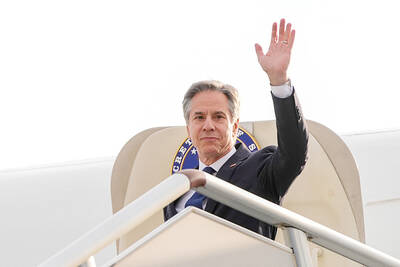
‘IN A DIFFERENT PLACE’: The envoy first visited Shanghai, where he attended a Chinese basketball playoff match, and is to meet top officials in Beijing tomorrow US Secretary of State Antony Blinken yesterday arrived in China on his second visit in a year as the US ramps up pressure on its rival over its support for Russia while also seeking to manage tensions with Beijing. The US diplomat tomorrow is to meet China’s top brass in Beijing, where he is also expected to plead for restraint as Taiwan inaugurates president-elect William Lai (賴清德), and to raise US concerns on Chinese trade practices. However, Blinken is also seeking to stabilize ties, with tensions between the world’s two largest economies easing since his previous visit in June last year. At the
Nearly half of China’s major cities are suffering “moderate to severe” levels of subsidence, putting millions of people at risk of flooding, especially as sea levels rise, according to a study of nationwide satellite data released yesterday. The authors of the paper, published by the journal Science, found that 45 percent of China’s urban land was sinking faster than 3mm per year, with 16 percent at more than 10mm per year, driven not only by declining water tables, but also the sheer weight of the built environment. With China’s urban population already in excess of 900 million people, “even a small portion

UNSETTLING IMAGES: The scene took place in front of TV crews covering the Trump trial, with a CNN anchor calling it an ‘emotional and unbelievably disturbing moment’ A man who doused himself in an accelerant and set himself on fire outside the courthouse where former US president Donald Trump is on trial has died, police said yesterday. The New York City Police Department (NYPD) said the man was declared dead by staff at an area hospital. The man was in Collect Pond Park at about 1:30pm on Friday when he took out pamphlets espousing conspiracy theories, tossed them around, then doused himself in an accelerant and set himself on fire, officials and witnesses said. A large number of police officers were nearby when it happened. Some officers and bystanders rushed
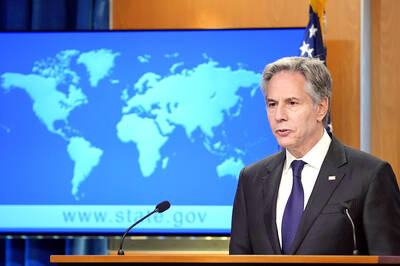
Beijing is continuing to commit genocide and crimes against humanity against Uyghurs and other Muslim minorities in its western Xinjiang province, U.S. Secretary of State Antony Blinken said in a report published on Monday, ahead of his planned visit to China this week. The State Department’s annual human rights report, which documents abuses recorded all over the world during the previous calendar year, repeated language from previous years on the treatment of Muslims in Xinjiang, but the publication raises the issue ahead of delicate talks, including on the war in Ukraine and global trade, between the top U.S. diplomat and Chinese


 RSS
RSS